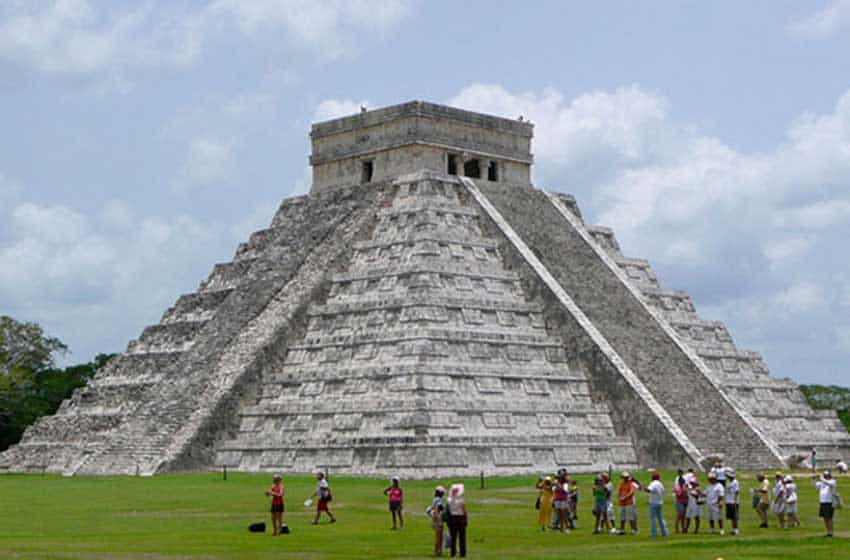
Travel agencies in Quintana Roo have begun suspending tours to the Chichén Itzá archaeological site to protest the admission fee increase introduced on January 1.
Cultur, a culture and tourism authority of the Yucatán state government, doubled the price of entry for foreign tourists to the ancient Maya city from 242 to 480 pesos (US $12.80 to $25.30).
Sergio González Rubiera, president of the Mexican Association of Travel Agencies (AMAV) in Quintana Roo, said the “boycott” of Chichén Itzá began Monday and will increase gradually until organized tours of the site are phased out completely.
“Obviously it’s not a total suspension from one day to the next . . . There are packages that have already been sold, especially those sold on the internet, that have to be honored. You can’t let the customers down,” he said.
“. . . It won’t be a total cut, it will be gradual. In the course of the week we’ll see a partial reduction,” González added.
The number of tourists who visit the site as part of an organized group is expected to drop by between 1,000 and 2,000 per week.
According to Jaime Solís Garza, president of the Tourist Business Council of Yucatán, 90% of tourists who visit Chichén Itzá are foreigners, and 90% of them travel to the site from Quintana Roo.

González said the decision to start suspending tours to the UNESCO World Heritage site would benefit Tulum and Cobá, which are the two most visited archeological sites in Quintana Roo.
He explained that travel agencies’ boycott of Chichén Itzá was not due to the admission price hike alone but because no improvements have been made to the site to justify it.
“It’s not just a question of the price for tourists going up, it’s a matter of this increase being introduced in exchange for nothing,” he said.
“The archeological site is invaded by vendors, we know that drugs are sold there, we know that Cultur has [the site] in terrible conditions, there are no water fountains for tourists . . .” González added.
The AMAV official said that an assistant of Yucatán Governor Mauricio Vila had contacted him and explained that the price hike was necessary because the state’s federal funding for the site had been cut.
“He told me there was a crisis, that the federal government reduced their budget and that they have to raise funds to improve . . . [Chichén Itzá]. I responded why not do it the other way around, carry out some improvements [first] . . . and we’ll help you to increase the price,” González said.
He added that the AMAV had requested that the admission fee increase be put on hold for six months and then introduced in increments in accordance with the progress of improvements carried out at the site.
Source: El Universal (sp)
CORRECTION: The photo that originally appeared with this story was not Chichén Itzá, but Mayapán.