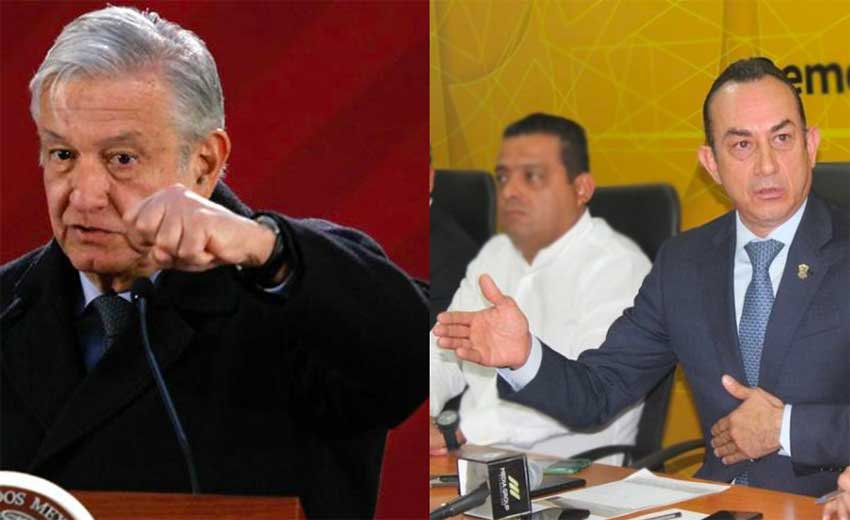
President López Obrador has been accused by his former party of pushing the country towards authoritarianism in a scathing attack published in a Mexico City newspaper.
In a full-page advertisement in Reforma, the Democratic Revolution Party (PRD) said that López Obrador was undoing reforms implemented over the past 30 years that were designed to keep the power of the state in check.
“We’re in the process of restoring a presidential, centralizing and authoritarian system that weakens and suppresses the legislative branch and undermines the independence of the judiciary,” the PRD said.
“We are not exaggerating. This regression to authoritarianism is being revealed in many areas,” the advertisement read, and went on to cite eight.
Among them: striking a blow against federalism through the creation of powerful state delegates, the continued militarization of security, attacks against autonomous government agencies and a lack of transparency.
Today, the PRD’s Michoacán director explained that the party was issuing a call to “progressive forces” to create a united anti-AMLO front.
Antonio Soto Sánchez said López Obrador “has not delivered. It looks like he is still campaigning for election, so the PRD has decided to call on progressive forces to unite to form a progressive opposition force and act as a counterweight to the federal government . . .”

López Obrador held power as mayor of Mexico City for the PRD between 2000 and 2005 and subsequently stood as the party’s candidate at the 2006 and 2012 presidential elections.
However, after finishing as runner-up for the second consecutive time in 2012, he split from the party to form the National Regeneration Movement, or Morena party, taking thousands of PRD supporters and members with him.
The fortunes of the PRD have since dwindled and it fared poorly at last year’s elections.
The president has enjoyed strong public support since taking office in December, attracting a 78% approval rating in a poll published by the newspaper El Financiero last month.
López Obrador has held daily press conferences at the National Palace during which he aims to set the day’s political agenda and often criticizes his political, civil society and media opponents.
Grupo Reforma, which published yesterday’s ad, has often been described as “prensa fifi” (snobbish press) by the leftist leader.
The president has frequently taken aim at past presidents who held power during the so-called “neoliberal period,” accusing them of corruption and causing all manner of other problems faced by the country, including the poor financial position of the state oil company and high levels of violence.
López Obrador claims that he is democratizing freedom with his daily news conferences – his predecessor Enrique Peña Nieto rarely fronted the media – and denies that he is aiming to install an authoritarian government.
“We respect freedoms and the right to dissent,” the president said on March 8, a mantra he often repeats.
Nevertheless, government opponents – and some analysts – continue to contend that López Obrador is concentrating power in the federal executive.
The president has described autonomous government agencies as “a great farce” and accused them of corruption, and in the case of the Energy Regulatory Commission (CRE), López Obrador hand-picked four new commissioners.
Energy sector experts warned that the appointments will result in a loss of autonomy for the CRE.
In an opinion piece published by Bloomberg last month, a Latin American expert contended that López Obrador “is systematically concentrating power in an already strong executive.”
Shannon K. O’Neil wrote that from the beginning of his administration the president “has undermined democratic norms and checks and balances,” often choosing “to work outside the formal legislative process,” even though the coalition led by his Morena party has a majority in both houses of Congress.
Later in March, opposition lawmakers accused the president of seeking to extend his rule by pledging to hold a revocation of mandate vote halfway through his six-year term. López Obrador subsequently signed a written undertaking that he will not seek re-election in 2024.
Now, opposition lawmakers argue that a Morena-backed legislative proposal to create an anti-corruption chamber in the Supreme Court (SCJN) and increase the number of justices from 11 to 16 is a ploy to enable López Obrador and his government to control the court.
The president distanced himself from the proposal.
Source: Reuters (sp), Primera Plana (sp)