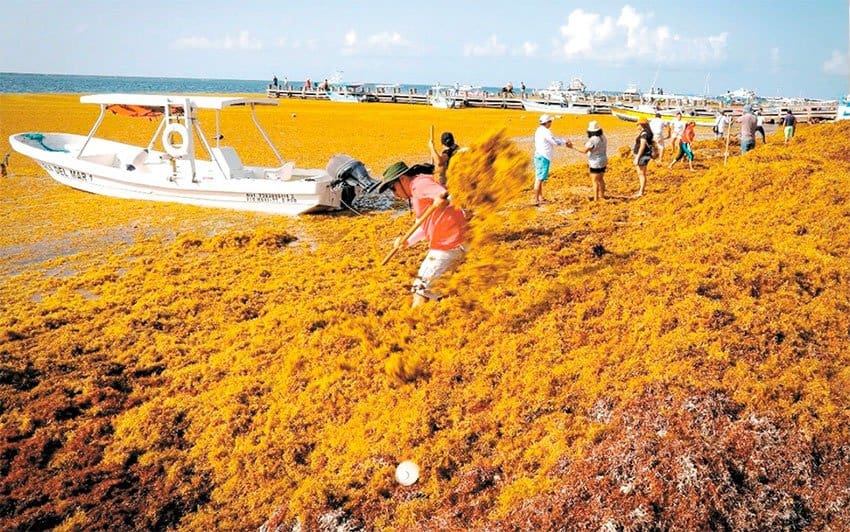
The methods used to prevent sargassum from reaching Quintana Roo beaches pose a risk to nesting sea turtles and their offspring, two conservationists warn.
Miriam Tzeek, president of the Quintana Roo Sea Turtles Committee, told the newspaper Milenio that barriers placed in the sea to stop the seaweed from washing up onshore and sargassum-gathering vessels both threaten the lives of female turtles and their hatchlings as they return to sea.
She said that more than 20,000 turtles nest on Mexico’s Caribbean coast beaches each year and that each mother can lay up to 100 eggs, meaning that the lives of as many as two million of the reptiles are at risk from the collection of sargassum.
The Quintana Roo turtle nesting season begins in May and eggs hatch 45 to 60 days after they are laid, a time when sargassum arrivals are usually at their seasonal peak.
Leonel Gómez, chief of the Rivera Maya-Tulum sea turtle program, explained that the use of sargassum-gathering vessels and barriers is particularly dangerous to recently-hatched turtles.
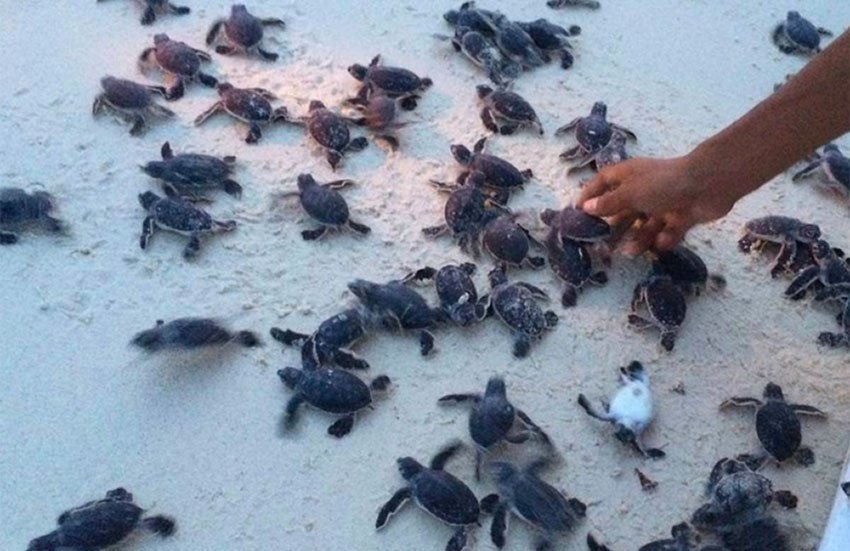
“Our fear is that once the hatchings leave their eggshell and move forward in the sea searching for ocean currents they will be picked up by these boats and will end up trapped in the large masses of sargassum that they remove every day,” he said.
“. . . The anti-sargassum barriers . . . will also affect babies, perhaps large turtles won’t be affected so much because they go beneath [the barriers] but the little ones don’t. A little turtle can get stuck in one of those nets,” Gómez explained.

Speaking to Milenio at the Xcacel-Xcacelito turtle sanctuary, one of the most popular Quintana Roo nesting areas, the conservationist said that sargassum collected on beaches can also threaten turtle nests if “huge piles” of the weed are inadvertently placed on top of them.
In such a case, sargassum causes nests – and eggs – to overheat, leaving the latter “completely cooked,” Gómez said.
The use of heavy machinery to collect sargassum can also harm the turtle nests, a Quintana Roo environmental group said in May when reporting that backhoes were being illegally used on Cancún beaches.
Even though turtle conservation efforts are being undermined by anti-sargassum strategies, Gómez acknowledged that hotel owners have no other option than to take action against the seasonal phenomenon because without turquoise waters and white sand beaches, the tourists won’t come.
“I don’t blame them [the hotel owners], that’s what they live from but sometimes the methods are so improvised and they don’t consider the damage they cause to the beach or the animals in the sea,” he said.
Both he and Tzeek called for the implementation of sargassum collection strategies that are mindful of marine creatures.
If anti-sargassum actions are not properly regulated, “the efforts that we’re making here to protect the turtle will be of no use,” Gómez said.
Source: Milenio (sp)