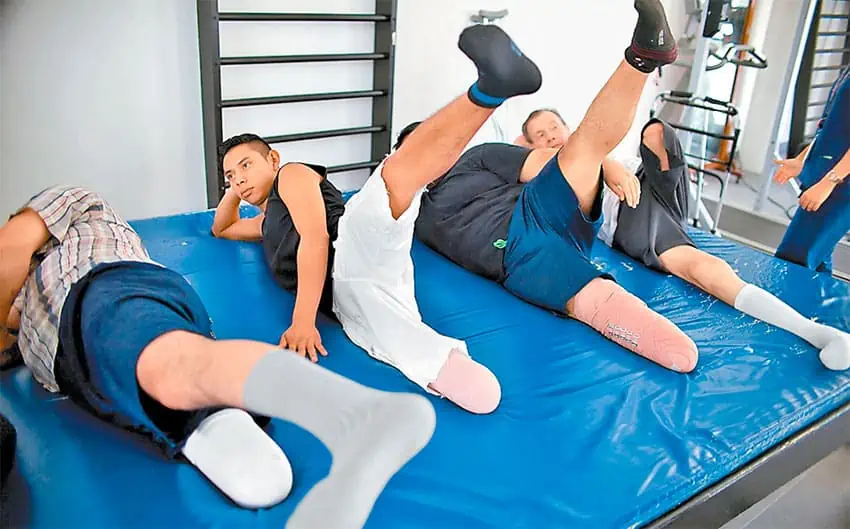
Nearly 400 Central American migrants who lost limbs hopping freight trains in Mexico have received prostheses over the past eight years thanks to a Red Cross program.
Boarding northbound freight trains known collectively and colloquially as “La Bestia” (The Beast) is a common practice among migrants aiming to reach the United States.
Unfortunately, the occurrence of accidents while riding the rails is also quite common.
Guatemalan Luis Estuardo lost his left leg below his knee earlier this year after falling from “La Bestia” in Achotal, Veracruz, and getting caught up in the train’s wheels.
He is now undergoing rehabilitation treatment in Celaya, Guanajuato, and will soon be fitted – at no expense of his own – with a prosthetic leg.
The artificial limb will be funded by a program first started by the International Committee of the Red Cross in Chiapas in 2011.
Since then, 388 migrants have received prosthetic legs, arms and hands, and three years ago the program’s hub was transferred to Guanajuato, where it is supported by the local Red Cross, a migrant shelter in Celaya and the state’s Institute for People with Disabilities (Ingudis).

Alberto Cabezas, a spokesman for the International Red Cross in Mexico, described the program as “important humanitarian work,” explaining that it has also helped migrants who lost limbs due to the violence of criminal gangs.
After migrants leave hospital, they are transported to the Casa ABBA shelter in Celaya, where they stay while undergoing physical and psychological therapy provided by Ingudis. During the same period, the migrants are measured for prostheses.
Leticia Díaz, the program’s rehabilitation coordinator, said that making an artificial limb that fits perfectly and feels like a natural part of a person’s body is a “delicate process.”
She added that migrants who lose limbs go through a lot of suffering and emotional stress in the lead-up to being fitted with a new arm or leg and for that reason a psychologist offers support and helps them plan for a new life.
After receiving their prostheses, some migrants have opted to travel to the northern border to seek asylum in the United States while others have chosen to return to their home countries.
In the latter case, the Red Cross assists with the repatriation process.
Source: Milenio (sp)