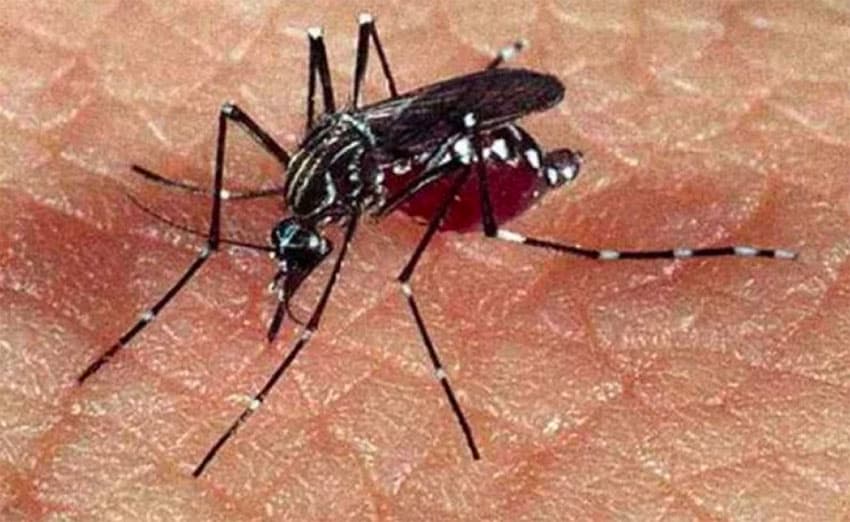
Confirmed cases of dengue fever more than tripled in the first eight months of the year but federal health authorities didn’t spend a single peso on insecticides until early August.
There were 10,211 confirmed cases of the mosquito-borne tropical disease between January 1 and August 25 compared to 3,196 cases in the same period of 2018.
Just under a third of the cases recorded so far this year were considered serious and 120 victims have died.
Veracruz has recorded the highest number of cases in 2019 followed by Chiapas, Jalisco and Oaxaca.
Despite the spike in the number of cases, health officials say that the outbreak isn’t abnormal or alarming.
“It’s a little bit above average but in the expected range,” said Dr. Ruy López Ridaura, director of the National Center for Disease Prevention and Control Programs (Cenaprece).
He said the prevalence of dengue fever fluctuates depending on weather conditions, so comparisons between consecutive years can be misleading.

“Dengue goes through cycles in which there is a resurgence of cases . . . every three or four years,” López said, adding that because the number of cases has been low in recent years “we expected an increase in 2019.”
Rosa María del Ángel, an infectious diseases researcher at the Center for Investigation and Advanced Study, agreed that large dengue outbreaks are cyclical but disagreed that the number of confirmed cases this year is only slightly above average.
“. . . I think that triple the number of cases is higher than . . . a normal outbreak,” she said, adding that insecticide spraying must be reviewed and strengthened if necessary because the rainy season still hasn’t finished.
Cenaprece has an annual budget of just 192.4 million pesos (US $9.7 million) to buy insecticides but information on the government’s online platform, CompraNet, shows that the agency didn’t sign any contracts for the purchase of the product until August 6.
However, López denied that mosquito spraying hasn’t occurred in parts of the country that are susceptible to dengue outbreaks.
“There was spraying . . . throughout the whole year,” the Cenaprece chief said, explaining that state authorities used their own funds to purchase insecticides.
“At a state level, there is a budget of 600 million pesos for insecticides, while the 192 million at Cenaprece is used to strengthen . . . spraying programs,” López said.
However, the anti-graft group Mexicans Against Corruption and Impunity reported on June 25 that spraying in the Veracruz municipality of Lerda de Tejada, where high numbers of dengue cases have been reported, has only been carried out twice this year.
The Cenaprece chief said he didn’t have specific information about the area but pledged that spraying will take place there because it is a “priority location.”
Source: El Universal (sp)