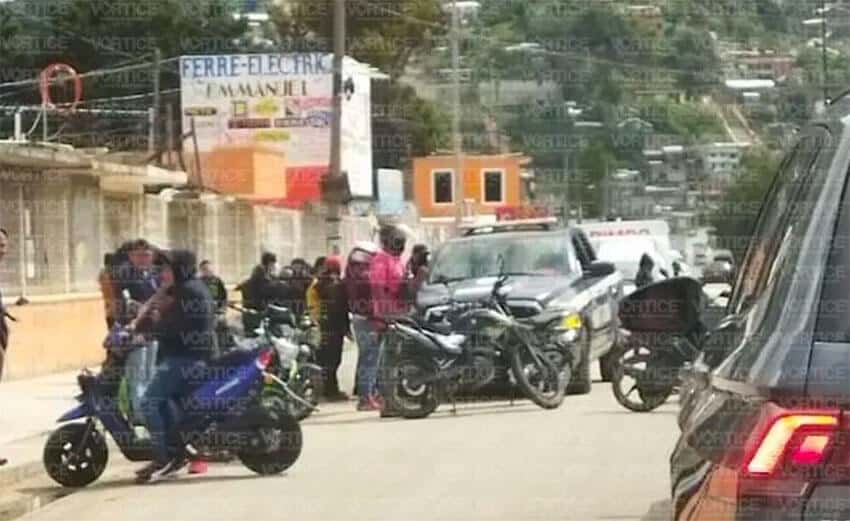
The southern state of Chiapas has been plagued by violence in recent months, carried out by a type of criminal group not usually associated with Mexico: a motorcycle gang.
On June 14, videos circulated on social media of clashes between heavily-armed men in San Cristóbal de las Casas, a major city in the southern state. Two groups exchanged fire as they reportedly sought to control a local market, which has also turned into a distribution point for “illegal merchandise,” according to the local news organization Chiapas Paralelo.
At least one person was reported to have been killed during the shootout, which lasted several hours and forced residents to seek shelter in their homes and shops. Several roads were blocked and a number of cars were burned. The police and National Guard allegedly only arrived on the scene after the gangs had left, according to local media reports.
Several vendors in the market, according to an investigation by El País, named the group behind the violence as the Motonetos (Scooters). One expert stated that the group’s members largely came from the indigenous Tzotzil community. “Those who call themselves the Motonetos are children of … displaced Tzotzil [living] in the poorest outskirts of the city,” Marina Page, coordinator of Sipaz, a human rights non-profit working in Chiapas, told El País.
This was not the only recent incident attributed to the Motonetos. On June 17, a group of hooded gunmen opened fire on police and overturned a trailer along a main road in the town of Oxchuc, 50 kilometers east of San Cristóbal. Local media reports alleged this was carried out by the same gang.
InSight Crime analysis
The Motonetos are a unique type of criminal group in Mexico, allegedly recruiting heavily from local indigenous communities, profiting from local criminal economies and acting as a link to larger criminal players.
The group obtained its name through its members’ mode of transportation, traveling by motorcycle and scooter with armed passengers riding behind the drivers. The Motonetos have been blamed for a slew of crimes, including kidnapping and murder, among others.

However, according to Carlos Rafael Coutiñ, a local journalist, the Motonetos mainly draw their income from local drug trafficking, control of prostitution and the production and sale of what has become known as “ethno-pornography.” This type of pornography, according to a BBC report, exclusively features people from indigenous communities and is often created via coercion and blackmail.
Coutiñ told InSight Crime that the violence in San Cristóbal de las Casas was due to a split between two Motonetos leaders, who were fighting for control of the market to sell this pornographic material, as well as drugs.
Coutiñ added that the Motonetos came from the Tzotzil community in San Juan Chamula, just north of San Cristóbal. He stated that they had also in the past been referred to as the San Juan Chamula Cartel.
Chiapas consistently ranks as the poorest state in Mexico, with its indigenous communities having been particularly disadvantaged due to a long history of marginalization.
However, Coutiñ dismissed the idea that the Motonetos were simply a motorcycle gang made up of impoverished youths with nothing to do. According to him, while the group has no formal alliances to larger cartels, they have regularly been recruited by groups such as the Jalisco New Generation Cartel to aid in drug trafficking operations.
Additionally, he warned that the Motonetos wielded large influence in local politics. The shootout in San Cristóbal de las Casas was “nothing out of the ordinary.”
“This is an everyday occurrence,” he said.
Reprinted from InSight Crime. Peter Appleby is a writer with InSight Crime, a foundation dedicated to the study of organized crime.