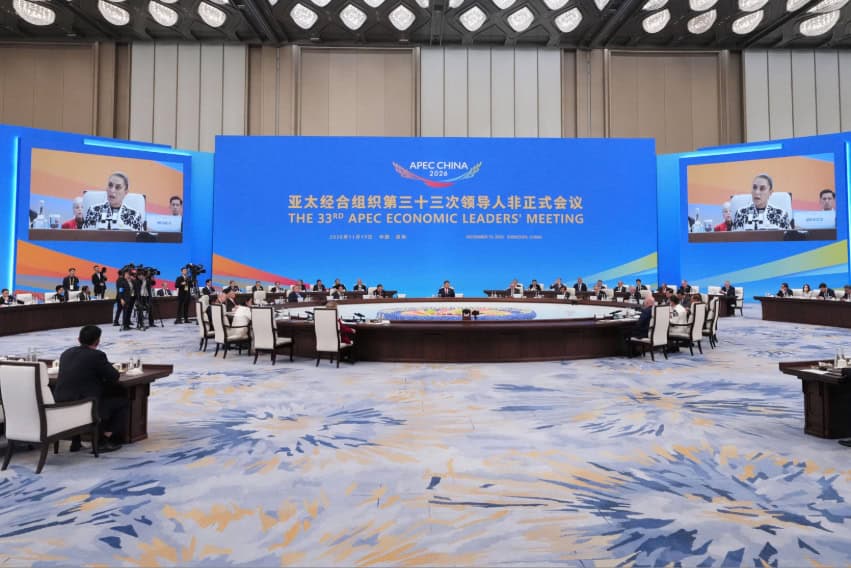
After what she described as a “very productive and successful” four-day visit to Shenzhen, President Claudia Sheinbaum left China on Thursday evening local time to return to Mexico.
While at the Asia-Pacific Economic Cooperation (APEC) Leaders’ Meeting, she addressed business and political leaders on Thursday, and held bilateral talks with several of her counterparts, including Chinese President Xi Jinping and U.S. President Donald Trump.
She also addressed the APEC CEO Summit, visited a “smart hospital” and met with members of the Mexican community in China at a Mexican restaurant in Shenzhen, the East Asian nation’s tech capital.
Here is an overview of Sheinbaum’s visit to China, her first trip to Asia since becoming president in October 2024.
Sheinbaum’s economy-class flight goes viral in China
To get to Shenzhen, a city in southern China near Hong Kong, Sheinbaum spent more than 20 hours in economy class on a China Southern Airlines flight that stopped off in Tijuana after departing Mexico City early Sunday morning. She has previously traveled on commercial flights to events in Brazil and Canada.
Bloomberg reported on Wednesday that Sheinbaum’s “move to join the masses in economy class on a flight to the APEC summit in Shenzhen has struck a chord with the Chinese internet.”

“A hashtag about her arrival has been seen 10 million times on the Chinese social media platform Weibo,” the news agency wrote.
After arriving in Shenzhen on Monday morning, Sheinbaum hustled to the Tequila Coyote’s restaurant to meet with Mexican citizens residing in China.
Afterward, she praised “the extraordinary Mexicans who have decided to live their lives [in China],” adding that “we should find ways for them to stay connected with Mexico.”
Mexico ‘guarantees’ conditions for investment, Sheinbaum tells CEOs
In a 13-minute speech at the APEC CEO Summit on Tuesday, Sheinbaum promoted Mexico as an investment destination.
“We have a privileged geographic location, an extensive network of trade agreements, an economy integrated into the world’s major markets, natural resources, expanding infrastructure and, above all, the human talent of a hardworking people,” she told the event.
“Mexico guarantees conditions for investment, certainty and a long-term vision for development,” Sheinbaum said.

She also touted Plan México — the federal government’s overarching economic and industrial policy — saying that it has a “humanist vision” in which “the economy is at the service of the people” rather than the other way around.
By speaking at the APEC CEO Summit, Sheinbaum had the opportunity to court investment from major companies in APEC economies and beyond.
The event attracted more than 2,000 representatives from 21 APEC economies and 13 non-APEC economies, including Britain, France, Germany and Switzerland, according to the Xinhua news agency.
Sheinbaum talks with Xi, Trump, Carney and other leaders in a 3-day blitz of bilateral meetings
Between Tuesday and Thursday, Sheinbaum held bilateral talks with leaders of several APEC countries, including China, Canada, Vietnam and the United States.
In her meeting with President Xi on Tuesday, Sheinbaum declared that her visit to China marked the beginning of “a new era” in Mexico’s relationship with the East Asian country.
She told the Chinese president that her government was “interested in strengthening cooperation in areas related to science and technology, agriculture, clean energy, water resources, health and, of course, culture and tourism.”
For his part, Xi said that China and Mexico “should first continue to treat each other with sincerity, deepen political mutual trust” and “keep growing bilateral relations in the right direction,” according to a statement issued by the Chinese Foreign Ministry.
There was no indication that trade tensions related to Mexico’s imposition of new and higher tariffs on imports from China were discussed in the meeting between the Mexican and Chinese leaders.
Sheinbaum also met with Canadian Prime Minister Mark Carney on Tuesday, with both leaders expressing support for the renewal of the U.S.-Mexico-Canada Agreement (USMCA). The Trump administration announced in July that it had decided not to renew the USMCA “in its current form” through 2042, creating uncertainty over North American trade even though the three-way free trade pact remains in effect.
Sheinbaum has stressed that the agreement can be renewed through 2042 “at any time,” and trade negotiations between both Mexico and the United States and the U.S. and Canada appear to be making progress.
After her meeting with Trump on Wednesday, Sheinbaum said that Mexico-U.S. trade negotiations are “very far along,” but didn’t say when a bilateral deal might be reached.
According to a statement from Carney’s office, the Canadian prime minister and Trump, in their meeting in Shenzhen, “discussed the work underway to reach a mutually beneficial trade agreement that would create good jobs, boost affordability, and fully respect Canada’s languages, culture and sovereignty.”
Mexico-US trade talks ‘very far along,’ says Sheinbaum after meeting Trump
Bilateral trade deals between Mexico and the U.S. and the U.S. and Canada would likely make the U.S. government more willing to back an extension of the USMCA to 2042.
Regarding the Mexico-U.S. trade relationship, Trump is particularly concerned about the United States’ large trade deficit with its southern neighbor, while the Mexican government is pushing for a reduction of U.S. tariffs that currently apply to Mexican steel, aluminum and vehicles.
On Wednesday, Sheinbaum also held a bilateral meeting with Vietnamese President Tô Lâm, during which she expressed Mexico’s interest in “deepening ties between both nations.”
On Thursday, she met with Australian Prime Minister Anthony Albanese, Singaporean Prime Minister Lawrence Wong and Peruvian President Keiko Fujimori. In addition, she held talks with Kristalina Georgieva, managing director of the International Monetary Fund, and reportedly had a brief exchange with Chilean President José Antonio Kast.
‘We are living at a decisive moment for humanity,’ Sheinbaum tells APEC Leaders’ Meeting
During a four-minute address at the APEC Leaders’ Meeting on Thursday, Sheinbaum declared that “we are living at a decisive moment for humanity.”
“Scientific and technological advances, [including] artificial intelligence, are opening up enormous possibilities, yet we continue to face profound inequalities,” she said.
Les comparto mi discurso en la Reunión de Líderes Económicos APEC China 2026. https://t.co/oLbaJv9qDT
— Claudia Sheinbaum Pardo (@Claudiashein) November 19, 2026
“Faced with this reality, it is worth asking ourselves: What kind of world do we want to build, and what kind of relationships do we want to establish between our economies? In Mexico, we believe that development should not be measured solely by economic growth, market size or technological leadership,” Sheinbaum said.
“Even in the age of artificial intelligence, it must be measured above all by people’s lives: by whether every woman and every man can live with dignity, and whether families have housing, food, employment and education. This is the vision that has guided us in Mexico in recent years,” she said before highlighting that over 17 million people in Mexico have been lifted out of poverty between 2018 and 2026, according to World Bank data.
“That should be the purpose of our economies,” Sheinbaum said.
‘A very productive and very successful tour for Mexico’
At a press conference on Thursday before embarking on the long return journey to Mexico, Sheinbaum said that her “tour” of Shenzhen was “very productive and very successful for Mexico.”
She highlighted that Mexico signed memorandums of understanding with China in areas including the environment, science and renewable energy and reiterated that her meeting with Trump was “very good.”
“We have made significant progress on several issues we have been working on regarding what … [U.S. authorities] call ‘non-tariff barriers’ — virtually all of which have been addressed — as well as on our interest in reducing [U.S.] tariffs on vehicles, steel, aluminum, and their derivatives,” Sheinbaum said.
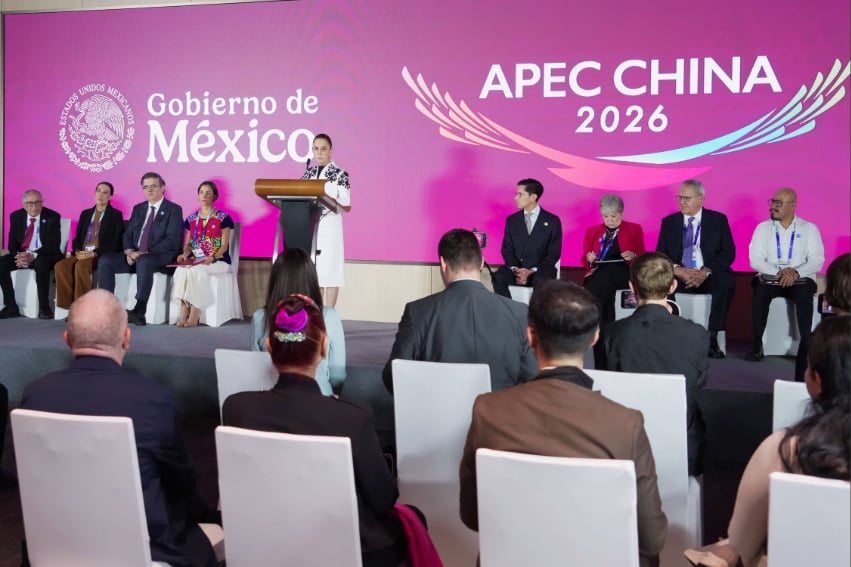
She reaffirmed her belief that the commencement of a “new era” in the Mexico-China relationship will not affect ties between Mexico City and Washington.
“As you know, we have a trade agreement with the United States [and Canada]. The economies of Mexico and the United States are highly integrated,” Sheinbaum said.
She said that Mexico wants “greater cooperation” with China, but stressed that a free trade agreement with the East Asian export powerhouse is not on the horizon.
“At the moment, we have no plans for a free trade agreement with China,” Sheinbaum said before emphasizing the importance of trade between Mexico and the United States, which are each other’s largest trade partners.
The president said that she and the officials who accompanied her to Shenzhen, including her economy, foreign affairs, environment, energy and tourism ministers, are leaving China “very happy” and “very satisfied.”
“It has been a great experience,” Sheinbaum said.
“Representing the people of Mexico is a privilege. And I believe everyone recognizes the moment Mexico is going through right now. It has been an extremely successful tour, both in terms of our relationship with China and with all the other countries,” she said.
Sheinbaum said she didn’t yet know whether she would attend the APEC Leaders’ Meeting in Vietnam in 2027. Mexico will host the annual event in 2028 at a location yet to be announced.
Sheinbaum is scheduled to arrive in Mexico City on China Southern Airlines flight CZ8032 late Thursday night Mexican Central Time, before leading an event in the capital on Friday to mark the 116th anniversary of the Mexican Revolution.
By Mexico News Daily chief staff writer Peter Davies (peter.davies@mexiconewsdaily.com)