Sheinbaum’s mañanera in 60 seconds
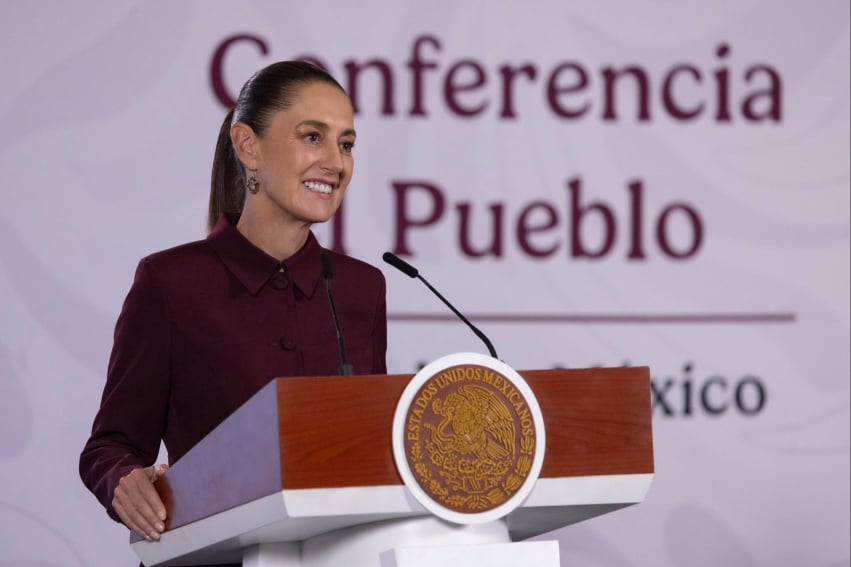
Today’s mañanera was important as President Claudia Sheinbaum spoke about a wide range of significant topics.
They included inflation, diplomatic relations with Peru, the arrest of a former governor, fracking and the suspension of U.S. avocado certifications in Michoacán.
Sheinbaum acknowledges decline in inflation
At the very start of her press conference, Sheinbaum highlighted that Mexico’s headline inflation rate fell to 3.12% in July, per data published by the national statistics agency INEGI on Friday.
She noted that the headline rate fell to that level from 3.37% in June, and described the decline as “very important.”
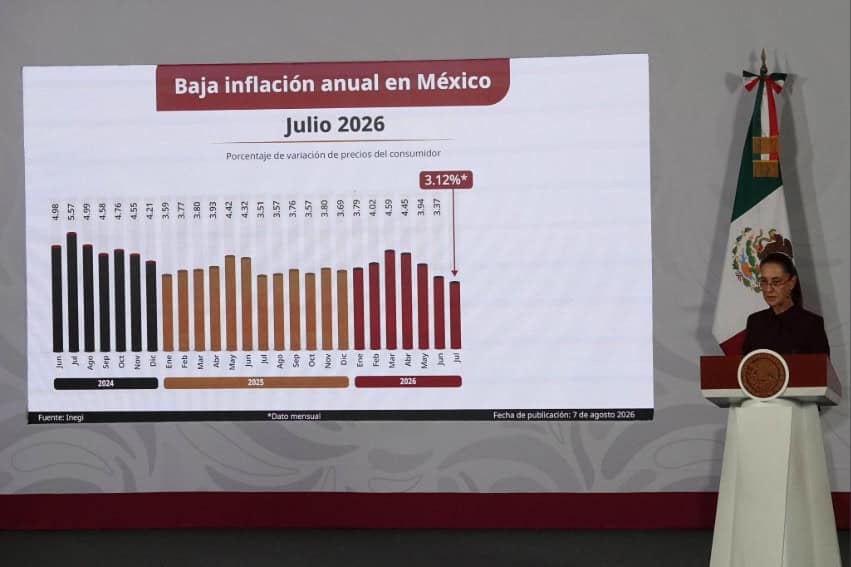
The inflation rate in July — just above the Bank of Mexico’s 3% target — was the lowest rate since May 2020.
Sheinbaum announces arrival of Bettsy Chávez to Mexico
Sheinbaum told reporters that former Peruvian Prime Minister Bettsy Chávez was “about to land in Mexico.”
She noted that Chávez, who briefly served as prime minister during the presidency of Pedro Castillo, stayed in Mexico’s Embassy in Peru for several months. Last November, the government of Peru severed diplomatic relations with Mexico after Chávez, who was accused of rebellion, was granted asylum at the Mexican Embassy in Lima.

“This embassy had to close because Peru broke off relations with Mexico and she remained [in the embassy] under the protection of Brazil, to whom we are very grateful,” Sheinbaum said.
The president said that Chávez was granted “safe passage” to travel to Mexico by the new Peruvian government, led by President Keiko Fujimori. She said that a Mexican Air Force plane traveled to the South American country to collect the ex-prime minister and bring her to Mexico.
Sheinbaum: Mexico and Peru to reestablish relations
Sheinbaum said that the granting of safe passage to Chávez was an act of “good will” from the government of President Fujimori “toward Mexico.”
She subsequently announced that Mexico and Peru would reestablish diplomatic relations.
“I don’t know if I can announce it now or not, but I’m going to announce it. With this [act of good will], relations with Peru are going to be reestablished,” Sheinbaum said.
“And we, as always, as we have done, are going to continue defending President Castillo,” said Sheinbaum, who last September described the 2022 ousting of the ex-president by the Peruvian Congress as a “coup.”
“… The new government of Peru knows that,” she said.
Sheinbaum: Arrest of ex-governor of Guerrero has nothing to do with politics
A reporter asked the president about the arrest on Thursday of former Guerrero Governor Ángel Aguirre, who is alleged to have ordered the concealment of security camera video footage that showed the bus on which students from the Ayotzinapa Rural Teachers College were traveling at the time it was stopped by police in Iguala, Guerrero, on Sept. 26, 2014. Forty-three students were abducted and presumably murdered after the bus was stopped.
Sheinbaum said that the arrest of Aguirre — governor of Guerrero between 2011 and 2014 — was the result of months of work by the Federal Attorney General’s Office (FGR). She said that the FGR has adopted “new ways of investigating” the Ayotzinapa case.
“It may be the same evidence, but now they’re deepening [the investigation] through different mechanisms, many of which involve scientific analysis,” Sheinbaum said.
Former governor of Guerrero arrested on Ayotzinapa-related charges
Asked whether the arrest of Aguirre had a “political background,” the president responded: “It has nothing to do with a political issue. It’s part of an investigation.”
As governor, Aguirre represented the Democratic Revolution Party, or PRD, but he was previously affiliated with the Institutional Revolutionary Party, or PRI, for decades. Mexico’s president at the time of the students’ disappearance was Enrique Peña Nieto, who represented the PRI both as president between 2012 and 2018 and governor of México state between 2005 and 2011.
Sheinbaum explains why there will be no fracking in the Tampico-Misantla basin
Sheinbaum reiterated that no final decision has been taken regarding the commencement of large-scale fracking in two shale basins in northern Mexico.
Subsequently, a day after an expert fracking committee publicly announced its recommendation against fracking in the resource-rich Tampico-Misantla basin in Veracruz and Tamaulipas, the president reaffirmed that her government would heed that advice.
“In the Tampico-Misantla basin, [there will be] no [fracking] there,” Sheinbaum said.
“Why? Because there are Indigenous peoples, because the nature is very rich, because the environmental impacts would be very serious,” she said.
Despite those remarks, Sheinbaum has asserted that the use of “new technologies” can make fracking a sustainable practice that doesn’t harm the environment.
Mexican and US officials to discuss suspension of avocado certifications
Sheinbaum told reporters that Mexican officials would meet with U.S. Embassy officials on Friday morning to discuss the U.S. government’s suspension of avocado certifications in Michoacán due to security concerns.
She said that the “objective” of today’s meeting is to address the U.S. government’s concerns with a view to resuming avocado exports to the United States.
By Mexico News Daily chief staff writer Peter Davies (peter.davies@mexiconewsdaily.com)