Inflation in Mexico is now just above the central bank’s target after falling to its lowest level in more than five years in June.
The national statistics agency INEGI reported on Thursday that the annual headline inflation rate was 3.37% in June, down from 3.94% in May.
The rate — just 0.37 percentage points above the Bank of Mexico’s 3% target — is the lowest for any month in Mexico since December 2020, when annual headline inflation was 3.15%.
Inflation has now declined during three consecutive months in 2026 after the headline rate increased in each month of the first quarter.
On X, Alfredo Coutiño, director for Latin America at Moody’s Analytics, said that the third consecutive decline in annual headline inflation was “supported by disinflation in the volatile prices of agricultural products and fuel.”
“Most of the decline in inflation is explained by the normalization of the supply of agricultural products, combined with price agreements between producers and the government, as well as a normalization of fuel prices,” he wrote in a separate post.

INEGI reported that the annual core inflation rate, which excludes volatile fuel and energy prices, was 4.03% in June, down from 4.19% in May.
Both the headline and core rates in June were lower than the median estimates of analysts surveyed by Bloomberg.
On a month-over-month basis, consumer prices fell 0.27% in June, INEGI reported. It was the second consecutive month that prices fell on a sequential basis after a 0.21% decline in May compared to April. The El Economista newspaper reported that it was the first time in at least 10 years that inflation declined in the month of June compared to May.
Deflation in fresh food prices helps to slow inflation
INEGI reported that prices for agricultural products were 1.72% lower in June than in the same month last year. Within that category, prices for meat fell 6.48% annually, while fruit and vegetable prices increased 5.56%.
Annual inflation for processed food, beverages and tobacco was 5.08% in June, while prices for non-food goods rose 2.24%.
Services were 4.49% more expensive in June than a year earlier while energy prices, including those for electricity and gasoline, rose 3.46%.
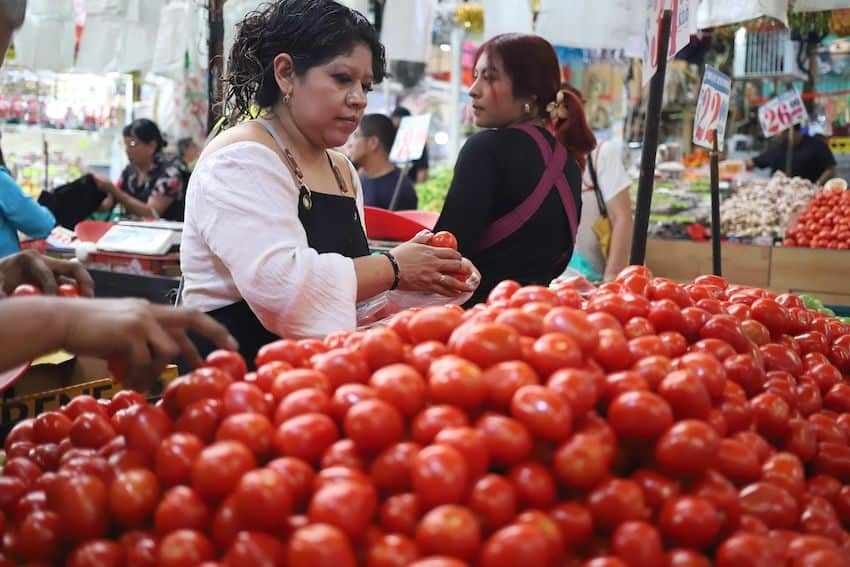
Compared to May, tomatoes were almost 39% cheaper in June while prices for poblano chilis plummeted more than 40%, according to INEGI. Tomato prices spiked sharply earlier this year, largely because crops in Florida were damaged by frost.
Grapes (-18.96%), cucumbers (-10.13%), limes (-8.94%) and eggs (-7.21%) were among the other products that were cheaper in June than in May. Among the products whose prices increased on a month-over-month basis in June were avocados (+24.53%), oranges (+9.55%), potatoes and other tubers (+9.32%) and onions (+6.87%).
Where is inflation headed?
The Bank of Mexico (Banxico) is currently forecasting an average headline inflation rate of 3.8% in the third quarter of 2026. In other words, the central bank expects inflation to increase from the 3.37% rate in June.
Mexico’s central bank holds interest rate at 6.50% while inflation continues to decline
Banxico anticipates average headline rates of 3.5% in the fourth quarter of 2026 and 3.2% in the first quarter of 2027. It forecasts that inflation will converge to its 3% target in the second quarter of next year.
In late June, the Banxico board voted in favor of maintaining the central bank’s benchmark rate at 6.50%. The bank has indicated that the key rate will remain at that level in the near future.
In its most recent monetary policy statement, Banxico said that its inflation forecasts were “subject to various risks,” including upside ones such as “disruptions due to foreign trade policies or to an inflationary impact from geopolitical conflicts”; “climate-related impacts”; and “a trend towards depreciation of the Mexican peso.”
On X, Gabriela Siller, director of economic analysis at Banco Base, pointed out that “unlike the previous four months,” Mexico’s trimmed mean inflation rate in June, at 3.53%, was higher than the headline rate.
That means that the “marked slowdown in general inflation was concentrated in generic items with extreme variations” that are excluded by the trimmed mean inflation measure, Siller said.
“… The bulk of prices showed a more gradual moderation. This means that inflation decelerated due to atypical events that aren’t expected to last, so inflation could rise,” she wrote without specifying the “atypical events” she referred to.
With reports from La Jornada, El Economista and López-Dóriga Digital