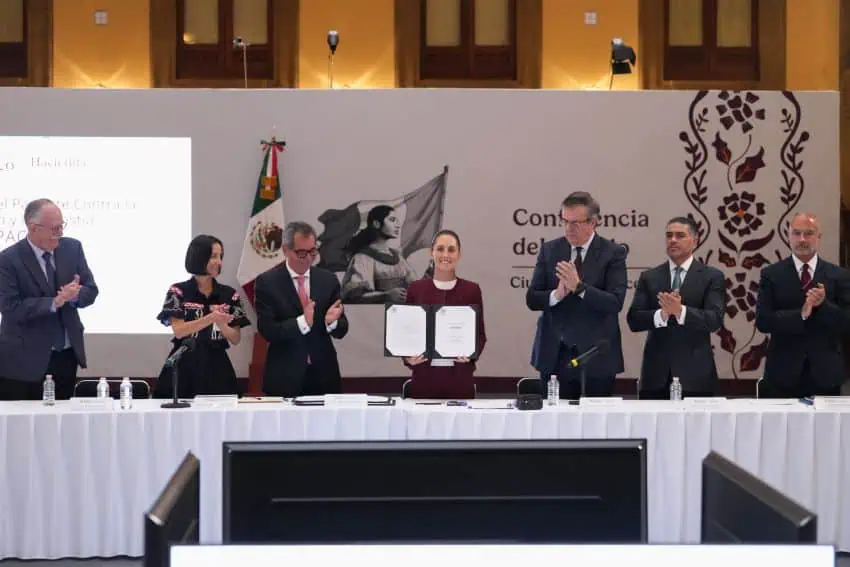
Mexican President Claudia Sheinbaum and business leaders renewed the national Package Against Inflation and High Costs (PACIC) on Monday to maintain the price of Mexico’s basic food basket, or canasta básica.
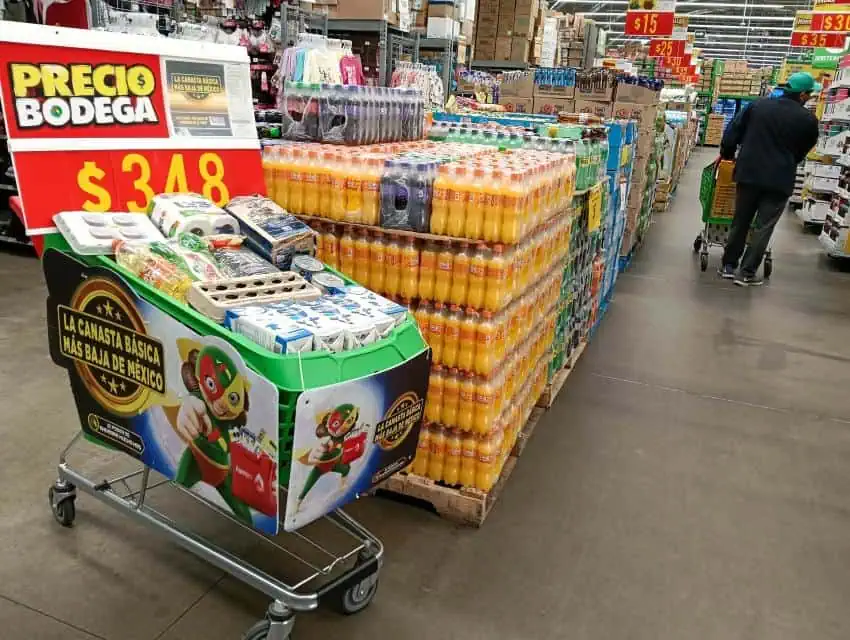
Under the agreement signed by Sheinbaum and Mexico’s major food and grocery companies, a “basket” of the 24 most essential pantry items will be capped at 910 pesos (US $46.8) for the next six months.
“We are taking care of the popular economy,” Sheinbaum said in a post on her official X account.
The canasta básica includes vegetable oil, pork chops, rice, apples, beans, chicken, canned tuna, soup pasta, eggs, plantains, canned sardines, brown sugar, soap, sliced bread, beef steak, tomatoes, carrots, corn tortillas, toilet paper, onions, milk, potatoes, jalapeños and lemons.
The PACIC is a move that began under former President Andrés Manuel López Obrador’s administration (2018-2024), following the COVID-19 pandemic, to control inflation.
This is the second time Sheinbaum has renewed the PACIC since taking office in October last year.
Cabinet members attending the signing ceremony included Finance Minister Edgar Amador Zamora, Economy Minister Marcelo Ebrard, Security Minister Omar García Harfuch, Energy Minister Luz Elena González, and the coordinator of the Business Advisory Council of the Mexican Government, Altagracia Gómez, among others.

Energy Minister Luz Elena González praised “the willingness of supermarkets and agricultural producers to join this action for the benefit of the people of Mexico” on her social media channels.
Inflation on the rise as Mexico anticipates another interest rate cut
The agreement comes amid ongoing inflationary pressures that are impacting low-income families.
At the end of April, inflation in Mexico was 3.93%, marking its third consecutive monthly increase, according to data from the National Institute of Statistics and Geography (INEGI). The Bank of Mexico’s target inflation rate is set at 3%, plus or minus one percent.
The federal government has not provided further details about the companies that renewed the agreement signed in November 2024. Companies listed in the previous agreement include Walmart, Chedraui, Soriana, La Comer, Merza, Calimax and Aprecio, HEB, Smart, Casa Ley, SuperKompras and Super AKI.
Agribusinesses in the agreement include GrupoMar, Minsa, Lala, Bimbo, SuKarne, Kimberly Clark, Pilgrims, Schettino, Pinsa, Maseca, Verde Valle, Ragasa, Alpura, San Juan, Bachoco, La Moderna, Sigma, Opormex and Grupo Porres.
To prevent rising fuel prices, the government said it will remain committed to keeping prices below inflation, including electricity rates and other public prices.
With reports from Proceso, Animal Político and Aristegui Noticias