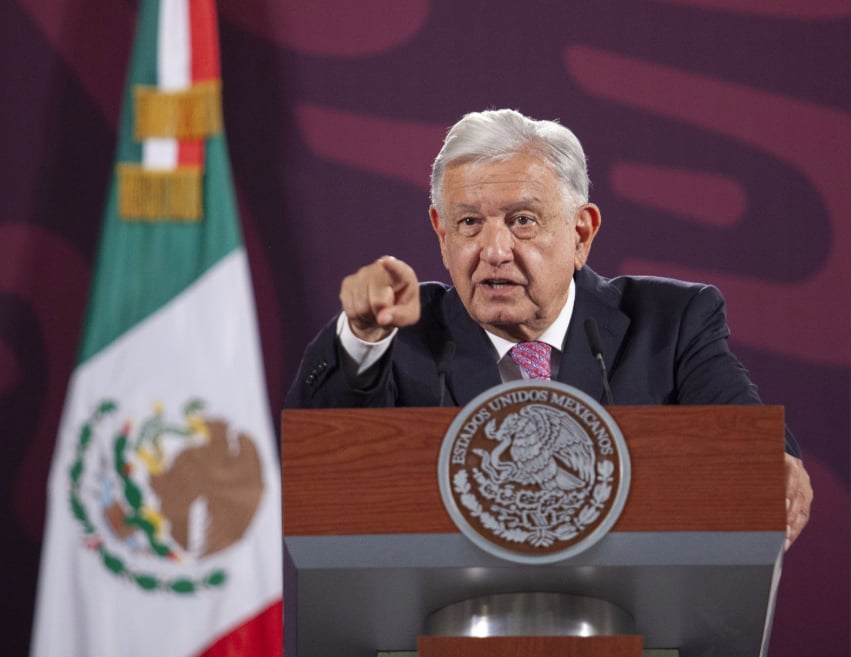
Researchers at the University of California-Berkeley Human Rights Center (HRC) say that legal grounds exist to try former President Andrés Manuel López Obrador for crimes against humanity, after a new report established a pattern of persecution including hostile rhetoric and digital espionage.
The HRC report assesses whether the former president’s constant disparaging rhetoric toward journalists and activists, as well as the alleged espionage carried out by his administration, amounts to a pattern of persecution that could fall under the Rome Statute.
The investigation also examined what role state institutions played in carrying out or enabling targeted killings, enforced disappearances, surveillance, stigmatization and other forms of harassment.
It then considered whether, taken together, these actions constitute crimes against humanity under the Rome Statute, the founding international treaty that established the International Criminal Court, which prosecutes individuals for genocide, war crimes and crimes against humanity from its base in The Hague.
The Berkeley report, entitled “Under Attack: Targeting of Journalists and Human Rights Defenders in Mexico,” makes the claim that Mexico was the most dangerous country in the world for journalists during López Obrador’s six-year term and the second most dangerous for human rights defenders.
The HRC documented 337 killings — 78 journalists and 259 human rights defenders — while also compiling 75 cases involving killings and enforced disappearances.
🧵1/6: After a multi-year investigation, we’ve launched the platform “Under Attack: Targeting of Journalists and Human Rights Defenders in Mexico,” which documents attacks on civic watchdogs during the presidency of Andrés Manuel López Obrador. pic.twitter.com/5kU3trgWfx
— Human Rights Center (@hrcberkeley) September 29, 2026

Researchers identified 2,827 instances of rhetoric they characterized as “explicitly disparaging and aimed at undermining the credibility and safety of independent journalists and civil society organizations.”
The report argues that the volume of vitriol “contributed to an increasingly hostile environment for journalists and human rights defenders in Mexico.”
In addition to the confrontational rhetoric, the Defense Ministry allegedly operated unlawful surveillance tools, including Pegasus spyware, to spy on the targeted groups.
In a separate publication, one of the lead authors asserted that although the numbers are indeed staggering, they are not the basis for the central finding.
Instead, Lindsay Freeman points to the “systematicity and the context in which they occurred,” describing the killings as “the visible edge of a broader attack … one the state openly encouraged and rarely punished.”
“The president used his daily press conferences to discredit and attack the press … and networks of fake accounts linked to state media amplified that rhetoric into threats and harassment online,” she said.
Freeman said that the unlawful surveillance, harassment, stigmatization and physical violence could be sufficient for the ICC prosecutor’s office to consider opening a preliminary examination under Article 7 of the Rome Statute.
With reports from UPI, LópezDóriga.com, Proceso and The Daily Californian