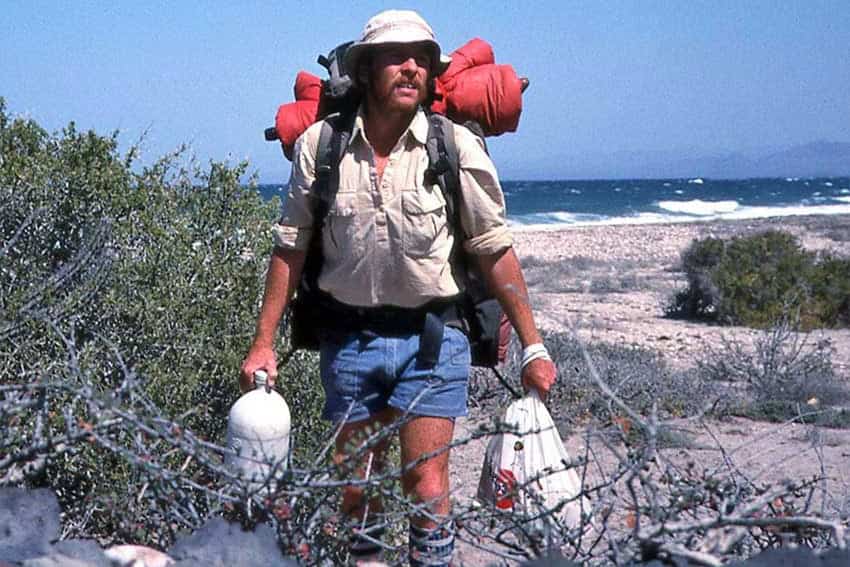
In 1979, Scotch-Irish Englishman Graham Mackintosh was “bitten by Baja.”
While visiting friends in Los Angeles, he had taken a bus to Ensenada and then could not resist hitching another 1,400 kilometers further south to see the rest of the peninsula.
In his book, “Into a Desert Place,” he says:
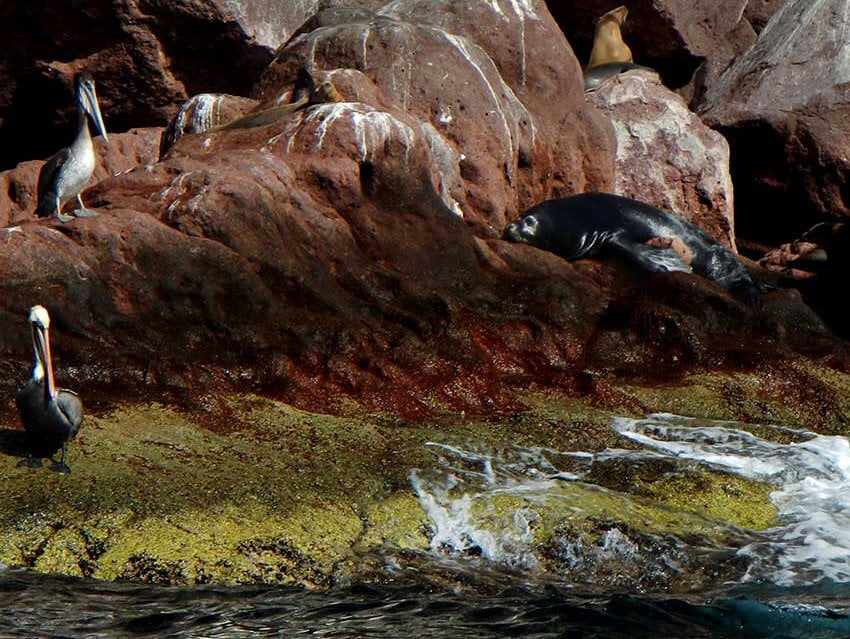
“My first glimpse of Bahía de los Ángeles, a fisherman’s paradise on the shores of the Sea of Cortez, was unforgettable. I thought it was a landlocked lake studded with deserted islands. The sea was warm and beautifully calm, the bluest of blue. Monster stingrays shuffled around in the shallows. Huge fish chased smaller fish almost onto the beach. Dolphins skipped around the bay. Friendly fishermen invited me out to try my luck. With each fish I hauled aboard, I became more hooked on Baja.”
This was the moment Mackintosh came up with the extraordinary idea of walking the entire coastline of the peninsula.
“I thought it was the most wonderful place I’d ever seen in my life,” he told me. “I fell in love with it.”
Out of water, out of luck
With no previous experience in hiking or camping, Mackintosh started from San Felipe, typically carrying a gallon of water in each hand and a 60-pound pack on his back.

“A lot of the problems I had came from dehydration,” he told me. “If I ran short of water, I was in real trouble. And occasionally I went inland. I couldn’t get by sheer cliffs, so I’d go inland a little bit to try and get around them. And very often, I got into trouble doing that. I ran out of water and it was a real struggle to get back to the coast. And that could have been very, very serious, especially when it’s hot and you need water continuously to keep hiking.”
Leaving the beach and climbing cliffs was often daunting.
He writes: “Jagged rocks, stunted trees and tearing bushes spitefully conspired to thwart my ascent. I hated to see seagulls flying below me. The sea looked a long way down. After pausing to catch my breath and admire the view, I began the descent and was soon sliding and scrambling down a narrow gulley of chute-like steepness. Brittle rocks came away in my hands and crumbled underfoot. Avalanche-like slides threatened to send me tumbling to my doom.”
Life is beautiful!
Having survived this experience, his reflection on it is very Graham Mackintosh and gives us an insight into how he could pull off a stunt that everyone (and I do mean everyone) told him was impossible.
“‘God, life is beautiful! Baja is beautiful,’ I chuckled to myself … who needs drugs? This is the greatest high in the world. These were the highs we were made for. They enable us to see further, do better and stand taller.”
One night, Mackintosh reached down to feed a log further into his campfire.
The dark, yellow scorpion
“Shock! Pain! I dropped the wood and leapt to my feet, cursing and trying to brush off what I assumed to be a red-hot ember. Then I saw the culprit in the firelight. A two-inch-long, dark yellow scorpion was still swinging his tail wildly … I could feel the venom spreading up my arm as a wave of tingling numbness. The key question was what would happen when it reached my chest. I hurriedly left a message in my diary and on my tape recorder, just in case.”
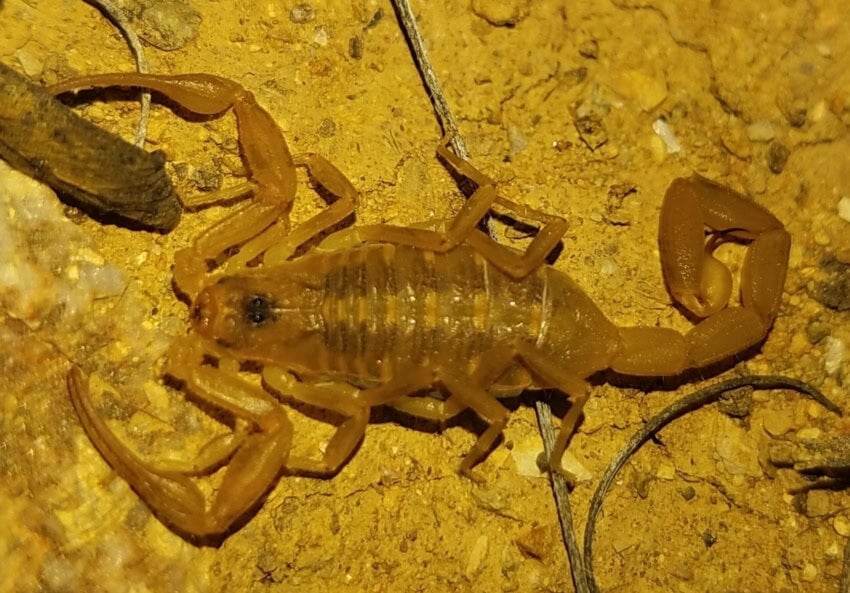
Shivering, he felt his throat tighten and his tongue thicken. An hour later, “the worst of the burning pain had passed. If I were about to die tomorrow, I thought, I might as well get a good night’s sleep.”
The next morning, he wrote in his diary: “Just a slightly stiff arm.”
Ode to a can of Tecate
After days of battles against cliffs and cacti, Mackintosh sees a cold can of Tecate beer in an entirely new light:
“Dry mouth watered as I clutched its cool promise. With foreplay relish, my fingers slipped along the can, wiping off the condensation. There was a little gasp as I opened it up. Oh, the first sip of cold beer when you’re thirsty! I could have drunk the lot in one go, but like one or two of life’s pleasures, it needed to be savored, experienced and definitely not rushed.”
Wild man of the beach
How did Macintosh appear to the Mexicans and foreigners who saw him coming down the coast?
“I looked a sight: boots taped together; clothes blood-stained, sweat-soaked and tattered; lips cracked; wild carrot-colored hair; unshaven; face as red as a beetroot and beaming elation; not the kind of thing you’d want to bump into with the sun going down.”
Whereas rattlesnakes were high on a long list of the dangers Mackintosh expected to find in Baja, he eventually came to see them in an entirely different light:
“The increasingly long, hot days ensured that I had a steady supply of rattlesnakes for my frying pan.”
Bonny
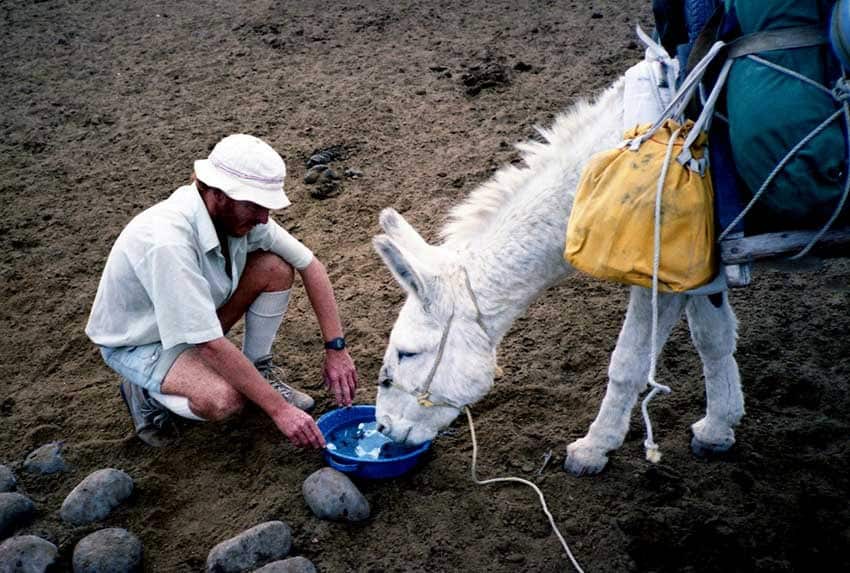
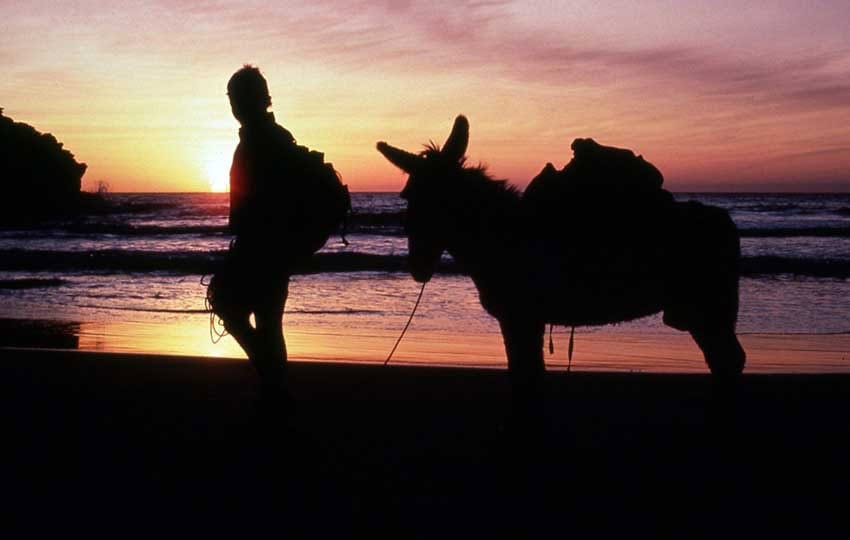
On the last leg of his long trek, Mackintosh came to a four-hundred-mile-long stretch of mangroves and soft sand, with no cliffs to climb. So, he decided to get a burro to carry his gear.
It was a male, and he named it Bonny at the request of his mother, in the good old Scottish tradition.
With Bonny’s arrival, the story takes on an irresistible charm and pathos.
Bony’s quirks, Bonny’s lice, Bonny’s fears, Bonny’s ecstasy at the sight of an orange peel, Bonny’s horrifying entrapment in the sucking mud of Magdalena Bay …
It is a beautiful story, a wonderful story, and you simply have to read “Into a Desert Place” to fully appreciate it.
But beware. By the time you finish this book, you may find yourself booking a ticket to Baja California.
John Pint has lived near Guadalajara, Jalisco, for more than 30 years and is the author of “A Guide to West Mexico’s Guachimontones and Surrounding Area” and co-author of “Outdoors in Western Mexico.” More of his writing can be found on his website.