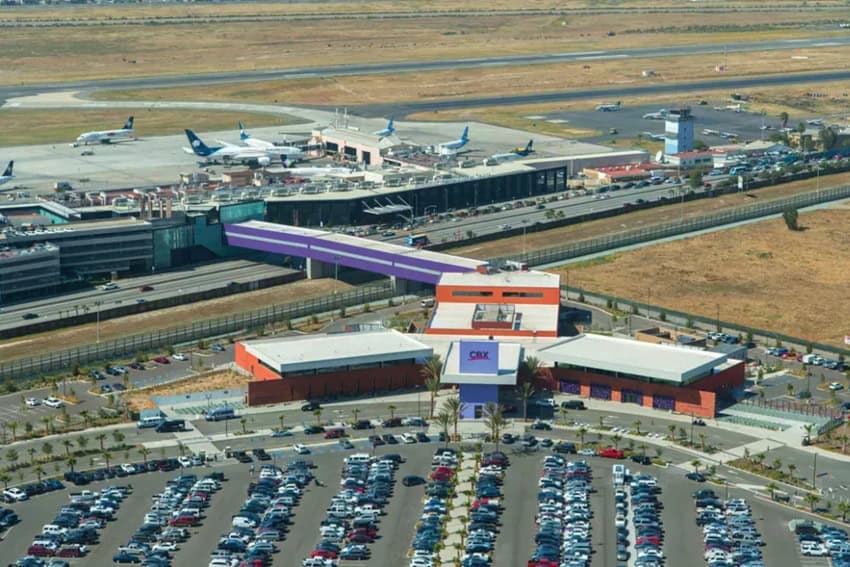
Serious thought about a bi-national airport for San Diego and Tijuana really began after the terrorist attacks on Sept. 11, 2001. Of course, Tijuana International Airport sits immediately across the border from the U.S. The airport is so close to the border that its runway veers from southeast to northwest and pilots must take a sharp left to avoid crossing into U.S. airspace.
San Diego International Airport, just 24.7 miles north, has limited room for expansion due to its proximity to the city on one side and the bay on the other, making it the busiest single-runway airport in the country. By 2006, the U.S. Navy had also stated unequivocally that potential expansions for San Diego International Airport using Marine Corps Base Camp Pendleton, Marine Corps Air Station Miramar and Naval Air Station North Island were not acceptable. That left a bi-national airport as the only viable solution — maybe.
Supporters and early efforts
Various entrepreneurs from both sides of the border had tried for years to develop plans to make airport cross-border travel work. These have included businessman Ralph Nieders, real estate magnate and civic leader Malin Burnham and Luis De La Calle, a Mexican economist and consultant, among others.
There were previous attempts to develop a cross-border airport called Twin Ports, utilizing San Diego City-owned Brown Field on the U.S. side and Tijuana International Airport in Mexico, but these failed due to financing as well as problems with land acquisition on the U.S. side. In addition, presidential permits would be required from both the U.S. and Mexican governments to make a new border crossing between Tijuana and San Diego.
Meanwhile, there was increased interest in the project by Guadalajara-based Grupo Aeroportuario Pacifico (GAP), operators of a dozen airports in Mexico, including the one in Tijuana. Instrumental with GAP was the enthusiastic support of Enrique Valle Alvarez, Director of the Tijuana airport. Also supportive were the San Diego Regional Chamber of Commerce and the South County Economic Development Corporation.
Partners in developing the project
The key to success was the acquisition of land on the San Diego side, which was completed along with the required presidential permits in August 2010. However, an anticipated problem was the estimated US $8 million annual budget for U.S. Customs and Border Protection (CBP), which CBP insisted be paid by the developer, since, according to its reasoning, the development was a private venture.
Led by Alan Bersin, the previous chairman of the San Diego County Regional Airport Authority and later U.S. Department of Homeland Security Secretary for International Affairs and Special Representative for Border Affairs, as well as the Commissioner of U.S. Customs and Border Protection, an agreement was reached that the operators of a cross-border terminal would fund the costs of CBP.

GAP strategic partners Eduardo Sanchez-Navarro, Carlos Laviada Ocejo and his wife, Laura Díez Barroso Azcárraga, were joined by Sam Zell of Chicago-based Equity Group Investments to fund the project. Land was then purchased on the San Diego side for the terminal as well as for parking spaces.
The Cross Border Xpress becomes a reality
There was some concern about what might happen to the cross-border terminal should Mexico ever close the border, making the planned San Diego terminal a white elephant. Ironically, it was the U.S. that closed the border during the COVID pandemic.
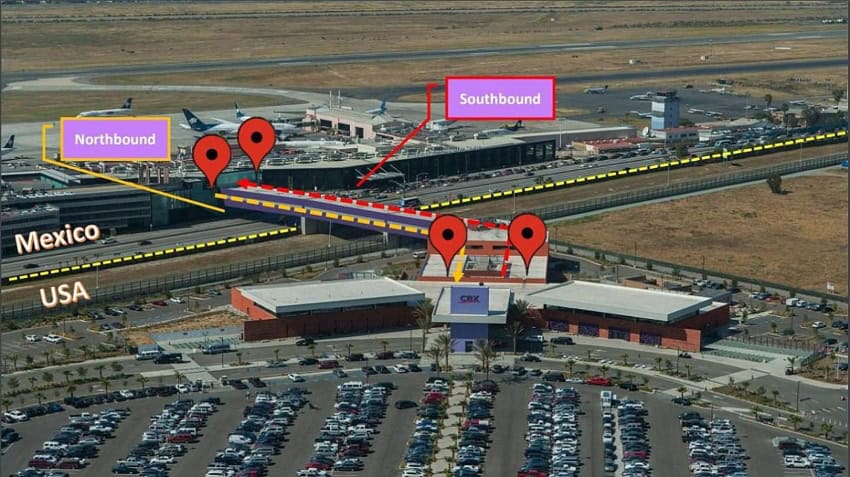
With all objections overcome, construction began in June 2014. The distinctive terminal was designed by its architect, the late Ricardo Legorreta. Special arrangements had to be made to permit the primary contractor, Turner Construction, to build the bridge that would cross the border and construct the connections on the Tijuana International Airport terminal.
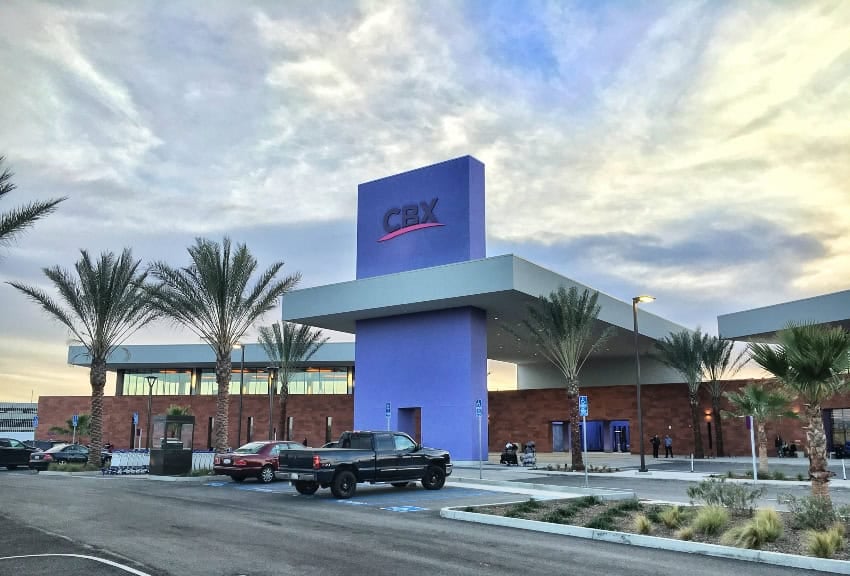
After more than a decade and all real and potential issues solved, the cross-border terminal, renamed Cross Border Xpress (CBX), opened on Dec. 9, 2015. Grateful passengers began using the 390-foot secure skybridge crossing between Mexico and the U.S., eliminating long waits at the other land border crossings. The San Diego Terminal even has its own airline code designation: TJC. Access is available to 40 destinations within Mexico and two in China (Beijing and Shenzhen), as well as Phoenix in the U.S.
10 years later
Since opening, 25 million ticketed passengers have used CBX, contributing to a 1.4% annual growth rate of Tijuana International Airport. There are 8,500 spaces available for short- and long-term parking. Uber and Lyft, as well as car rental companies, have designated pickup locations. Under the leadership of Jorge Goytortúa, Chief Executive Officer and his team, CBX and its facilities on both sides of the border continue to expand and make travel from California to Mexico seamless and easy.
Today’s air passengers take for granted the ease of accessing Tijuana International Airport from the CBX San Diego Terminal. Most have no idea how hard it was for the many players who made “the impossible dream” a reality 10 years ago.
James Clark writes for Mexico News Daily.