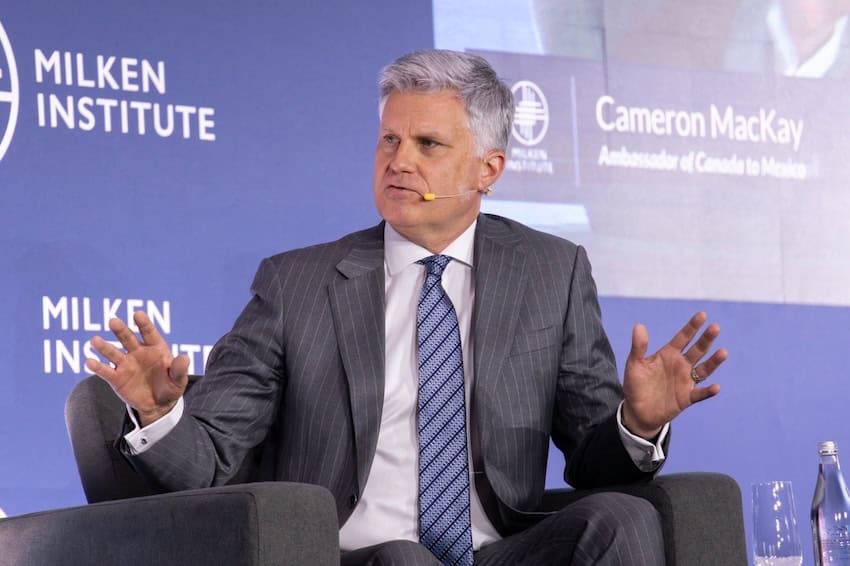
Canadian Ambassador to Mexico Cameron MacKay urged the Mexican private sector to increase capital investment in Canada, emphasizing the necessity of “rebalancing the asymmetrical bilateral investment flow” between the two North American partners.
Speaking during an investors symposium panel entitled “Unlocking the Next Trillion: Mobilizing Long-Term Capital for Regional Development,” the diplomat noted that although Mexico has considerably improved its investment conditions, risks and uncertainty persist.

(Milken Institute)
MacKay pointed out that approximately US $66 billion has been deployed by Canadian manufacturers, corporations and institutional investors into Mexico, while Mexican companies have invested only about US $3-4 billion in Canada.
Insisting that Canada offers favorable conditions for attracting new investments, MacKay outlined several key competitive advantages, including Canada’s 6.4% marginal tax rate tailored specifically for new projects, which the ambassador described as “very competitive.”
“That’s half of what it is in the United States and the lowest in the OECD,” he said, referring to the Organization for Economic Cooperation and Development, of which both nations are members.
Mackay also spoke about the importance of solidifying corporate supply chains ahead of the scheduled U.S.–Mexico–Canada Agreement (USMCA) trade review, while highlighting the critical importance of a coordinated front between Canada and Mexico.
Regarding the future of the USMCA, MacKay pointed out that the United States has made it clear that free trade in North America will not return to what it once was, increasing the importance of the Canada-Mexico Action Plan 2025-2028.

“Around 80-85% of trade between the three nations is duty-free and we have to see what we do with the remaining 15%,” he said.
MacKay also voiced concern regarding the operating environment for Canadian companies in Mexico. Earlier this year, he noted that Canadian operators face “concrete, non-abstract headwinds that slow down investment cycles.”
The symposium, sponsored by the Milken Institute, sought to address the question: How can Mexico align institutional capital, government priorities and private investment to finance key sectors, while leveraging the USMCA to strengthen investor confidence and supply chain integration?
The expressed goal was “to examine how trade-policy certainty, innovative financing structures and effective partnership frameworks can turn development priorities into bankable projects.”
Speaking before MacKay, Mexico’s Finance Minister Edgar Amador did not address the asymmetrical imbalance during his keynote address.
Amador told the assembled national and international investors that Mexico’s economy is gaining momentum and preserving an upward trend.
He highlighted factors such as a strong labor market, steady foreign direct investment and decreasing inflation as key elements supporting Mexico’s economic outlook.
With reports from Reforma, El Economista and El Financiero