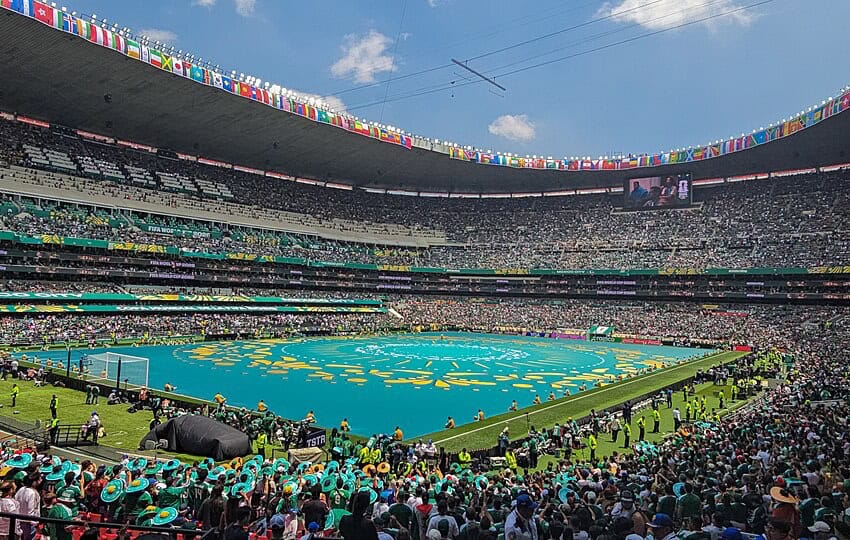
Grupo Ollamani, which owns the iconic Estadio Azteca, is perhaps one of the big financial losers of the World Cup after the release of a new financial report, cited by El País, that reveals a multi-million dollar loss.
The holding company, which also owns the publishing subsidiary of Grupo Televisa, reported to the Mexican Stock Exchange (BMV) a net loss of 557.2 million pesos (US $32.2 million) in its second-quarter financial results, primarily associated with the cost of the World Cup.
Led by media mogul Emilio Azcárraga Jean, Grupo Ollamani also estimated an additional financial impact of 255.9 million pesos (US $14.9 million) in July, when the stadium also hosted World Cup matches.
Combined, the total impact would amount to 813 million pesos (US $47.4 million) covering the costs of what’s been described as FIFA operations.
These operations include making Estadio Azteca (also known as Estadio Banorte) available to host five matches and organizing tournament-related activities in Mexico City.
Cause of losses
Ollamani said the reported financial loss was partly due to payments related to a dispute over the use of the stadium’s premium seats and box seats.
In the lead-up to the event, people who owned boxes and premium seats inside the stadium demanded those seats for World Cup matches. But FIFA ultimately required full control. A legal dispute was eventually resolved, whereby Ollamani had to pay FIFA 1 billion pesos (US $58.3 million) so the owners could use their seats.

The company noted that the negative financial impact did not reflect the ordinary course of its operations and stems from extraordinary circumstances related to the World Cup.
“At the same time, investments were made to prepare and modernize Banorte Stadium — representing long-term improvements to its infrastructure, functionality, operational capacity, and digitalization — the benefits of which will extend beyond the World Cup period,” the company said in a statement cited by El País.
Ollamani’s report adds to a broader picture that confirms the World Cup did not generate the expected economic impact. The results were particularly disappointing for the hospitality sector.
In stark contrast, FIFA emerged as the tournament’s biggest financial winner, reportedly generating a record US $15 billion in revenue, which far exceeded its US $11 billion forecast. This performance was mainly fueled by the sale of licensing, broadcasting and hospitality rights, as well as sponsorships and ticketing sales.
With reports from El País, The Guardian and Infobae