Inflation in Mexico declined more than expected in the first half of October, falling to an annual headline rate of 3.63%, according to official data.
The decline from a headline rate of 3.78% in the second half of September and 3.76% across last month came after inflation increased during four consecutive quincenas, or 15-day periods.
The 3.63% headline rate reported by national statistics agency INEGI on Thursday is lower than both the 3.73% median forecast of analysts surveyed by Bloomberg and the 3.70% prediction of analysts polled by Reuters. It is 0.79 percentage points lower than the highest annual inflation rate so far in 2025, which was 4.42% in May.
The slowing of inflation beyond expectations in early October likely gives the Bank of Mexico (Banxico) board leeway to extend its monetary policy easing cycle.
The central bank’s board has voted in favor of reducing Banxico’s benchmark interest rate at each of its last 10 monetary policy meetings. The bank’s key rate is now set at 7.5%, its lowest level since May 2022.
Banxico’s board will hold its next monetary policy meeting on Nov. 6. The central bank targets 3% inflation, but tolerates a 2-4% range.
Core inflation also declines
INEGI reported on Thursday that Mexico’s core inflation rate was 4.24% in the first half of October, down from 4.28% across September. Unlike the headline rate, which encompasses all goods and services, core inflation excludes food and energy prices, which are subject to volatility.

INEGI also reported that consumer prices rose 0.28% in the first half of October compared to the second half of September.
INEGI’s data shows that processed food, beverages and tobacco were 5.24% more expensive in the first half of October than a year earlier. Prices for non-food goods rose 3.06% annually, while services were 4.42% more expensive.
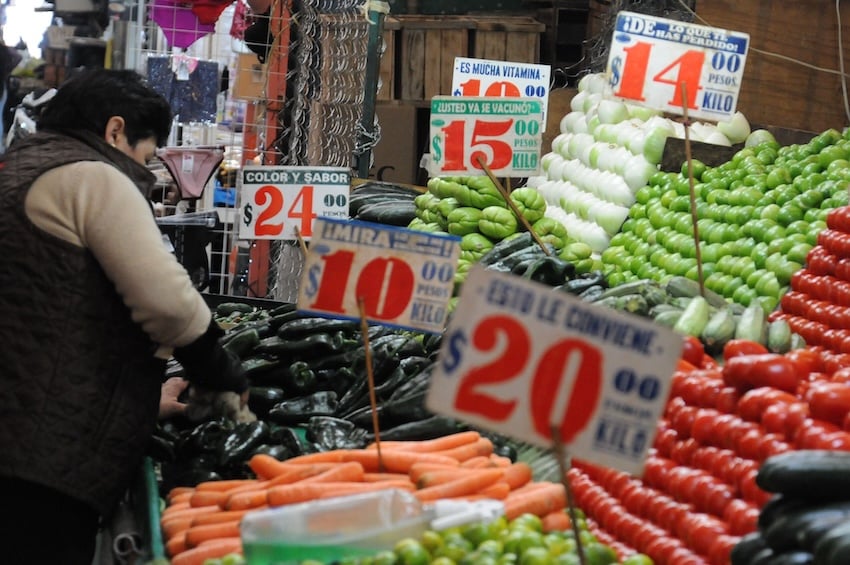
Low inflation for the fresh food category — fruit, vegetables and meat — helped moderate inflation in the first half of October. Annual inflation for the category was just 1.06%. That figure came from an 8.27% annual increase in meat prices and an 8.38% annual decrease in the cost of fruit and vegetables.
Energy prices, including those for electricity and gasoline, increased 1.99% annually, according to INEGI.
Compared to the second half of September, electricity prices shot up 17.65% due to the conclusion of the “warm season” power rates program in 18 cities including Mérida, Monterrey, Cancún and Veracruz.
With reports from El Economista and Bloomberg