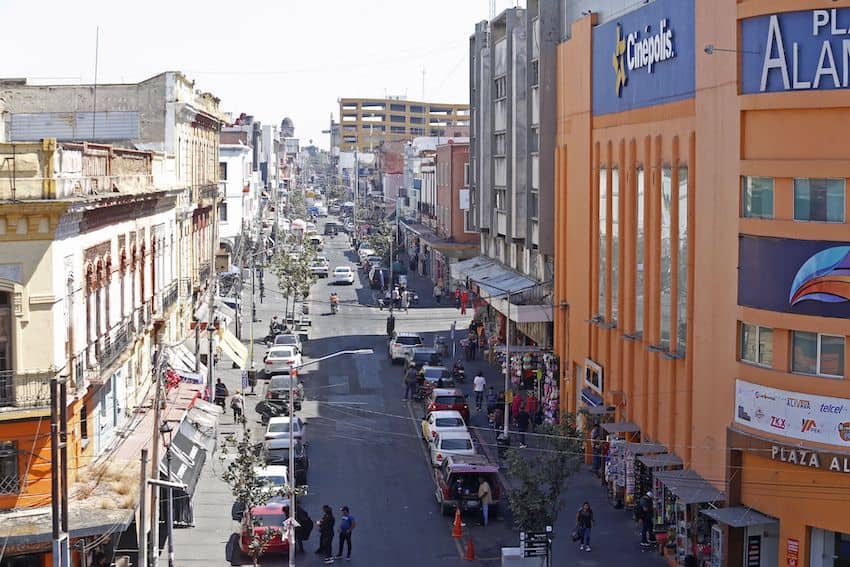
It’s business as usual in the state of Jalisco.
Less than 10 days after 103,000 businesses reported suffering a negative economic impact from the Feb. 22 anti-cartel military operation and its violent aftermath, the state’s economy appears to be running on all cylinders again.
It’s not that the economic damage inflicted on that Sunday wasn’t real.
According to the Jalisco chapter of the Mexican Employers’ Confederation (Coparmex), “88% of businesses reported direct economic impacts, with losses exceeding one million pesos (US $56,600) each for medium and large companies, while losses for micro and small businesses ranged primarily between 10,000 ($566) and 50,000 pesos ($2,830).”
The damage could also be seen in the details of daily life. Ridership on the touristic Turibus in Tlaquepaque, part of the greater Guadalajara area, fell from around 300 a day to just 30 in the week following the operation, as visitors were understandably in no mood to go sightseeing. Some 22,000 tons of food went unsold from the Mercado de Abastos wholesale market.
But a return to normalcy came quickly. For example, according to the head of the Guadalajara Convention and Visitors Bureau, Gustavo Staufert, around 10,000 hotel rooms were canceled within two days of the troubles. But just two days after that, hotel occupancy rose from 15% to 40%, and continues to work its way back to normal.
Moreover, all domestic and international air routes to Guadalajara and Puerto Vallarta were quickly restored, confirming that any potential connectivity crisis was only a short-lived immediate reaction, fueled, perhaps, by the flood of fake news on social media.

In what was probably the surest indicator of full recovery, the American Chamber of Commerce (AmCham) Guadalajara chapter, comprising 16 large U.S.-owned companies operating mainly in Jalisco, held a special session on Thursday to assess the economic impact of the event. Members agreed that the organization will not stop or pause its investment projects in Jalisco.
“Regarding the medium and long-term investment outlook, everyone absolutely confirmed that they see no reason to halt new investments or pause current projects in the state,” the president of AmCham’s Guadalajara chapter, Ernesto Sánchez Proal, told the newspaper El Economista. “It’s important to emphasize that American companies are very pleased with the security performance and the coordination between both the state and federal governments.”
Furthermore, planned activities continue apace: 95% of the events scheduled to take place in Jalisco in 2026 are confirmed, despite previous speculation around Guadalajara’s role as a FIFA 2026 World Cup host city.
“Within 48 hours of the incident, our destinations were fully operational and back to normal,” Jalisco’s Tourism Minister, Michelle Friedman, stated in a press conference in Puerto Vallarta. “Very few organizers have announced cancellations, especially those that were very close [in date] to the event.”
Friedman stressed that during the emergency, the spread of fake news generated a perception of risk greater than the actual situation.
Jalisco expects to welcome around 3 million visitors during the 29 days of the World Cup, which will be shared by Mexico, Canada and the United States.
With reports from La Jornada and El Economista