Amid uncertainty in their trade relationships with the United States, Mexico and Brazil are seeking to enhance their commercial ties with each other.
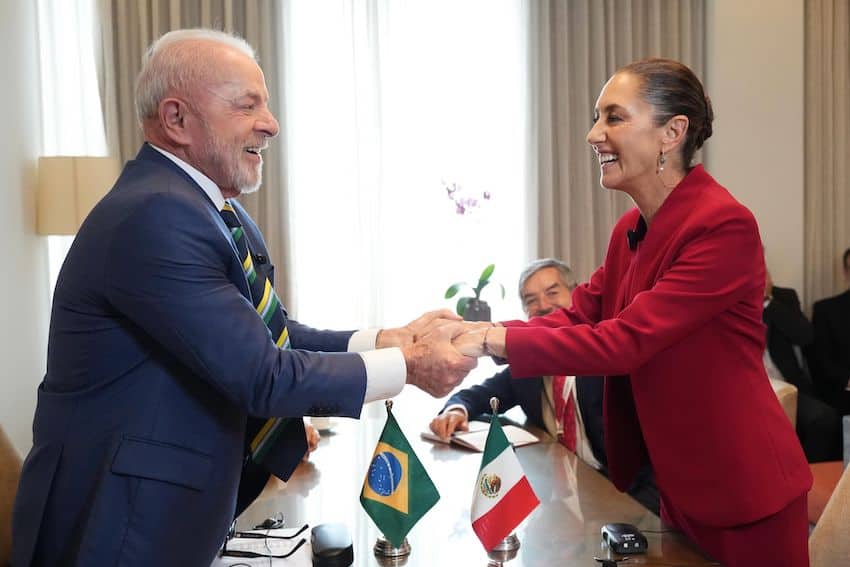
President Claudia Sheinbaum spoke to her Brazilian counterpart, President Luiz Inácio Lula da Silva (Lula), on Wednesday ahead of a visit to Mexico by a Brazilian government and business delegation next month.
Esta tarde conversé telefónicamente con el presidente de Brasil, Luiz Inácio Lula da Silva; dimos seguimiento al acuerdo para recibir en México a autoridades y empresarios de Brasil, con el propósito de profundizar nuestra colaboración en diversos temas. pic.twitter.com/7LGdEQG53X
— Claudia Sheinbaum Pardo (@Claudiashein) July 24, 2025
“We followed up on the agreement to welcome in Mexico authorities and business people from Brazil, with the aim of deepening our collaboration on various issues,” Sheinbaum wrote on social media.
In his own social media message, Lula said that he emphasized to Sheinbaum “the importance of deepening economic and trade relations between our countries, especially in light of the current uncertainty.”
United States President Donald Trump recently informed the Mexican and Brazilian leaders of his intention to impose 30% tariffs on imports from Mexico and 50% tariffs on imports from Brazil starting Aug. 1.

Both Mexico and Brazil are aiming to reach agreements to stop those tariffs from taking effect, but there is no certainty they will achieve their goals.
In his social media post, Lula noted that he and Sheinbaum agreed that a delegation led by Brazilian Vice President Geraldo Alckmin would visit Mexico on Aug. 27 and 28.
He also said that he and Sheinbaum “discussed the expansion of the Brazil-Mexico trade agreement, highlighting the potential of the pharmaceutical, agricultural, ethanol, biodiesel, aerospace, innovation and education sectors as strategic areas in our bilateral relationship.”
Negotiations aimed at the expansion of the 23-year-old bilateral trade pact are expected to commence during next month’s meetings in Mexico.
Telefonei nesta quarta-feira, 23 de julho, para a presidenta do México, @Claudiashein. Recordei o encontro que tivemos durante a Cúpula do G7, no Canadá, e agradeci pela presença do chanceler mexicano na Cúpula do BRICS, no Rio de Janeiro.
Ressaltei a importância de aprofundar…
— Lula (@LulaOficial) July 23, 2025
Sheinbaum and Lula have met in person on several occasions since the former took office last October. The Mexican president attended the G20 Leaders’ Summit hosted by Lula in Rio de Janeiro last November, and held a bilateral meeting with the Brazilian leader on the sidelines of the CELAC Summit in Tegucigalpa, Honduras, in April. Sheinbaum also spoke to Lula at the G7 Summit in Canada last month.
After the Tegucigalpa meeting, Lula said that he and Sheinbaum “decided to further strengthen relations between our two countries by promoting periodic meetings between our governments and the productive sectors of industry in Brazil and Mexico.”
Sheinbaum called for “greater regional economic integration” in an address to the CELAC Summit, and has advocated a broadening of the USMCA pact to include more Western Hemisphere countries.
Her conversation with Lula on Thursday came just after Brazil adopted a new protocol that allows Mexico to export avocados to Latin America’s most populous country and largest economy.
The trade relationship between Mexico and Brazil
According to Mexico’s Economy Ministry, two-way trade between Mexico and Brazil amounted to US $14.53 billion in 2024.
Mexico’s exports to Brazil were worth $4.23 billion, while imports from Brazil were worth $10.3 billion.
Mexico’s top export to Brazil was motor vehicle parts and accessories, accounting for 19.1% of all revenue earned from products shipped to the South American country.
Auto sector exports (parts, cars and trucks) accounted for just over 43% of Mexico’s total revenue from products sent to Brazil last year.
Mexico’s largest import from Brazil in 2024 was intermediate products of iron or non-alloy steel, accounting for 20.5% of the total outlay on Brazilian products.
Mexico’s second largest export from Brazil was cars followed by meat.
Brazil to import avocados from Mexico, unlocking a market of over 200 million
A Mexico-Brazil trade pact signed in 2002 “sets the exemption or the reduction of import fees for some 800 types of products,” Reuters reported last September when Mexican and Brazilian authorities began advocating for an updated and expanded agreement.
Marcelo Ebrard, economy minister since the beginning of the Sheinbaum administration, said at the time that “the growth of our relationship has already topped that agreement.”
“We need to update it,” he added.
Brazil ranked as the 10th largest economy in the world in 2024, while Mexico ranked 13th, according to the International Monetary Fund (IMF).
The two countries are the No. 1 and No. 2 economies in Latin America. Brazil’s nominal GDP in 2024 was US $2.17 trillion last year, according to the IMF, while Mexico’s GDP was $1.85 trillion.
With reports from El Universal and AFP