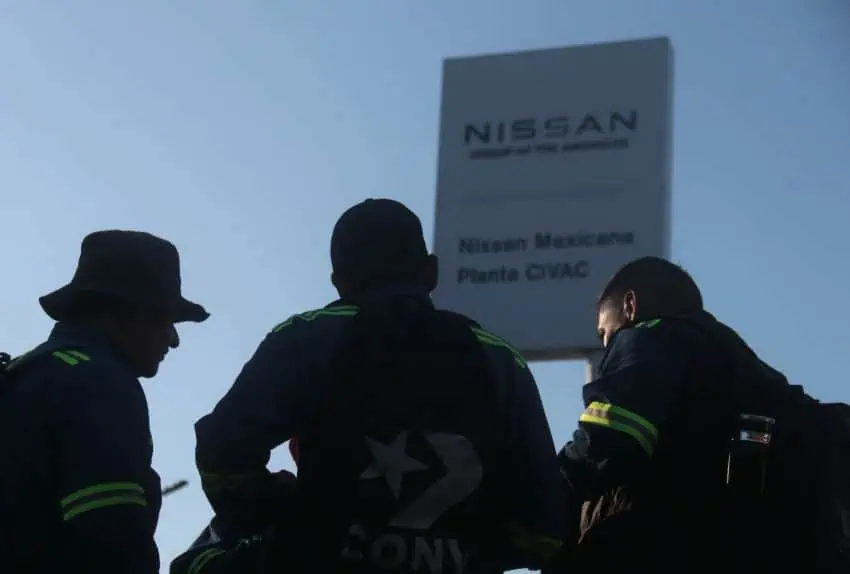
Nissan has officially announced the closure of its plant in the state of Morelos after nearly 60 years of operations, leaving the fate of thousands of employees up in the air.
The Cuernavaca Valley Industrial City (Civac) plant, located in Jiutepec, Morelos, just outside Cuernavaca, was Nissan’s first production facility outside of Japan. However, beginning in March 2026, the end of the Japanese fiscal year, production of all models currently assembled at Civac, including the NP300, Frontier and Versa, will be transferred to the more modern Aguascalientes automotive complex.
😔🏭 Así fue el momento en que la directiva de Nissan anunció a los trabajadores el cierre de la planta de Jiutepec tras 59 años de historia ⏳ La producción se traslada a Aguascalientes 🚚⚙️https://t.co/XN1BFkm9hC
📹@InfoAgenda_Mor pic.twitter.com/hakR1z7bTb
— @diario24horas (@diario24horas) July 30, 2025
This Spanish-language video, possibly taken clandestinely and posted on X, captures the moment when employees of Nissan’s 59-year-old Cuernavaca plant first learned that they will soon be out of a job.

“Today, we have made the difficult but necessary decision that will allow us to become more efficient, more competitive, and more sustainable,” CEO of Nissan Motor Corporation Ivan Espinosa said, adding that relocating production to Aguascalientes, the capital of the central state of the same name, will ensure the continuity of key models in a facility with greater technological capacity.
This decision is part of the global “Re:Nissan” restructuring plan, which seeks to consolidate production and optimize the company’s efficiency worldwide. According to the newspaper El Universal, Nissan plans to reduce its non-China global production capacity from 3.5 million units to 2.5 million units yearly.
Though Nissan is not leaving Mexico, its current plans mark the end of an era.
The Cuernavaca plant accounted for approximately 11% of Nissan’s total production in Mexico and had produced more than 6.5 million vehicles since its opening in 1966, marking the beginning of the brand’s international expansion outside of Japan. Over the years, its vehicles have not only been distributed in Mexico but have also reached international markets, including Japan. The Nissan Tsubame was exported in 1993, marking the first model manufactured in Mexico and sold in the Asian country.
Since its opening, Civac has boosted development for the local community and acted as a benchmark for the Mexican automotive industry, which is why the move has raised concerns about the future employment of the plant’s direct employees. The company did not mention in its announcements how many employees will be affected, but the newspaper El País reported that figures from Nissan itself put the number of Civac workers at 4,800 in 2016.
Nissan says it is committed to ensuring a respectful transition for affected employees. However, it has not announced any specific plans about severance, relocation or retirement plans, leaving workers feeling uncertain.
Morelos Governor Margarita González Saravia and state Minister of Economic Development Víctor Sánchez Trujillo announced plans to meet with Nissan representatives to ensure compliance with labor rights and to facilitate a fair transition. The action plan includes placement of employees in other automotive companies in the state, a special program through the National Employment Service (SNE) for new job opportunities, and support for entrepreneurship, leveraging employees’ technical skills.
In an interview, González added that her government will seek to bring in another automotive company to replace Nissan.
With reports from Diario de Morelos and Merca 20