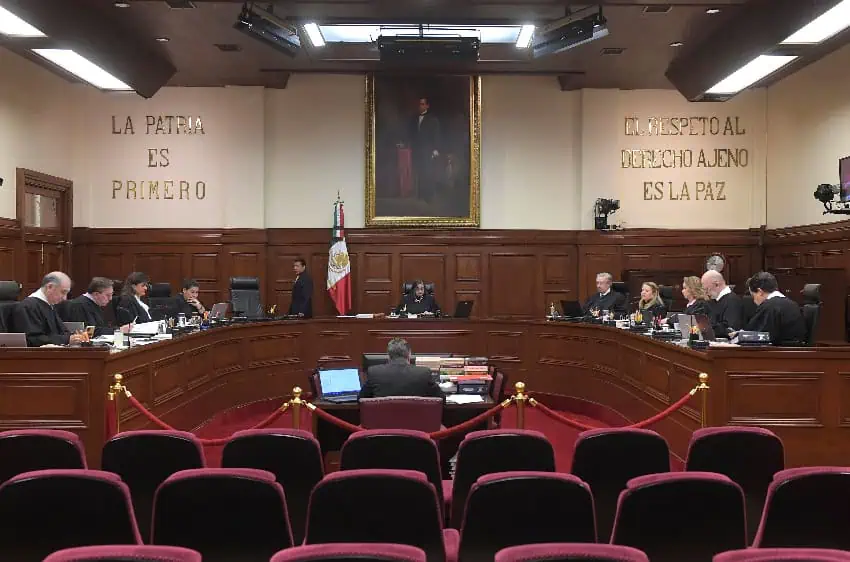
The following statement on President López Obrador’s proposed judicial reform in Mexico was published by the American Chamber of Commerce of Mexico (AmCham) on Monday.
The American Chamber of Commerce of Mexico (AmCham) has been a pillar of trust in Mexico for more than a century. Since our founding in 1917, we have been a proactive and committed community dedicated to generating shared well-being in Mexico.
Examples of this are our pioneering actions such as the historic job board, the reconstruction of Mexico City after the 1985 earthquake, the management to bring COVID-19 vaccines, or more recently, the coordination of support to rebuild Acapulco accompanied by the working mechanism with the governors of the south-southeast.
Our joint history with 19 administrations in the United States and 22 in Mexico has taught us that in dialogue, analysis, and finding common ground amidst differences lies the key to overcoming any challenge. In recent years, this lesson has been no different, and today, AmCham continues to trust in Mexico.
In the most recent quarter of 2024, more than 97% of foreign direct investment (FDI) was reinvestment of profits, and more than 44% came from American companies. Our companies — American, Mexican, and international; large, medium, and small — are invested in Mexico and provide formal employment to more than 10 million Mexicans.
In every democracy, the path to strengthening the rule of law must be evaluated, debated, and enriched. When multiple voices rise in a chorus of warnings, it is wise to pay attention. The convergence of diverse opinions on a risk is not mere coincidence but an echo of shared experiences and knowledge. Our Chamber has thoroughly analyzed the judicial reform and shared recommendations with the current government, the transition government, and representatives of Congress.
We agree with Ambassador Ken Salazar on the vision of Mexico-U.S. integration that transforms the region into an example of economic prosperity. This vision requires legal certainty, judicial transparency, and clarity in the application of laws.

As companies invested in Mexico and generating millions of jobs for past and future decades, we see risks in the independence of the judiciary in the judicial reform, and a potential delay in the professionalization of specialized justice, an increase in costs, a reduction in the effectiveness of the judicial system, and the generation of uncertainty for investment.
Mexico is a country that favors investment and the growth of companies. In light of this concern expressed by the private sector, we call for continued dialogue to carefully evaluate the potential consequences of this and other reforms, and we reaffirm our commitment to collaborating in the creation of public policies that strengthen legal security and Mexico’s competitiveness.
**It is important to remember Annex 23-A of the USMCA, where Mexico committed to having independent labor courts, and Chapter 31 on the use of alternative dispute resolution mechanisms. These mechanisms are essential for efficiently resolving business conflicts and reducing the workload of the judicial system. The proposed changes could compromise the fulfillment of the USMCA.
Disclaimer: The views expressed in this article are solely those of the author and do not necessarily reflect the views of Mexico News Daily, its owner or its employees.