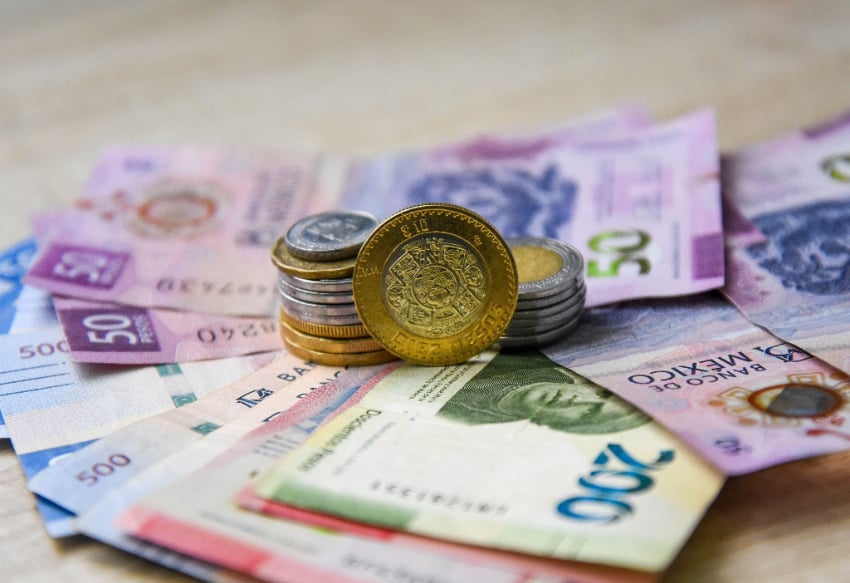
The peso gained against the dollar in early trading on Friday, hitting its strongest point in 28 months and highlighting recent assertions that the “super peso” is back.
But before Mexico’s currency gets fitted for a cape, it’s worth examining what the peso’s surge means for Mexico.
At 10 a.m. Mexico City time on Friday, the spot exchange rate hit a new yearly low of 16.863 pesos to the US dollar, a gain of 6.5 centavos compared to Thursday’s close of 16.928 pesos.
With the peso on track to gain nearly 10 centavos this week and last month’s 1.87% gain pushing yearly appreciation to nearly 6%, it’s no wonder that talk of the super peso has been revived.
What is driving the peso appreciation?
The peso — one of the most-traded emerging market currencies — is not unusually strong compared to other emerging market currencies, Graham Stock, an analyst at RBC BlueBay Asset Management, told Reuters.
Instead, “the dollar has been weak compared to previous cycles.”

If the peso’s strength were purely a result of dollar weakness, however, it would be rising alongside other currencies. Instead, it has gained against other major currencies.
Alejo Czerwonko, emerging markets analyst at UBS Global Wealth Management, says this is “a sign that domestic factors, not just broad dollar weakness, are at play.” Those factors include lower trade-risk premiums, political stability and solid macroeconomic conditions, Czerwonko said.
Marco Oviedo, senior strategist for Latin America at XP Investments, said that after Mexico’s 2024 election many long-term investors, such as pension funds and insurers, stepped back from the peso and have largely stayed away.
Recent gains have been stoked primarily by “fast money” investors (i.e., hedge funds and short-term traders) rather than by the reappearance of longer-term institutional buyers — an important distinction, analysts say, since the type of investor can shape how long a rally lasts.
Investors, strategists and economists have also issued warnings about trade policy.
For instance, RBC BlueBay’s Stock cites “clear uncertainty” around how the U.S.-Mexico trade relationship plays out after the Trump administration declined to approve a 16-year extension for the USMCA free trade agreement.
It remains to be seen what the USMCA will look like afterward, Stock said, particularly as Mexico pursues separate bilateral discussions.
Is the peso punching above its weight? The results of our latest MND Peso Index™
So what are the positives and negatives?
A stronger currency can be a mixed blessing.
On the positive side, there are lower import costs, less inflationary pressure, cheaper inputs and greater purchasing power for those who buy products from abroad.
On the negative side, there is lower value in remittances, pressure on exporters’ margins and a loss of competitiveness for domestic producers against cheaper imports.
The stakes are high since Mexico sends more than 80% of its exports to the United States. A stronger peso benefits sectors that import a significant portion of their inputs, machinery and equipment. The agricultural export sector, meanwhile, faces a less favorable outlook because its costs are not linked to imported inputs, preventing it from compensating for losses when exporting.
“About 77% of Mexican imports are intermediate goods … [and] used to produce other goods,” Ana Karen García, a researcher at the Mexican Institute for Competitiveness (IMCO) told the newspaper El Economista. “This protects the manufacturing sector, since although it loses money when exporting, it pays less for these goods when importing.”
As a result, states with strong manufacturing sectors integrated into global supply chains, such as automotive, electronics, electrical and machinery, stand to benefit, García said.
On the other hand, states dominated by the agriculture sector lose out. Many of those states — such as Michoacán — rely on remittances which often shrink in the face of the super peso.
With reports from El Economista and Reuters