Mexico and the European Union (EU) on Friday signed a long-awaited Modernized Global Agreement (MGA) as both sides seek to expand trade relations and diversify exports away from the United States so as to partially insulate themselves from U.S. tariffs.
The accord, signed at an EU–Mexico summit in Mexico City, will reduce Mexican tariffs on European agricultural products by 95% and boost critical mineral projects in Mexico, officials said.
Wherever there is trust and partnership, there is Global Gateway.
We are investing €5 billion in Mexico, in line with President Sheinbaum’s Plan México.
Your priorities are our priorities ↓ https://t.co/RuGk9mZPK6
— Ursula von der Leyen (@vonderleyen) May 22, 2026

The new pact eliminates tariffs on 99% of products traded between the EU and Mexico, significantly facilitating agricultural trade. It will enter into force once ratified by the European Parliament and the Mexican Senate.
It will also eliminate mutual tariffs on electric vehicles and batteries.
The MGA updates the trade deal in force from 2000 by including services, government procurement, digital trade, investment and farm produce. It allows duty-free access (with some quotas) for goods such as Mexican chicken and asparagus and European milk powder, cheese and pork.
The 2000 accord covered only industrial goods.
The MGA also replaces the old bilateral agreements with a novel Investment Dispute Resolution Tribunal, which is expected to facilitate trade and investment.
Before signing the long-delayed accord (broad agreement was reached last year), Sheinbaum met privately with the European delegation to discuss issues related to political cooperation, trade and investment as part of the Mexico-European Union Summit, the first in more than a decade.
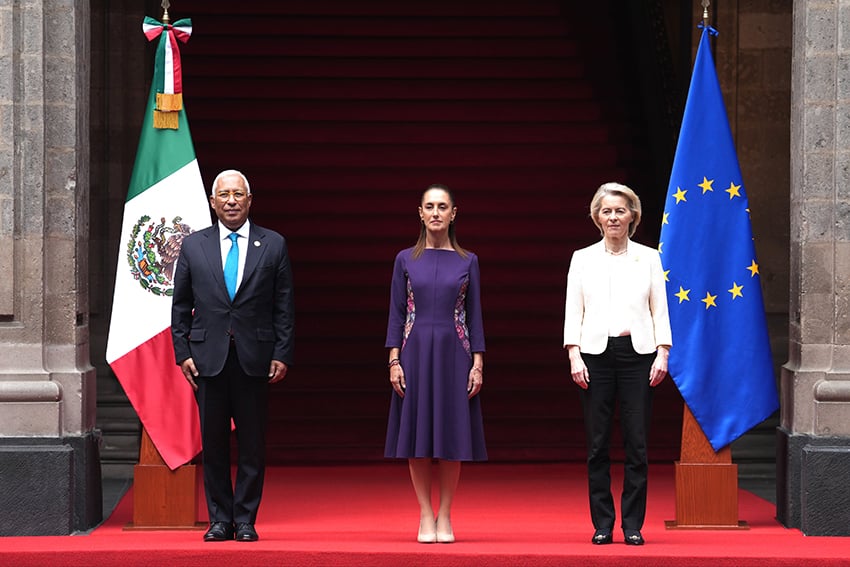
Earlier Friday morning, Ursula von der Leyen, president of the European Commission, and António Costa, president of the European Council, were welcomed by Sheinbaum with an official ceremony in the National Palace’s Courtyard of Honor.
The ceremony included renditions of the Mexican national anthem and the official anthem of the European Union.
Sheinbaum was accompanied by Foreign Minister Roberto Velasco, Interior Minister Rosa Icela Rodríguez, Finance Minister Édgar Amador and Economy Minister Marcelo Ebrard, among others.
Representing the EU were the High Representative for Foreign Affairs and Security Policy and Vice President of the European Commission, Kaja Kallas; the European Commissioner for Trade and Economic Security, Maroš Šefčovič; and the EU Ambassador to Mexico, Francisco André.
Comenzamos la 8ª cumbre #UEMéxico. Presidenta @Claudiashein gracias por su liderazgo y compromiso con el fortalecimiento de las relaciones entre México y la UE. Los acuerdos que cerraremos en CDMX son auténtica declaración geopolítica, una demostración de nuestro compromiso con… pic.twitter.com/yij41sy6QQ
— António Costa (@eucopresident) May 22, 2026
Ebrard said the reduction of more than 90% of the tariff lines would create an opportunity for Mexico to grow much faster with investments from the EU.
“There is a very large opportunity in agribusiness, the entire automotive industry, auto parts, electronics and advanced electronic components,” he said on Thursday. “The trends in our investments and trade today, including financial services, tell you where this is going.”
Trade between Mexico and the EU has risen by 75% in a decade, boosted by transport equipment, machinery, chemicals, fuels and mining products.
The EU was Mexico’s second-biggest export market after the United States last year and Mexico is the second largest importer of European agri-food products in Latin America.
With reports from Euro News, El Economista, Deutsche Welle, Excelsior, Euractiv and The Wall Street Journal