
The U.S. government imposed new tariffs on 80 countries effective on Friday, but Mexico escaped relatively unscathed.
Taxes on Mexican goods replace the 10% duty U.S. President Donald Trump dictated in February after the Supreme Court invalidated the broad-based tariffs he had applied last year. Those original replacement tariffs were valid for only 150 days, prompting Friday’s new levies.
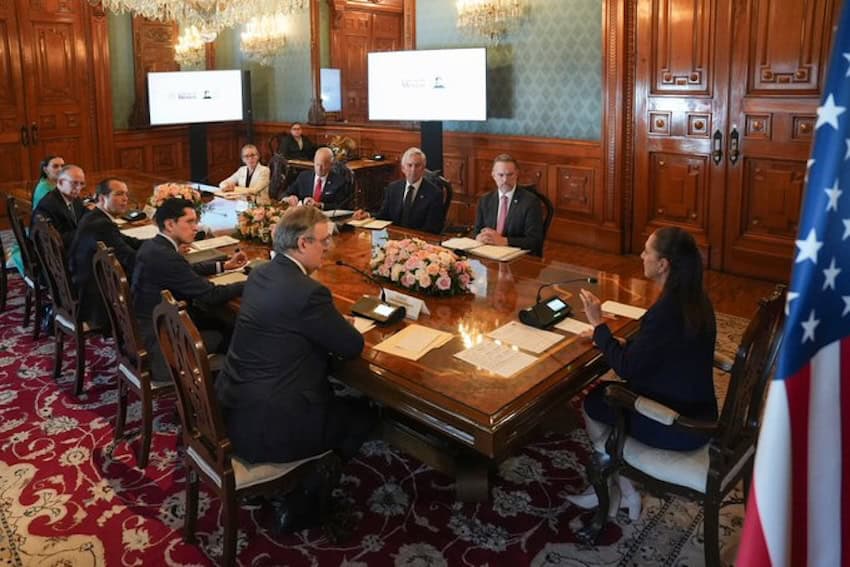
U.S. Trade Representative (USTR) Jamieson Greer informed President Claudia Sheinbaum of the pending decision during a Thursday morning meeting at the National Palace.
Afterward, Mexican Economy Minister Marcelo Ebrard explained that the 10% tariff does not affect approximately 80% of the products Mexico exports to the U.S.
“Mexican products that comply with the terms of the US-Mexico-Canada trade pact (USMCA) will remain tariff-free,” Ebrard said.
The other 20% involved previously established sectoral duties — including those applied to specific non-USMCA goods, steel and vehicles — that were already set at 10% and therefore will essentially be unchanged.
There is a possibility that Mexico could be subject to an “excess capacity” tariff — an obscure provision of a 1930 trade law that applies to countries that “put undue burdens on U.S. imports.” This is likely to be addressed during ongoing USMCA negotiations.

The new U.S. tariffs seek to address what the Trump administration claims are unfair trade practices in an effort to restore some of the rates struck down by the Supreme Court.
The USTR conducted investigations seeking to establish that some countries had failed to take steps to curb forced labor, with the alleged worst offenders now facing a 12.5% tariff rate. However, the forced-labor compliance requirements do not affect Mexico, Ebrard said.
Sheinbaum reiterated this news during her Friday morning press conference.
“All products we exported within the USMCA have zero tariffs, with the exception of steel, some vehicles and products exported outside the treaty,” she said. “Mexico remains exactly the same as we were a week ago.”
The US Trade Representative’s Mexico City agenda
In addition to meeting with Sheinbaum, Greer was in Mexico City to participate in bilateral talks as part of the ongoing review of the USMCA.
Greer and Ebrard discussed topics ranging from steel and aluminum and derivative products, automobiles, economic security, labor, agriculture and electronic payment services.
Sheinbaum said her meeting with Greer served as “an assessment of how far the talks have come, to learn more about what the U.S. is proposing, and to consider the timeline.”
With reports from El Economista, El Financiero and Atlantic Council