Three northern states are at risk of regressing to the red light “maximum” risk level on the federal government’s coronavirus stoplight system, health authorities said Friday.
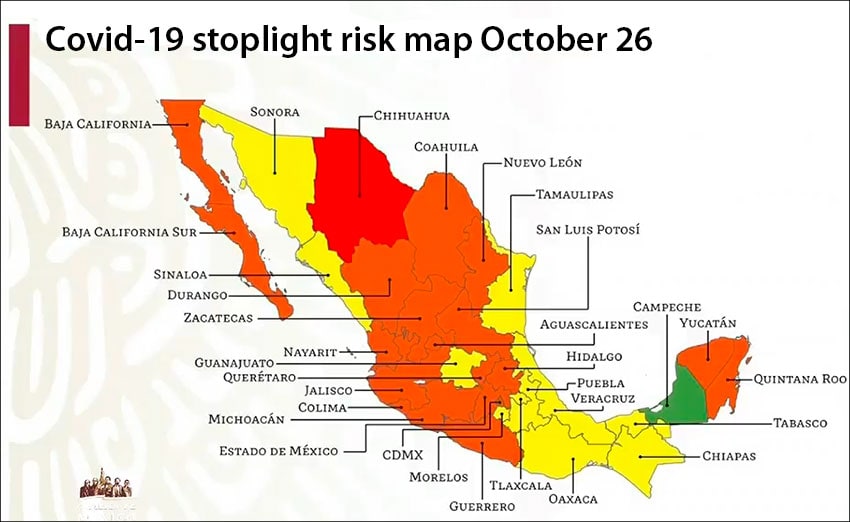
Presenting an updated stoplight map that will take effect Monday, federal health promotion chief Ricardo Cortés said that the orange light “high” risk states of Coahuila, Durango and Nuevo León will turn red if their coronavirus outbreaks don’t wane.
The Health Ministry announced at the start of this week that new case numbers had recently risen in those three states and five others including Chihuahua, which is the only red light state on the updated stoplight map.
As of Monday the coronavirus risk level will be orange light “high” in 19 states, an increase of two compared to the current number, and yellow light “medium” in 11, a decrease of three.
Five states will switch from yellow to orange on Monday. They are Baja California, Baja California Sur, San Luis Potosí, Quintana Roo and Michoacán.
They will join Aguascalientes, Mexico City, Coahuila, Colima, Durango, México state, Guerrero, Hidalgo, Jalisco, Nayarit, Nuevo León, Querétaro, Yucatán and Zacatecas, which are already orange light states.
The yellow light states as of Monday will be Sonora, Tamaulipas, Guanajuato, Veracruz, Puebla, Tlaxcala, Morelos, Chiapas, Tabasco, Oaxaca and Sinaloa.

The first nine states are already yellow and will remain at the same risk level for the next two weeks while Oaxaca and Sinaloa will make the switch back to the “medium” risk level after regressing to orange two weeks ago.
Campeche, which switched to green at the end of September, will maintain its “low” risk status for the next fortnight while Chihuahua, for the time being at least, will be the sole red light state.
The Health Ministry uses 10 different indicators to determine the stoplight color allocated to each state including the Covid-19 effective reproduction rate (how many people each infected person infects), the weekly positivity rate (the percentage of Covid-19 tests that come back positive) and hospital occupancy levels.
It also recommends coronavirus restrictions for each risk level but several states ease and tighten rules according to their own criteria rather than that of the federal government.
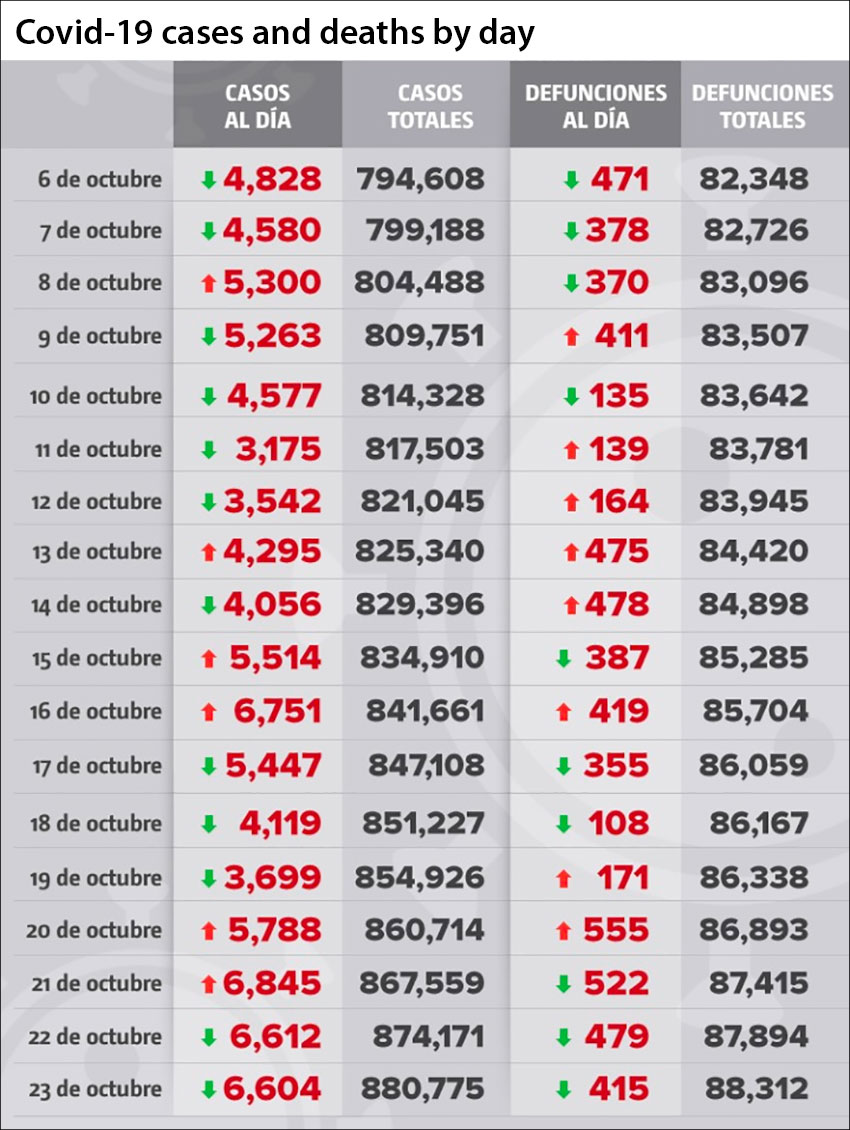
Prior to the presentation of the new stoplight map at Friday night’s coronavirus press briefing, Health Ministry Director of Epidemiology José Luis Alomía announced that Mexico’s accumulated case tally had increased to 880,775, an increase of 6,604 cases compared to Thursday.
It was the third consecutive day that the single-day tally of new cases was above 6,000. The Health Ministry estimates that there are currently 51,532 active cases across the country.
The official Covid-19 death toll rose to 88,312 with an additional 418 fatalities registered. Mexico ranks fourth in the world for total Covid-19 deaths and 10th on a per capita basis with 70 fatalities per 100,000 inhabitants, according to Johns Hopkins University.
The per capita rate here is slightly higher than that of the United States, which has recorded 68.5 Covid-19 deaths per 100,000 inhabitants.
With a new wave of coronavirus infections possibly looming, Deputy Health Minister Hugo López-Gatell was asked whether the federal government would change its strategy to combat the pandemic.
The coronavirus point man, who said this week that stricter measures are needed to control the spread of the virus, told reporters that wasn’t necessary because the government has planned for a range of different scenarios.
“The strategy is the general plan and it already considers the possibility of having a favorable scenario, with a reduction of cases, hospitalizations and deaths, as well as the least favorable [scenario]. All scenarios … were considered from the beginning of the pandemic,” López-Gatell said.
“It’s not about changing the strategy but rather implementing specific interventions that the strategy provides for when the scenario changes.”
The government has been heavily criticized for not testing widely for Covid-19, not enforcing a strict lockdown early in the pandemic and not being forceful enough in its promotion of face masks.
López-Gatell, who has been dismissive of the value of widespread testing, gave no indication that the government plans to ramp up testing and stressed that it would not seek to implement restrictions with force.
“We need to maintain harmony and act by persuasion, not social coercion,” he said.
Source: El Universal (sp), Milenio (sp)