Poverty has increased to record levels this year due to the economic impact of the coronavirus pandemic.
Between the first quarter of the year and the third, the percentage of the working-age population considered poor increased to 44.5% from 35.7%, according to the national social development agency Coneval. It is the highest percentage since 2005 when Coneval began keeping comparable records.
People are deemed to be living in poverty if their monthly income is insufficient to purchase a canasta básica, a basic selection of foodstuffs including beans, rice, eggs, sugar and canned tuna. The monthly cost of the canasta is about 1,700 pesos (US $84) in urban areas and 1,200 pesos in rural parts of the country.
The increase in poverty is attributed to the loss of jobs, a reduction in incomes and an increase in the price of the goods that make up the canasta básica.
Over a million formal sector jobs were lost due to the pandemic, although a recovery is now underway, and millions more who work in the vast informal sector also became unemployed or saw their incomes drop or dry up completely. Wages have decreased 6.7% in real terms compared to 2019 and people’s purchasing power declined 12.3% on average between the first and third quarters of 2020.
Annual inflation was 3.9% in the third quarter, 0.6% higher than in the same period of 2019. Higher prices for fruit and vegetables, which are included in the canasta básica, are partially responsible for higher inflation.
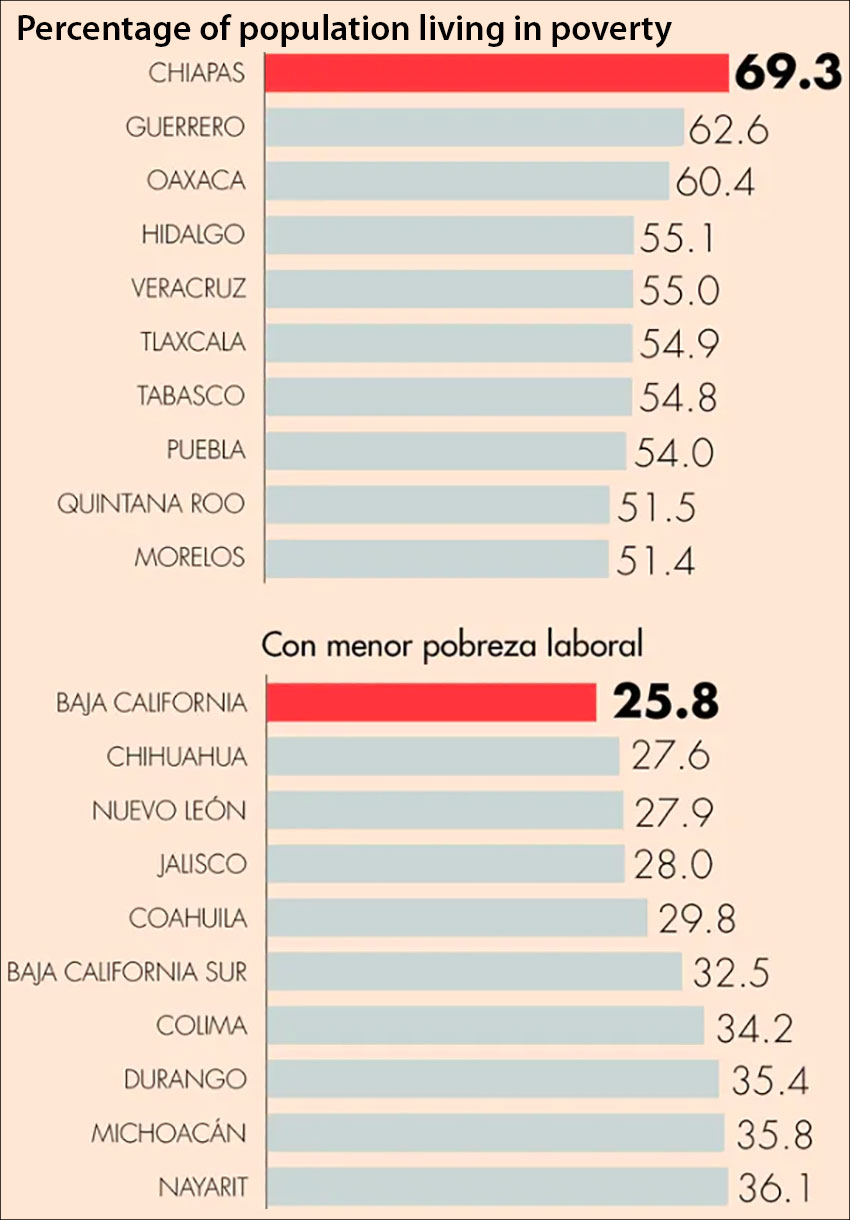
Among Mexico’s 32 states, Chiapas has the highest levels of poverty among working-age people, according to Coneval. In the third quarter of the year, 69.3% of people in the southern state earned incomes below the value of the canasta básica.

Guerrero, Oaxaca, Hidalgo and Veracruz had the next highest poverty levels at 62.6%, 60.4%, 55.1% and 55%, respectively.
Poverty has increased across the country this year but Quintana Roo, which is heavily dependent on tourism, saw the biggest spike. Just over half the residents of the Caribbean coast state – 51.5% – were living in poverty in the third quarter, a 23.1% increase compared to the first quarter.
Mexico City saw the next biggest increase, with poverty levels spiking 16.7% to 45.1%, followed by Tabasco, where the percentage of poor residents rose 15.9% to 54.8%.
Coneval also determined that income inequality has significantly increased this year. In the third quarter of last year, the average income of the richest 20% of the population was 34.3 times higher than the average wage of the poorest 20%.
In the third quarter of 2020, the average salary of the richest 20% was 146.3 times higher that that of the poorest quintile, Coneval found.
There is also a significant difference in the incomes earned by indigenous and non-indigenous Mexicans.
In the third quarter, the average income of residents in mostly non-indigenous municipalities was 4,253 pesos (US $211) per month whereas in mainly indigenous municipalities it was just 1,999 pesos (US $99).
Average incomes declined 218 pesos between the first and third quarters in mainly indigenous municipalities, while they only fell 155 pesos in non-indigenous ones.
Source: El Universal (sp)