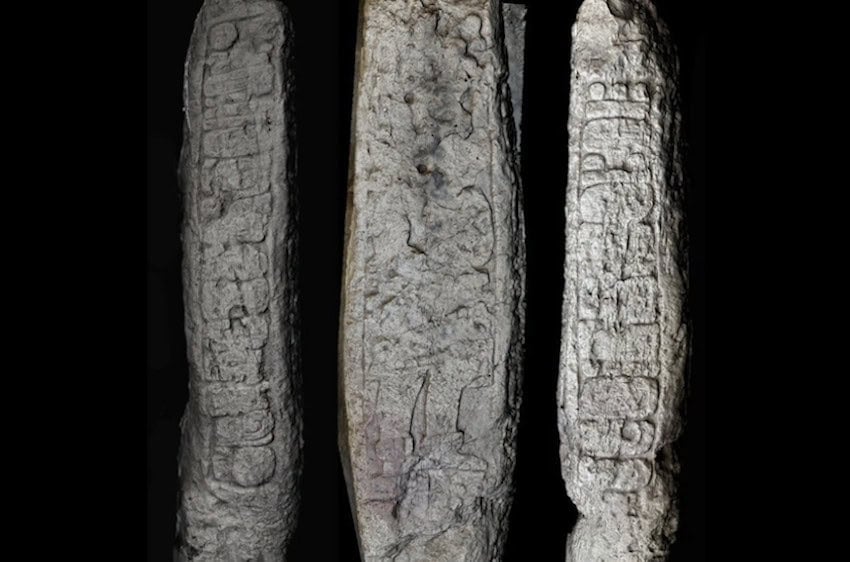
A new study of an ancient monument using high-resolution 3D scanning technology reveals that the stela contains the oldest documented Long Count inscription in the Maya Lowlands, prompting a re-examination of Maya history.
By virtue of the new information, it is now understood that complex Maya writing and established dynastic lineages began much earlier than previously thought.
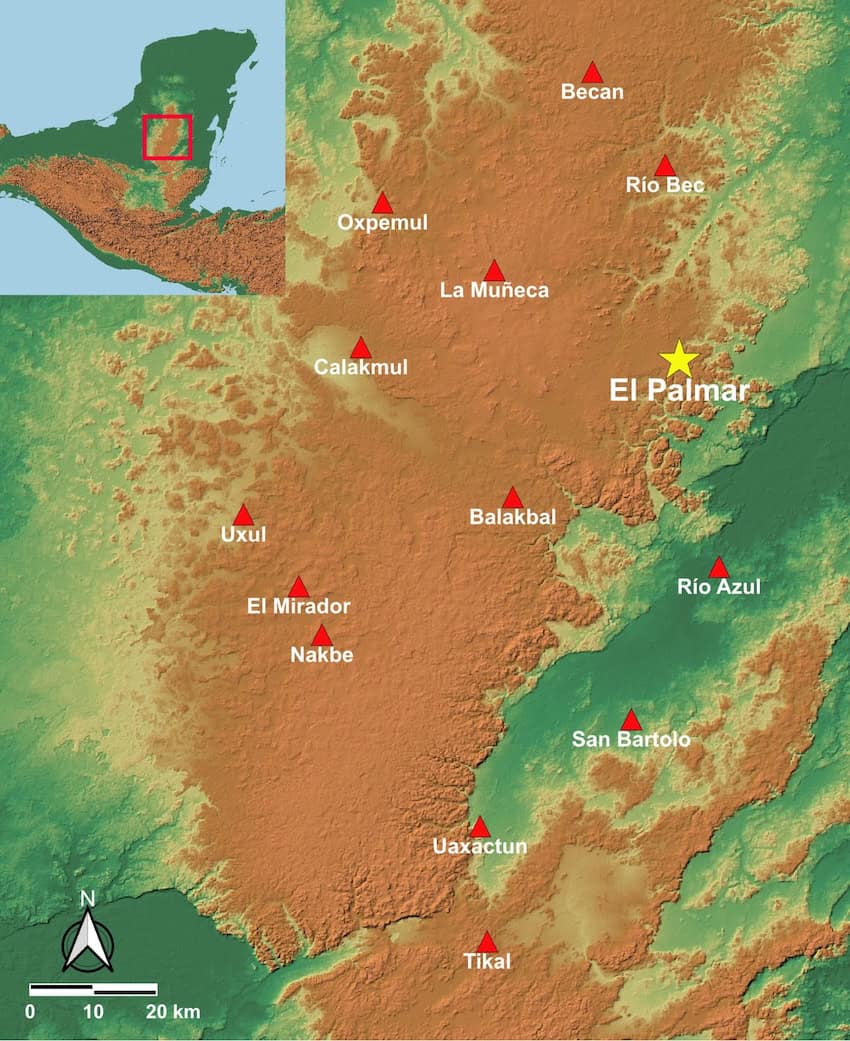
Stela 46 is a massive limestone block (nearly 3 meters tall) featuring the carving of a Maya ruler and hieroglyphs. The date on the monument — which translates to Aug. 31, 180, CE — makes it the earliest Long Count date recorded in the Maya Lowlands, predating the previous record holder (Stela 29 at Tikal, Guatemala) by 112 years.
The main face of the monolith features a sovereign adorned with a feathered headdress holding the head of what is likely a jaguar, a figure of profound symbolic significance that the ancient Maya associated with the underworld and various ritual contexts of power.
The 3D scans reveal that the king known as Ajaw K’al Ubaah came to power in A.D. 131. Forty-nine years later, he performed a royal ritual before the stela and had the events carved into its surface, including an inscription corresponding to the date 8.7.0.0.0 of the Long Count.
The Maya Long Count is an ancient, non-repeating calendar system used by the Maya to track absolute time and record historical events. Unlike the repeating cyclical calendar we use today, the Long Count uniquely identifies every single day by counting the total number of days that have passed since the mythical creation date which corresponds to Aug. 11, 3114 BCE.
Typically, Long Count inscriptions record dates without context, but Stela 46 links the calendar directly to royal succession and ritual, showing how Maya kings used time itself as an instrument of political authority.

As it is dated so early, the monument suggests that some cities in the Maya Lowlands already had power structures capable of promoting the construction of stelae and the production of complex hieroglyphic texts during the first centuries of our era.
Stela 46 was discovered decades ago at the El Palmar archaeological site in the state of Campeche, a location that preserves numerous stelae and sculpted monuments that have allowed for the reconstruction of part of the region’s political history.
The stela was moved to a storage facility in 1985 as protection against looters. Researchers knew of its early inscriptions, but the surface was too eroded to fully read using conventional methods.
It was only after researchers were able to use photogrammetry and high-resolution 3D scanning — devices that are accurate to a tenth of a millimeter, producing models that could be illuminated from multiple angles to reveal details that conventional photography missed.
The inscriptions were then decoded and the findings published in the academic journal, Ancient Mesoamerica, on June 5.
After undergoing extensive conservation, Stela 46 has been on permanent display at Campeche’s Museo de Arquitectura Maya (in Baluarte de la Soledad) since January.
With reports from Historia National Geographic, La Brujula Verde and Ancient Mesoamerica