Archaeologists discover 16th-century cemetery in Chapultepec Park

Archaeologists have found a cemetery in Mexico City’s Chapultepec Park that dates from less than 100 years after the Spanish conquest of Tenochtitlán.

The cemetery was discovered in an archaeological rescue process during building work on the Chapultepec gardens and scenic pavilion. After an initial sounding pit revealed evidence of human remains, a full dig was organized to excavate the burial ground.

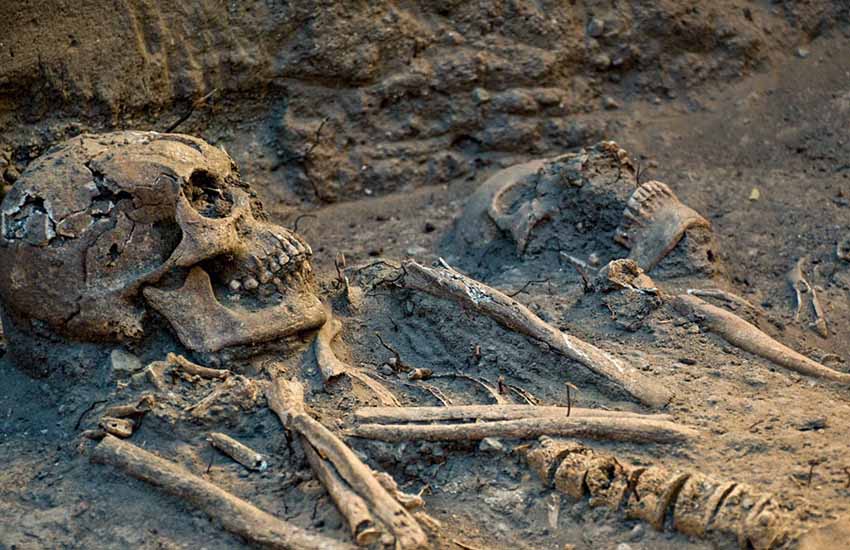
The National Institute of Archaeology and History (INAH) said that 21 skeletons were found in the cemetery, including two infants. The bodies had been buried at three different times, all  after Tenochtitlán’s fall in 1535. 

Some were buried in the Catholic style and others according to Mesoamerican traditions, the researchers said.

“We propose that this collective burial corresponds to a cemetery of the early viceroyalty (A.D. 1521–1620) because it shows the transition from pre-Hispanic funeral customs to those implemented with the arrival of the Spaniards and their religious system,” said dig coordinator, María de Lourdes López Camacho.

She explained that most of the skeletons were found facing east, likely alluding to the Christian belief in resurrection. But two were buried in a bent and lateral position, as in Mesoamerican rituals, and another two were found carrying obsidian objects of pre-Hispanic origin.

This led the archaeologists to believe that some of the dead were European and others Mexica. Tests revealed they had suffered from various conditions, including malnutrition, infection and inflammation in the bones.

This is not the first time that human remains of this period have been found in Chapultepec Park. In 2005, archaeologist María Guadalupe Espinosa Rodríguez excavated a 16th-century burial ground near the Garden of the Lions — an area previously occupied by the church of the indigenous village of San Miguel Chapultepec.

Excavations are continuing to the south and east of the newly discovered site.

With reports from El País

Have something to say? Paid Subscribers get all access to make & read comments.
Chichén Itzá

A history of the Maya: The myth of ‘collapse’

2
Maya culture never collapsed. It simply adapted to changing circumstances in the centuries leading up to the Spanish colonization of Mexico.
Manzanillo, Colima, México, 13 de marzo de 2026. La doctora Claudia Sheinbaum Pardo, presidenta Constitucional de los Estados Unidos Mexicanos en conferencia de prensa matutina, “Conferencia del Pueblo” desde Colima. La acompañan Indira Vizcaíno Silva, gobernadora Constitucional del Estado de Colima; Omar García Harfuch, secretario de Seguridad y Protección Ciudadana (SSPC); Raymundo Pedro Morales Ángeles, secretario de Marina (Semar); Bulmaro Juárez Pérez, divulgador de lenguas originarias, presentador de la sección “Suave Patria”; Ricardo Trevilla Trejo, secretario de la Defensa Nacional (Sedena); Jesús Antonio Esteva Medina, secretario de Infraestructura, Comunicaciones y Transportes; Bryant Alejandro García Ramírez, fiscal general del Estado de Colima; Fabián Ricardo Gómez Calcáneo; Rocío Bárcena Molina, subsecretaria de Desarrollo Democrático, Participación Social y Asuntos Religiosos de la Secretaría de Gobernación; Efraín Morales López, director general de la Comisión Nacional del Agua (Conagua); Marcela Figueroa Franco, secretaria ejecutiva del Sistema Nacional de Seguridad Pública (SESNSP) y Guillermo Briseño Lobera, comandante de la Guardia Nacional (GN). Foto: Saúl López / Presidencia

Mexico’s week in review: Congress deals Sheinbaum her first legislative defeat

1
The week of March 9 in Mexico was marked by standoffs between allies in Congress and adversaries at the airport. Here's what you missed.
A soldier displays seized handguns

The US and Mexico, growing together and growing apart: A perspective from our CEO

1
From a historic drop in homicides to opposite bets on electric vehicles, Mexico News Daily's CEO breaks down where the U.S. and Mexico are converging — and where they're not.
BETA Version - Powered by Perplexity