
Why would a woman decide to fake a pregnancy and see it through to its ultimate consequences?
This is the central question that Chilean director Maite Alberdi — an Oscar nominee for “The Mole Agent” and “The Eternal Memory” — sets out to answer in “Un Hijo Propio,” or “A Child of My Own,” a Chilean-Mexican coproduction and Alberdi’s first project shot outside her home country.
Recently released on Netflix, “A Child of My Own” chronicles real events that took place in Mexico City in 2009.
Great Mexican television series that have returned in 2026 (and two more we can’t wait to see)
The story follows Eleonor Alejandra Marín Mendoza, a young woman who pretends to be pregnant for months and ultimately kidnaps a newborn baby to sustain her lie. It is a crime that still shocks Mexico, and for which Marín served more than 13 years in the Santa Martha Acatitla prison.
Unlike conventional true crime, which often revels in sensationalism, this 96-minute documentary takes a more human and intimate approach. Through a structure that combines reenactments and real testimonies, the film chooses to explore the sociological and psychological causes of the event.

Or, as Alberdi said in an interview with Marie Claire, “I was never interested in making a film focused solely on what happened, but rather in trying to understand the ‘whys’: what personal, family, and social context lies behind their decisions.”
Widely acclaimed by international critics, “A Child of My Own” is already emerging as a strong favorite to represent Mexico at the upcoming Goya and Oscar awards.
If you haven’t added it to your streaming list yet, here are four compelling reasons not to miss it.

1. A documentary that surpasses any fiction
The first reason to get hooked on this documentary is its plot: a true story that captivates with its almost unbelievable scope.
The film traces the married life of Eleonor Alejandra Marín Mendoza, also known as Ale, with a sensitive performance by Ana Celeste Montalvo in the dramatized segments, and portrays a young woman whose identity has been completely reduced to her reproductive role. Somewhere between the absurd and the tragic, we witness a farce that defies all logic.
Like many Mexican women, Alejandra always dreamed of a traditional home and a family full of children. With that goal in mind, she marries Arturo Calderón Gamiño (played by Armando Espitia) at a young age, but her plans are thwarted when she suffers several miscarriages.
As if that weren’t enough, she is forced to cope with an increasingly hostile environment, especially since her husband blames her for the losses and rejects the idea of adoption.
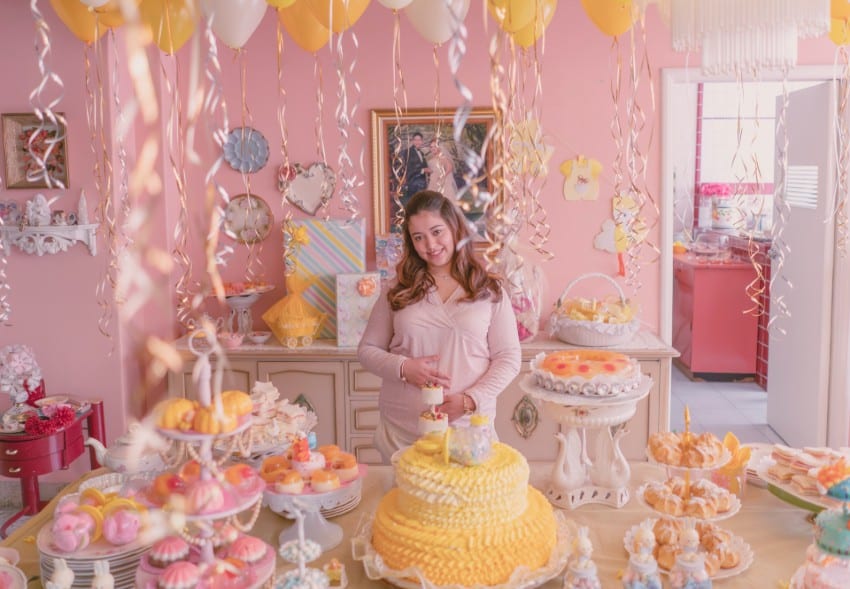
Under pressure from her suffocating family and her own desire, Alejandra hides her miscarriage and pretends she’s still expecting a baby. To keep up the charade, she drastically changes her routine: she gains weight to simulate a growing belly, obtains fake ultrasound images at her workplace and organizes her own baby shower.
Against all odds, her scheme seems to finally come to fruition when she meets a pregnant woman willing to give up her newborn, and they reach an informal agreement. But, as is often the case with lies, the situation eventually spirals out of control, and the documentary takes a surprising turn.
Revealing exactly what happens would spoil the key plot twists. What we can tell you is that Alberdi dissects the anatomy of the farce, showing how a lie and a mental health crisis escalate into a serious crime.
One of the documentary’s more striking moments comes from Alejandra, who sums up her tragedy: “I was afraid that [Arturo] would leave me because I hadn’t been able to become a mother, and that I would be singled out and judged. In the end, I was judged for something much worse.”
2. A narrative structure that breaks the mold
Another reason to watch “A Child of My Own” is its narrative structure: a bold blend of dramatizations and real-life testimonies. Overall, this project differs from Alberdi’s previous works in that it is divided into two distinct sections that play with the viewer’s expectations.
The film begins with the casting call to select the actress who will play Alejandra. From there, the first half unfolds as a traditional fictional drama. Through the use of professional actors and meticulous staging, this section reconstructs the events from the protagonist’s perspective. It’s a practical tool for understanding how social pressure and the trauma of failed pregnancies led her to mental dissociation and the creation of a parallel reality in front of her family.
Among them are Alejandra herself, her husband Arturo, Judge Taissia Cruz Parcero, and Mayra Navarro, the mother of the abducted child. The film’s hybrid nature requires the viewer to confront a woman in crisis before unpacking the structural causes of the problem.
3. Alberdi’s judicious direction
The third reason to watch this documentary is Alberdi’s judicious direction, as she intelligently distances herself from the sensationalism that often plagues the true crime genre. Instead of seeking visual impact or exploiting the scandal, the Chilean filmmaker’s camerawork stands out for its maturity, compassion and respect.
Alberdi masterfully walks a fine line: she films her subject with profound humanity, yet without ever justifying the crime or glossing over the gravity of the theft. The director delivers a well-rounded work that trusts the viewer, demonstrating that documentary film is not meant to condemn, but to help us understand the most complex dimensions of the human condition.
4. An important social commentary on motherhood
Historically, Latin American society — and especially Mexico — has demanded that women fulfill the maternal role. When a woman does not have children, it is common for those around her to judge her and make her feel incomplete or dysfunctional.
“A Child of My Own” shows the consequences that this cultural mandate can entail. Without resorting to simplistic judgments, the documentary analyzes the reproductive expectations placed on women.
Rather than simply recounting the kidnapping, the film strives to shed light on the cultural forces and the familial and institutional negligence, such as the lack of psychological support following pregnancy loss, that contributed to the crime.
In this case, Alejandra resorts to lying to protect herself from the constant rejection of those around her and from her own sense of failure as a woman and a wife.
“Of course, Alejandra committed a crime; of course, she had to go to prison. But at the same time, she is a victim of the system. She is a victim of her family,” Alberdi told the BBC in an interview.
Undoubtedly, one of the greatest strengths of this film lies in its ability to shake the viewer with pressing questions: Why is a woman’s worth still reduced to her reproductive capacity? And, above all, what are we doing to change this collective reality?
Carolina Alvarado is a Venezuelan journalist who has devoted much of her career to creative writing, university teaching and social work. She has been published in Lady Science, Latina Media, Global Comment, Psiquide, Cinetopic, Get Me Giddy and Reader’s Digest, among others.