We are just days away from the 2026 FIFA World Cup Play-Off Tournament. In Mexico, football is a powerful social engine: kids play it during recess, club loyalties are passed down across generations and stadiums — the “homes” of those teams — take on a life beyond sport. They are not just venues for games, but historic sites where family memories and national stories overlap.
The most important of these in Mexico City is Estadio Azteca. Built in the 1960s, it was
conceived to project, to a global audience, the image of a modern and prosperous
country that still took its history seriously. The man responsible for creating a stadium so
loaded with meaning was Pedro Ramírez Vázquez, a quintessential midcentury
polymath: erudite, socially minded and determined to use architecture not just to
produce buildings, but to strengthen a shared culture.
A boy of books and streets
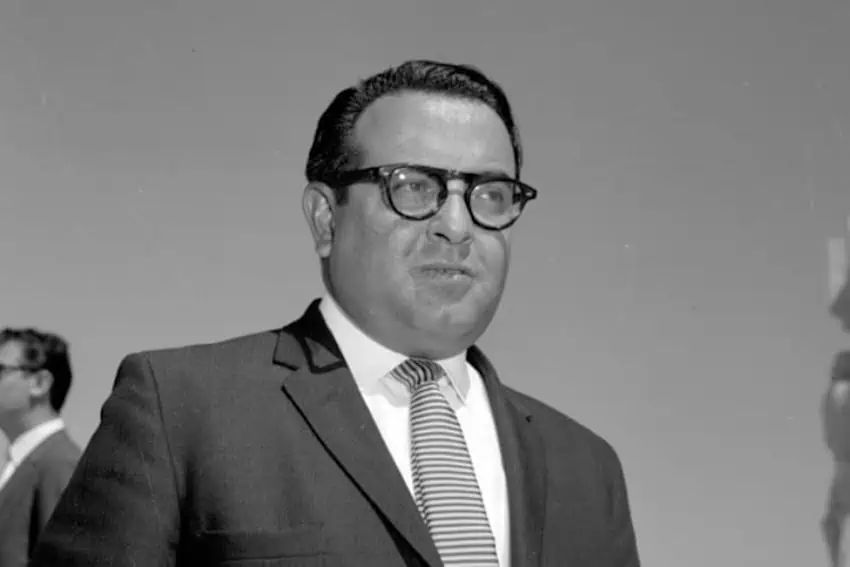
Pedro Ramírez Vázquez was born in Mexico City in 1919, one year before the Mexican
Revolution was officially declared over. He grew up in the historic center, where his
father ran a bookshop, watching the capital change around him as new neighborhoods
appeared and the urban landscape shifted. At the same time, he was surrounded by
books, which sharpened his sense that ideas and culture could be engines of social
change.
As a teenager, he travelled to Europe, encountering the continent’s architecture firsthand.
But it was the Acropolis in Athens that truly captivated him and nudged him towards
architecture studies at UNAM. From his thesis onward, Ramírez Vázquez leaned
towards social architecture. He was less interested in single-family homes than in public
buildings and, above all, in urbanism – how to organize collective space so that cities
are habitable and inclusive rather than mechanisms of segregation.
From public works to citymaking
That vocation soon translated into public service. Early on, Ramírez Vázquez joined the
federal schoolbuilding program and helped design a system of rural
“houseclassrooms” that allowed thousands of municipalities to have a school at the
center of town — spaces that functioned both as classrooms and community meeting
points.
In Mexico City in the 1950s, he coordinated the Urbanism Commission of the National
Economic and Social Planning Council, tasked with diagnosing living conditions and
proposing planning measures to improve life in the capital. Markets, clinics,
social security medical units and public offices were redesigned under the notion of
“service architecture”, a practical, robust language that many residents still recognize in
their neighbourhoods today.
During the 1970s, he helped found and briefly served as the first rector of the
Metropolitan Autonomous University (UAM), envisioned as a multicampus public
university with trimester calendars and interdisciplinary programs embedded in
different areas of the city. By the early 1980s, he became Secretary of Human
Settlements and Public Works, where he helped push through the National Urban
Development Plan and coordinated state and municipal plans across the country —
putting into policy the idea that every city should have a framework for land use, growth
and infrastructure.

Three Ramírez Vázquez masterpieces
Estadio Azteca
Estadio Azteca will become the only stadium in the world to host three World Cups, but
its architectural story is just as remarkable. Built between 1962 and 1966 on volcanic
ground in the south of the city, it replaced the conventional rectangular stadium with a
continuous elliptical bowl, eliminating blind corners and improving sightlines.
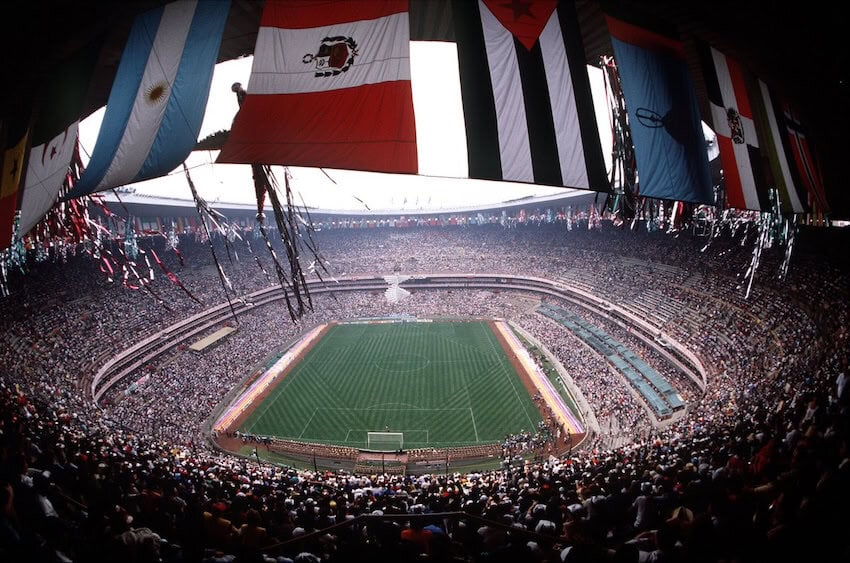
The design used unusually advanced isoptic studies for its time — horizontal, vertical
and diagonal visibility — so that the view of the pitch would be clear from almost any
seat, an effort recognized by FIFA with a medal. Seating distances were calibrated so
that even the furthest fan stayed within a controlled range from the center spot, while a
dense network of ramps and concourses allowed more than 100,000 people to enter
and leave with fewer bottlenecks. The result is a concrete giant that feels surprisingly
“democratic”: from the cheap seats to the corporate box, everyone sees the same
game.
Structurally, the Azteca rose on volcanic ground that required massive earthworks: more
than 63,000 square meters were blasted and some 180 million kilograms of rock
excavated, consuming much of the original budget and forcing a redesign to build
higher above ground. Around 42,000 cubic meters of concrete (close to 100,000 tons)
and 8,000 tons of reinforcing steel were used to create a continuous ring of cantilevered
stands with no interior columns blocking the view. Its brutalist language — exposed
concrete, massive columns, clear geometric forms and a projecting metal roof — placed
it at the forefront of modern movement sports infrastructure in Latin America.
National Museum of Anthropology

A short ride away in Chapultepec Park, the National Museum of Anthropology shows a
different side of his work. Conceived in the early 1960s under President Adolfo López
Mateos, the museum was meant to leave visitors “proud to be Mexican” by presenting
pre-Hispanic cultures and Indigenous diversity in a modern setting.
Designed by Ramírez Vázquez with Jorge Campuzano and Rafael Mijares, it opened in
1964, after just 19 months of construction. Galleries ring a vast central courtyard
covered by the famous “umbrella,” a dramatic concrete and steel canopy resting on a
single column that gives shade and shelter from rain without enclosing the space. The
building avoids copying archaeological styles, instead reusing elements like plazas,
patios and platforms to evoke pre-Hispanic spatial ideas in a modern vocabulary.
Circulation between galleries pushes visitors back into the courtyard again and again,
turning it into a “break” in the route and a constant reminder of the connection between
the collections and the surrounding Chapultepec park.
Basilica of Guadalupe
In the north of the city, the new Basilica of Guadalupe completes the trilogy. By the
1960s, the old baroque basilica at Tepeyac was structurally damaged and clearly
inadequate for the millions of pilgrims arriving each Dec. 12, making a new
sanctuary urgent. The commission required a solution that combined large capacity,
structural safety on unstable ground, and symbolic continuity with the historic ensemble
at the Villa.
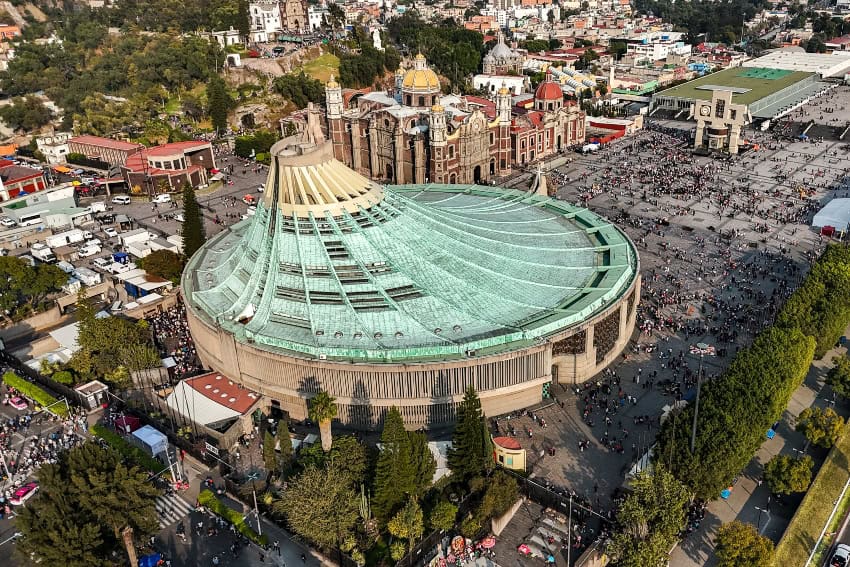
The circular basilica, inaugurated in 1976, was designed by a team led by Ramírez
Vázquez and José Luis Benlliure, together with Alejandro Schoenhofer, Friar Gabriel
Chávez de la Mora and Javier García Lascuráin. Its sweeping concrete and copper roof
is supported by a hanging structure system that allows long spans without interior
columns, so that most worshippers have a clear view of the image of the Virgin. Inside,
around 10,000 people can be seated, and with upper chapels and the open atrium, the
complex can host up to 50,000 on peak days. As in the stadium and the museum,
Ramírez Vázquez works here with flows, vistas and big crowds — only this time, the
ritual is religious rather than civic or sporting.
The Olympic design that became an identity
One last piece completes the picture. In 1966, Ramírez Vázquez was appointed
president of the Organizing Committee for the 1968 Olympic Games, with just 27
months to prepare. Beyond stadiums and venues, he pushed for an integrated design
program that would cover logo, typography, signage, posters and even a Cultural
Olympiad, bringing together architecture, urban design and graphic communication.
Working with designers such as Eduardo Terrazas, Lance Wyman and Beatrice
Trueblood, he helped shape the now iconic “México 68” identity, with its concentric line
wordmark, sport pictograms and color-coded signage system. Scholars read that
program as a form of cultural diplomacy: a way to present Mexico as modern and
technologically sophisticated while still rooted in Indigenous and popular visual
traditions.
Closing
As the world tunes in to watch the 2026 FIFA World Cup from Mexico City, Estadio Azteca will appear on millions of screens as a familiar icon: the place where Pelé and Maradona
were crowned, a concrete bowl still roaring after six decades. Behind that image stands
Pedro Ramírez Vázquez, an architect who helped design not only a stadium, but also
the museum where Mexico narrates its past, the basilica where it gathers around the
Virgin, the schools and markets that anchor everyday neighborhoods, and even the
visual language of one of the twentieth century’s most influential Olympic Games.
For World Cup visitors, following his trail — from the Azteca to the Museum of
Anthropology, from the Basilica to the ghosts of México 68 — is a way of seeing how one
architect’s ideas about crowds, space and collective ritual still shape how Mexico
moves, believes and celebrates today.
Maria Meléndez writes for Mexico News Daily in Mexico City.