Mexico is one of the world’s most biodiverse countries, hosting more than 10% of the world’s known species on just 1.5% of the planet’s territory, as Mexico News Daily reported in August.
There is also ample linguistic diversity in Mexico, a country with 68 surviving Indigenous languages, according to the national statistics agency INEGI.
Which of those Indigenous languages have the highest numbers of speakers? Which states have the highest proportion of speakers of Indigenous languages among their residents?
You’ll find the answers to both those questions in this “Mexico in Numbers” article, whose data is derived from INEGI’s report on the results of the 2025 Intercensal Survey.
Mexico’s most-spoken Indigenous languages
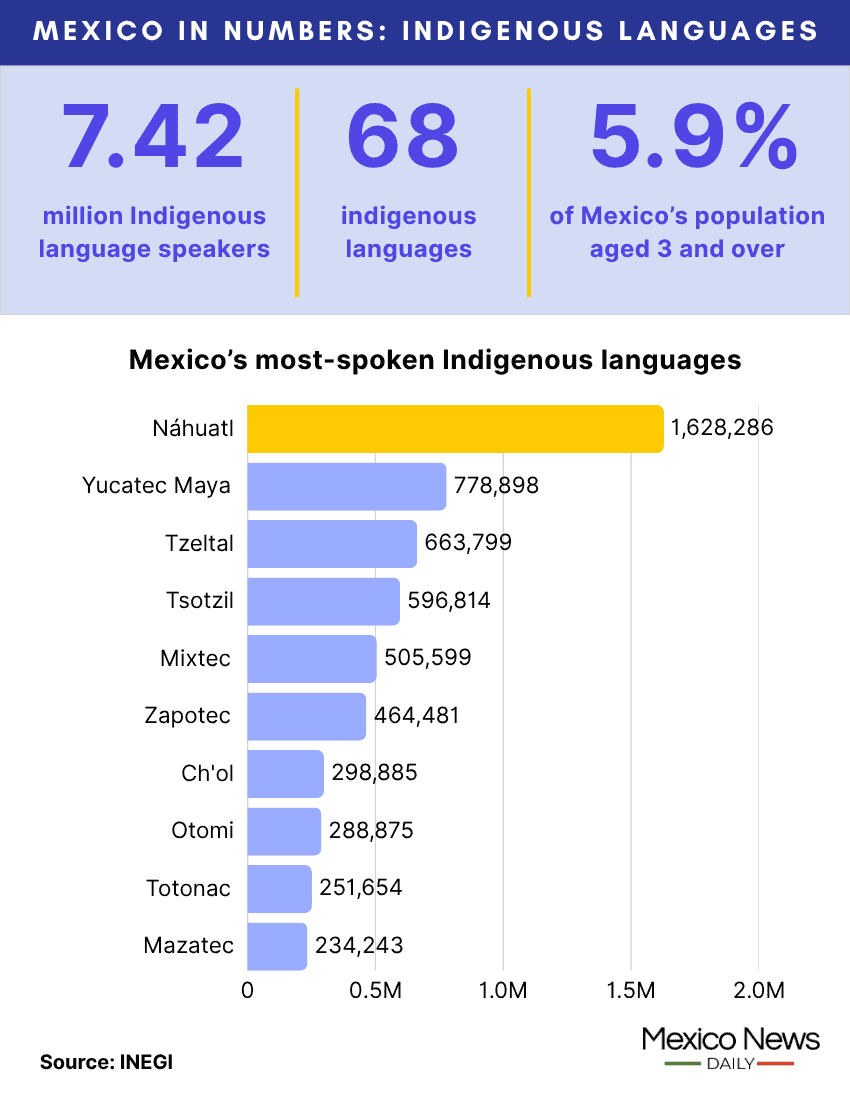
The 10 Indigenous languages listed below have the highest number of speakers in Mexico.
INEGI counted speakers of these languages age three and above. The area or areas of Mexico where each language is mainly spoken appears in parentheses.
- Náhuatl (central and eastern Mexico): 1,628,286 speakers
- Yucatec Maya (the Yucatán Peninsula): 778,898 speakers
- Tzeltal (Chiapas) 663,799 speakers
- Tsotzil (Chiapas): 596,814 speakers
- Mixtec (Oaxaca, Guerrero, Puebla): 505,599 speakers
- Zapotec (Oaxaca, Veracruz): 464,481 speakers
- Ch’ol (Chiapas, Tabasco, Campeche): 298,885 speakers
- Otomi (central Mexico): 288,875 speakers
- Totonac (Veracruz, Puebla): 251,654 speakers
- Mazatec (Oaxaca, Puebla, Veracruz): 234,243 speakers
All told, there were 7.42 million Indigenous language speakers in Mexico in 2025, according to INEGI. That figure accounts for 5.9% of the national population age three and over.

About nine in 10 Indigenous language speakers also speak Spanish, according to the results of the 2020 census.
In 2025, speakers of the 10 most-spoken Indigenous languages accounted for 77% of all Indigenous language speakers in Mexico. Speakers of the five most-spoken Indigenous languages accounted for 56.2% of all Indigenous language speakers in Mexico.
Almost 22% of all Indigenous language speakers speak Náhuatl, the language spoken by the Mexica inhabitants of Tenochtitlán.
Chiapas and Oaxaca have the highest proportion of Indigenous language speakers
According to the 2025 Intercensal Survey results, 29% of residents of both Chiapas and Oaxaca speak an Indigenous language.
Yucatán, where 21.4% of residents speak an Indigenous language, was the only other state with a share above 20%.
Rounding out the top ten states with the highest shares of speakers of Indigenous languages were:
- Guerrero: 15.4%
- Hidalgo: 11.2%
- Quintana Roo: 11%
- Campeche: 9.8%
- Puebla: 9.2%
- Veracruz: 8.3%
- San Luis Potosí: 8.3%
Speakers of Indigenous languages accounted for less than 1% of the population in eight states:
- Aguascalientes: 0.2%
- Coahuila: 0.2%
- Guanajuato: 0.2%
- Zacatecas: 0.4%
- Jalisco: 0.6%
- Colima: 0.7%
- Sinaloa: 0.8%
- Tamaulipas: 0.9%
More than 24 million people in Mexico consider themselves Indigenous
According to INEGI’s Intercensal Survey result, just over 24.2 million people in Mexico consider themselves Indigenous. That number represents 18.6% of Mexico’s total population in 2025, which was just over 130.9 million.
Among people age three and over who consider themselves Indigenous, 29.5% speak an Indigenous language, according to INEGI.
“The remainder identified as Indigenous based on their identity, cultural belonging, history, or traditions, even though they did not speak any Indigenous language,” INEGI said.
In its 2025 Intercensal Survey report, the statistics agency also said that 2.1 million people in Mexico consider themselves afromexicanos (Afro-Mexicans) or afrodescendientes (people of African descent). That number accounted for 1.6% of Mexico’s total population in 2025.
Among Afro-Mexicans age three and above, 8.7% speak an Indigenous language, according to INEGI.
By Mexico News Daily chief staff writer Peter Davies (peter.davies@mexiconewsdaily.com)