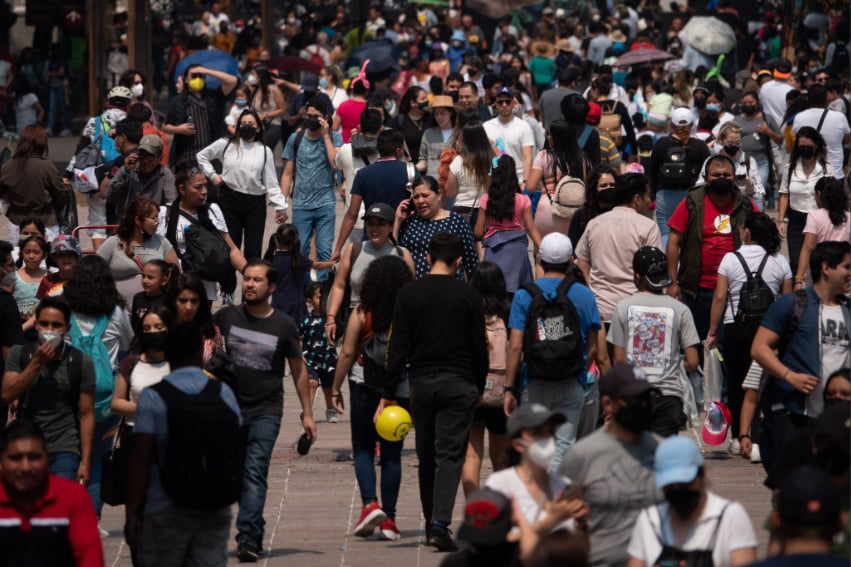
Mexico’s population was just over 130.9 million in late 2025, an increase of almost 4% compared to five years earlier, according to the National Institute of Statistics and Geography (INEGI).
The estimated population figure is among the findings of INEGI’s 2025 Intercensal Survey, conducted last October and November at more than 7.3 million homes across Mexico.
Among the other key findings of the survey — whose results were published on Tuesday — are that Mexico’s population growth has slowed, the median age of the population has risen and the fertility rate has declined.
Mexico’s population approaches 131 million
INEGI reported that Mexico’s population was 130,911,314 (130.91 million) in late 2025.
That figure represents an increase of 3.9% compared to the 126.01 million people counted when INEGI conducted Mexico’s most recent census in 2020.
Of Mexico’s 130.9 million people, 51.9% are female and 48.1% are male.
Just 0.9% of Mexico’s population was born in a foreign country, according to INEGI. Of the 1.17 million residents born outside Mexico, 57.1% — 668,658 people — were born in the United States, INEGI said.

The next largest cohorts of foreign-born residents are natives of Venezuela, Cuba and Guatemala.
Annual population growth falls below 1%
INEGI reported that the number of people who live in private dwellings in Mexico — around 99.6% of the population — increased by an average of 0.7% per year between the 2020 Census and the 2025 Intercensal Survey.
Average annual population growth in the 2020-25 period was 0.3 percentage points lower than the average yearly growth recorded between 2015 and 2020.
Mexico’s median age rises above 30
INEGI reported that Mexico’s median age was 32 in 2025, up from 29 in 2020.
In other words, half of Mexico’s population is 32 or younger and the other half is 33 or older.
Mexico’s median age is now 10 years higher than it was in 2000.
INEGI reported that the increase in Mexico’s median age was “accompanied by a relative decline in the younger age groups and a greater share of adults and older adults in the national demographic composition.”
A graph included in INEGI’s survey results report shows that 29.8% of Mexico’s population is aged 19 and below.
Fertility rate declines sharply
INEGI reported that Mexico’s total fertility rate was 1.2 in 2024, down from 1.9 in 2019. Mexico City had the lowest fertility rate in the country at 0.8, while Chiapas had the highest at 1.8.
Mexico’s population will decline in the coming decades if its fertility rate doesn’t rise and immigration doesn’t increase significantly.
According to Our World in Data, the replacement-level fertility rate (the total fertility rate needed to keep the population size stable overtime, without migration) is commonly stated to be 2.1.”
“But the level can vary based on the sex ratio, child mortality rates, and other factors,” adds the data-focused website.
At her Wednesday morning press conference, President Claudia Sheinbaum acknowledged that Mexico’s fertility and population growth rates are falling. She noted that many Mexicans are having children (or just one child) later in life or deciding not to have children at all.
Sheinbaum highlighted that the phenomenon is not “exclusive” to Mexico, but rather something that is happening in countries around the world.
The federal Finance Ministry noted in a recent budget document that demographic changes in Mexico could cause the taxpayer base to decline in the coming years at a time when senior pension obligations are higher.
Mexico News Daily