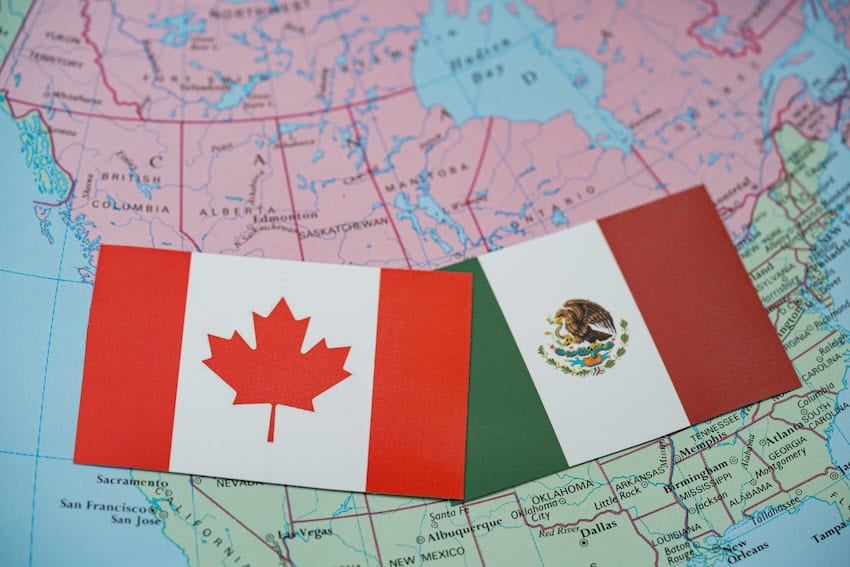
Two-way merchandise trade between Mexico and Canada increased by more than 18% between January and August compared to the same period of last year, according to data published by Statistics Canada.
Trade in goods between the two North American countries was worth 34.42 billion Canadian dollars (CAD) (US $24.6B) in the first eight months of 2026, a year-over-year increase of 18.3%.
Mexico exported goods worth 26.91 billion CAD to Canada between January and August, a year-over-year increase of 17.4%.
In the same period, Canada’s exports to Mexico were worth 7.51 billion CAD, a year-over-year increase of 21.4%.
Mexico recorded a trade surplus of 19.41 billion CAD in the first eight months of 2026.
Among the goods traded between Mexico and Canada are vehicles and auto parts, electrical and electronic equipment, industrial machinery, agricultural products and metal.
The increase in Mexico-Canada trade this year comes at a time when both countries are navigating trade tensions with the United States, their largest trading partner. The Trump administration, which has imposed tariffs on various Mexican and Canadian goods, announced in July that it had decided not to renew the USMCA for an additional 16 years, although the three-way free trade pact remains in effect.

Despite the imposition of tariffs on Mexican steel, aluminum and vehicles, the value of Mexico’s exports to the United States increased 18.3% in the first eight months of 2026 compared to the same period of last year, according to the U.S. Census Bureau and the U.S. Bureau of Economic Analysis.
The total value of Mexico’s exports to the U.S. in the period was US $419.34 billion, a record high.
For every US $1 worth of goods Mexico exported to Canada in the first eight months of 2026, it exported about US $22 worth of goods to the United States.
Mexico-Canada trade grows as the two countries cultivate closer ties
Trade between Mexico and Canada has increased as President Claudia Sheinbaum and Prime Minister Mark Carney have sought to strengthen cooperation between the two countries at a time when the U.S. government is pursuing protectionist trade policies under President Donald Trump.
A key example of their efforts to strengthen cooperation is the Mexico-Canada Action Plan 2025-28, which the two leaders launched in Mexico City in September 2025. The plan covers areas such as trade facilitation and commercial cooperation, investment promotion, trade policy cooperation, innovation and joint action in sustainable mining.
Sheinbaum and Carney have met in person on at least three occasions and have also spoken by telephone several times.
In January, Sheinbaum praised Carney for his speech at the World Economic Forum meeting in Davos, Switzerland, during which the Canadian prime minister asserted that the rules-based international order was undergoing a “rupture, not a transition.”
During a call in August around seven weeks after the Trump administration announced its decision to not renew the USMCA until 2042, the Mexican and Canadian leaders “underscored the importance of renewing … [the trade agreement] as soon as possible to provide greater certainty for North American businesses and workers,” according to a statement released by Carney’s office.
Sheinbaum has stressed that Mexico, the United States and Canada could reach a deal to extend the USMCA for an additional 16 years “at any time,” although the Trump administration has various concerns about the pact and its trade relationships with its neighbors, including ones related to trade deficits, energy policy and China.
The statement released by Carney’s office on Aug. 20 also said that the Canadian prime minister and Mexican president discussed “the progress between Canada and Mexico on cross-border trade.” That progress is reflected in Statistics Canada’s trade data for the first eight months of 2026.
Mexico News Daily