Surrealist artist Pedro Friedeberg, considered one of the most prolific and eccentric artists to come out of Mexico, died at his home in San Miguel de Allende on March 5. He was 90 years old.
“Pedro died surrounded by his family, with much love and in peace,” his children said in a statement. “His family feels deeply grateful to have been able to share all this time with him. His work and his creative spirit leave an immense legacy.”

Friedeberg is survived by two children, Diana and David Friedeberg, as well as his wife, Carmen Gutiérrez.
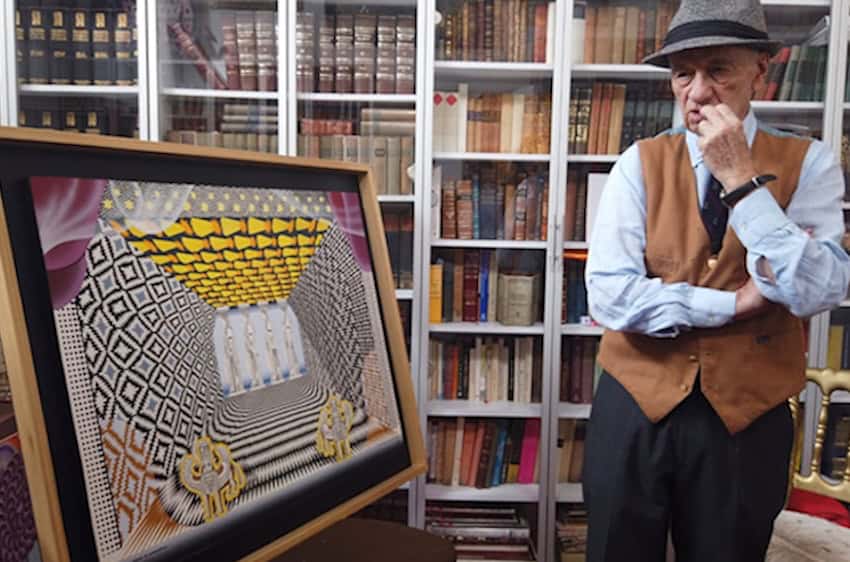
Friedeberg’s work is recognizable for its ornamental exuberance and irony, often featuring symbolic references to religion, Mesoamerican codices and esoteric traditions, characteristics that earned him status as a cult figure within modern and contemporary Mexican art.
His artistic output spans more than six decades, encompassing painting, sculpture, furniture design and imaginary architectural projects.
He once explained his artistic approach by saying, “If only I could spread out everything that stirs within me with such heat, with such exuberance of life, onto paper, turning it into a mirror of my soul.”
Though commonly labeled a Surrealist, Friedeberg bristled at being associated with that movement.

The National Institute of Fine Arts and Literature lamented Friedeberg’s passing, saying in a statement that “the Mexican art world lost … a fundamental figure of contemporary art.”
His passing “marks the loss of one of the most eccentric and recognizable creators in Mexico’s art scene,” wrote the newspaper El Economista.
Born in Florence, Italy, in 1936 to German-Jewish parents, Friedeberg arrived in Mexico with his family at the age of three. He attended college in Boston briefly before returning in 1957 to study architecture at Mexico City’s Ibero-American University.
There, one of his professors, Mathias Goeritz, convinced him to become an artist. Friedeberg worked summers as an assistant to Goeritz, a renowned artist and poet, during which time he met surrealists including Remedios Varo, Leonora Carrington and Edward James.
His first exhibition came about in 1959 at the Diana Gallery in Mexico after Varo recommended his work to the owners, and from there, his work expanded internationally.
In the early 1960s, Friedeberg, along with Goeritz, co-founded “Los Hartos,” a group that included José Luis Cuevas, Chucho Reyes, Ida Rodríguez Prampolini and Alice Rahon. Los Hartos reacted against functionalist rationalism in art, claiming to defend a more imaginative and iconoclastic aesthetic, as well as the hierarchization of art from individualism.
View this post on Instagram
Friedeberg’s art can be found throughout Mexico, with notable works in Mexico City, including the mural “Sixteen Riddles of a Hindu Astronaut” (in the Camino Real hotel in Polanco), the sculpture “The Lighthouse of Silence” (in the Maia Contemporary art gallery) and the “Listening in the Metro” mural (in the Bellas Artes subway station).
Among his most notable works is the 1962 creation “The Hand of Akhenaten,” known familiarly as “The Hand-Chair.”
Friedeberg also submitted 34 of his works to the Finance Ministry over the years as “payment in kind,” saying in 2014 that it “would help immortalize my work.”
With reports from El Economista, EFE and Art News