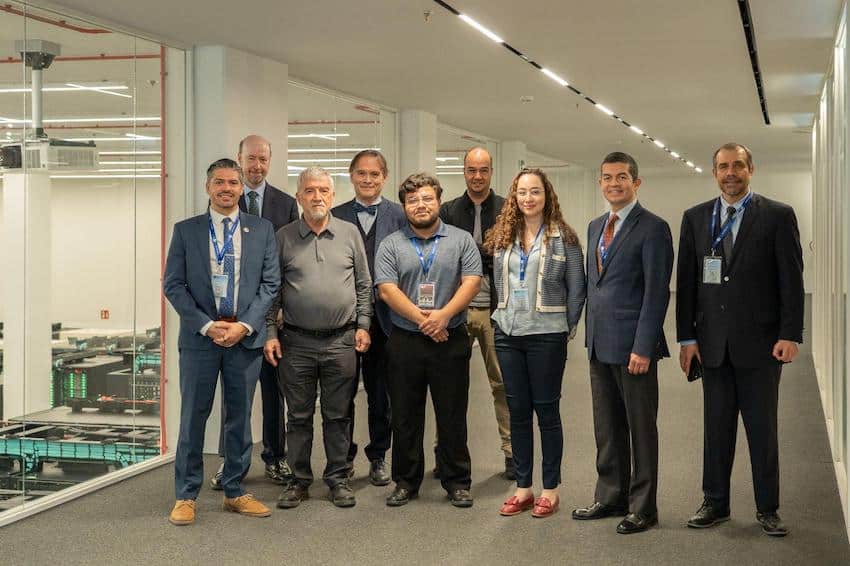
Mexico’s ambitious supercomputing program — first announced last November — has officially gotten underway, with Mexican researchers now working at the Barcelona Supercomputing Center (BSC) in Spain on a new climatological investigation protocol.
The Mexican Supercomputing Program, a collaboration between Mexico’s Digital Transformation and Telecommunications Agency (ATDT) and the BSC, was unveiled by President Claudia Sheinbaum late last year with the long-term goal of building Mexico’s own supercomputer: Coatlicue, named after the Aztec mother of the gods, which would be the largest in Latin America.
Mexico is less than 3 years away from having Latin America’s largest supercomputer
The program’s first phase is now active. Researchers from Mexico’s National Meteorological Service (SMN) have begun working at BSC facilities to standardize Mexico’s meteorological data, gaining access to the MareNostrum 5 supercomputer — a machine capable of performing 314 quadrillion calculations per second — to process millions of data points that would otherwise take weeks to analyze.
Furthermore, BSC specialists will train Mexican scientists on how to build Coatlicue’s hardware and software in Mexico, thereby retaining Mexican talent.
Beyond weather forecasting, the program ultimately aims to put Coatlicue’s processing power to work across a range of sectors such as agriculture, energy, customs and anti-corruption.

“Having Coatlicue means that for the first time, we will have the real ability to address problems that, in theory, we already know how to solve, but we have never had access to the technology needed to tackle them,” Jorge Luis Pérez Hernández, the National Coordinator of Digital Infrastructure at ATDT, told Wired magazine in an interview.
With an estimated investment of 6 billion pesos, Mexico’s supercomputer will reportedly be seven times bigger than Pegaso — Brazil’s largest supercomputer — and will be among the 10 largest in the world.
Construction is expected to begin in the second half of 2026 and could take up to two years.
“Coatlicue will allow Mexico to fully embrace the use of Artificial Intelligence and data processing, which we currently lack the capacity to do because we don’t have sufficient computing power,” President Claudia Sheinbaum said last year. “It will help us tremendously, not only in the development of science and technology, but essentially in the development of the country.”
The location for Coatlicue is yet to be determined. Mexican authorities are searching for a site with access to water and energy, low seismicity and high connectivity.
With reports from Wired, El Financiero and Agencia de Noticias Científicas