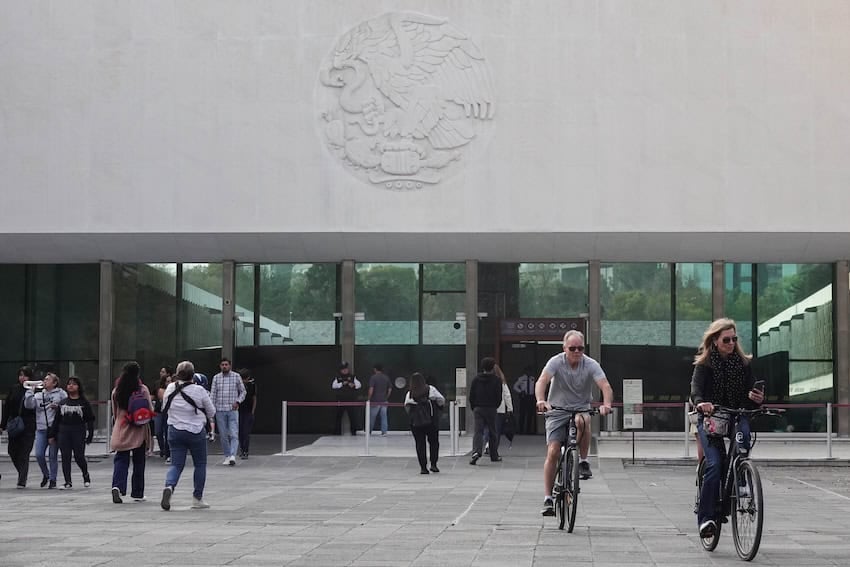
Mexico City’s famed National Museum of Anthropology has received the highest level of protection afforded to a cultural heritage site, making it the first building in Latin America and the Caribbean to receive such a safeguard.
The Blue Shield, granted by UNESCO, serves to identify highly valued cultural property in the event of armed conflict, natural disaster or any other threat to its integrity. Displaying the shield on a cultural monument signals to military or civilian authorities that the site and its collections have enhanced immunity and must be safeguarded.

“Attacking cultural property during war not only violates the right to culture, but also undermines the identity and dignity of peoples,” Andrés Morales, the head of UNESCO México said at the unveiling ceremony.
The Blue Shield reads “Protected Cultural Property” and features a blue and white diamond with a bright red outline. It has been placed on the roof of the National Museum of Anthropology (MNA) to ensure visibility in satellite images, thereby helping prevent the safeguarded monument from becoming a military target. It has also been placed at the main entrance of the museum.
Francisco Vidargas, head of World Heritage at Mexico’s National Institute of Anthropology and History (INAH), noted that the MNA houses over 200,000 archaeological, artistic and ethnographic objects, many of which come from archaeological sites that have also been designated for protection under the Blue Shield emblem (such as Chichen Itzá and Monte Albán).
However, unlike the MNA, those sites bear the standard Blue Shield design, which indicates general cultural protection rather than the enhanced protection – distinguished by the red outline – that is reserved for assets of greater importance under international law.

Pablo Arrocha Olabuenaga, legal consultant at the Foreign Relations Ministry, said that this emblem highlights the “exceptional” value of the MNA, and underscores Mexico’s regional leadership in preserving memory and universal heritage.
“This symbol is not just an emblem. It is the visible manifestation of Mexico’s commitment to international law and its deep conviction that its cultural heritage is memory, identity and the legacy of its peoples, and therefore its protection is a shared responsibility of the international community,” Arrocha said.
Mexico News Daily