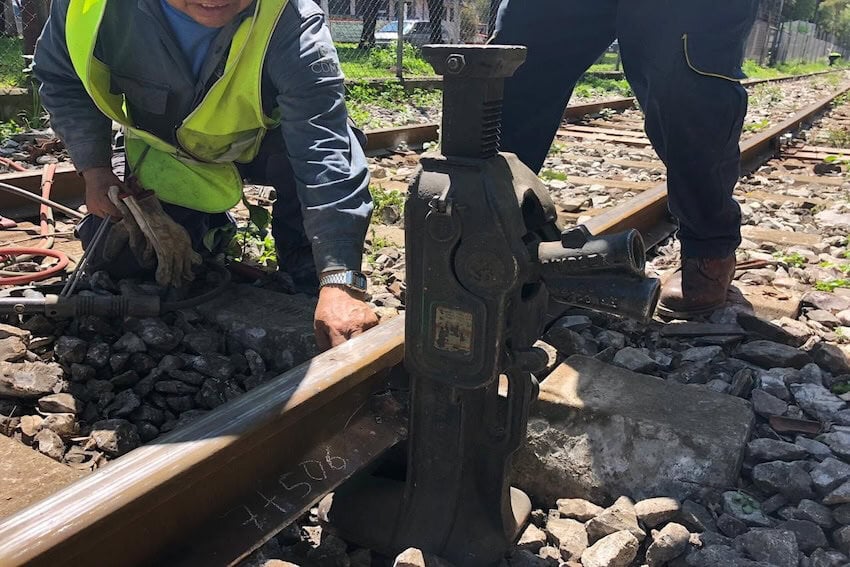
As the government continues to secure rights-of-way and conduct environmental impact studies for the 3,000 kilometers of railway track it intends to build during the current administration, some route alterations are inevitable.
The most recent modification was announced last week when President Claudia Sheinbaum confirmed that an 8-kilometer detour will be designed to protect petroglyphs along the proposed Mexico-Querétaro rail line.
The El Venado petroglyphs are etched onto a rock wall in the municipality of Atotonilco de Tula, 88 kilometers north of Mexico City in the state of Hidalgo.
The track will be rerouted beginning about 4 kilometers before the site — which is roughly 70 meters long — and return to the original line about 4 kilometers beyond the petroglyphs.
Sheinbaum said that not only is it impossible to safely move the artifacts to a museum, but the site is also considered a sacred space by local residents. In addition to the petroglyphs, ancient pottery and utensils have been found in the area, which also features hiking trails maintained by the municipality’s Culture and Tourism Ministry.
“So, the route will be modified slightly,” Sheinbaum said, “but it does not represent a significant expense.”
Complementing the government’s land acquisition activities, archaeologists from the National Institute of Anthropology and History (INAH) are carrying out exhaustive field research — as they have been doing along the proposed routes of all the rail projects — to identify, assess and salvage artifacts of historical significance.

Archaeologists work to preserve 200 historical sites as Mexico’s northern train line breaks ground
INAH has classified the El Venado site, as well as nearby petroglyphs known as El Chamán and El Nahual, as sites of archaeological importance. A total of four rock art elements categorized as petroglyphs were identified, along with movable and immovable archaeological monuments — including basalt stone terraces — related to Mesoamerican cultures of the Epiclassic period (600–900 AD).
Nearly a decade ago, construction of the region’s new wastewater treatment plant uncovered human and animal bones, dating back to the late Pleistocene period (more than 10,000 years ago). Some of the fragments were identified as bones from a mammoth, camel, deer, bison, horse, mastodon and glyptodon (an extinct mammal related to modern armadillos).
At the time, archaeologist Alicia Bonfil Olivera said it was “the largest and most varied discovery of extinct megafauna remains in the Basin of Mexico.”
Officials said last week that nearly 120 kilometers of the proposed 226-kilometer Mexico City-Querétaro train line have been formally acquired and cleared for construction, while environmental studies and archaeological prospecting continue on the remaining track.