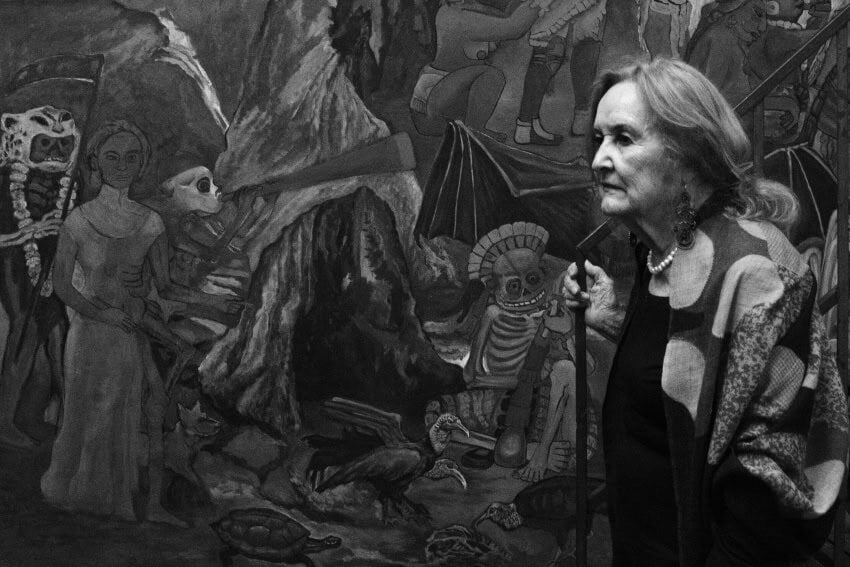
When asked about her nationality, 20th-century muralist Rina Lazo would smile and confidently state that she was Mesoamerican. Even though there’s no geopolitical territory with such a name, it was accurate, for Lazo embraced the aesthetics and motives of Mesoamerican art in her paintings.
In her claim of Mesoamerican identity, Lazo, who studied under Mexican muralists Diego Rivera and Carlos Orozco Romero, was part of a 20th-century Latin American movement recognizing pre-Hispanic heritage as a vital source of artistic renewal and native pride. However, if you twisted the nationality question a bit and instead asked her about her birthplace, she would describe the Guatemalan landscape in loving terms.
Her birth in Guatemala
“I was born in the most beautiful country in the world,” she once said. “Because I’ve seen many, but none as green and as full of volcanoes, lakes and marvelous weather.”
Although Lazo grew up in Guatemala City, her family spent time in the more rural Maya city of Cobán, which had a tight-knit German community of coffee plantation owners but was otherwise mainly populated by Mayas who spoke only the Indigenous Q’eqchi language.
Although Lazo never learned the language, her mother — the daughter of a German coffee producer — knew it and provided Rina with phrases to use at the market. She would never forget her encounters with the Maya in Cobán, and it would later influence her art.
Two things marked Lazo’s childhood: One was her grandfather’s interest in art, specifically painting; the other was the archaeological discoveries of ceramic pieces in Cobán. The images on those sherds would be forever present in Lazo’s paintings. She firmly believed that if you were meant to become someone, you would find a way to do it and that no school or teacher could determine your passion.
“That’s something you’re born with,” she said.

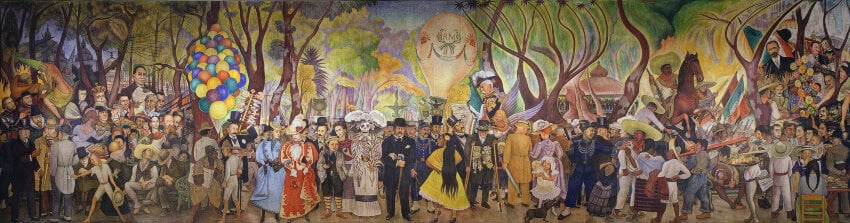
And when her professor Andrés Sánchez Flores invited her to work with Diego Rivera on what would become one of Rivera’s most famous murals, Sánchez said exactly the same thing: “It’s just a matter of will.”
Her arrival in Mexico
When Lazo was young, she wanted to be an astronomer, which is perhaps why many of her paintings feature astronomical phenomena. But she apparently changed her mind and began pursuing a career as a painter, earning a scholarship to study in Mexico. Since her financial resources were limited, she decided to enroll in the mural art class at La Esmeralda, Mexico’s National School of Art, where major Mexican artists like Diego Rivera, José Chávez Morado and Frida Kahlo were professors.
In her first mural class, her professor, and Diego Rivera’s mural technician, Andrés Sánchez Flores, presented her with a golden opportunity: the chance to work as an assistant to Diego Rivera on a project — the now iconic “Dream of a Sunday Afternoon in the Alameda Central” — a 50-foot mural for the Hotel del Prado in Mexico City. She started out doing minor tasks, such as grinding pigments, but after Rivera saw her work, he began assigning her to paint small details on the mural, decorative items on the clothing and the leaves on trees.
Her name now appears next to Rivera’s on the iconic work, which depicts Mexican history and was an instructive moment for Lazo.
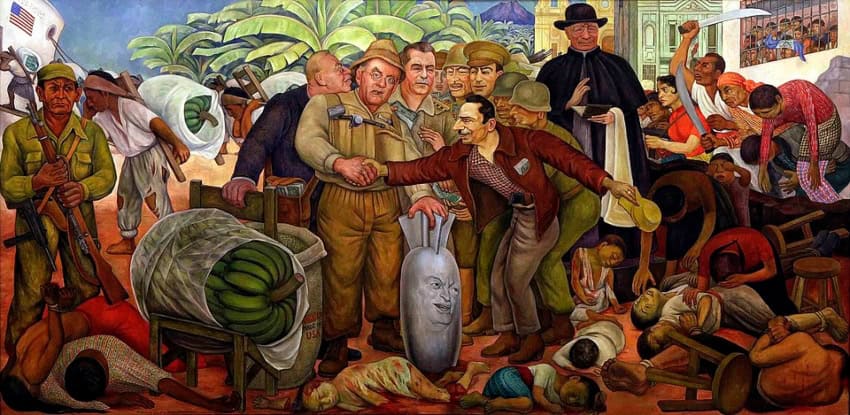
From that moment on, she became Rivera’s apprentice for the next decade, until he died in 1957. She worked on a challenging underwater mural with him at the Cárcamo de Dolores hydraulic structure in Chapultepec Park. Even now that the structure no longer serves its original purpose, you can still visit the artwork in Chapultepec’s Second Section. And in the 1954 Rivera work, “Glorious Victory,” whose subject is the 1954 military coup that deposed Guatemalan president Jacobo Árbenz, Rivera asked Lazo to paint the prisoners in the painting. She also appears in the painting as one of the Guatemalan revolutionaries.
After Rivera
In 1966, Lazo competed for and won an assignment to create replicas of the ancient Maya murals at the Bonampak archeological site in Chiapas for the National Museum of Anthropology in Mexico City.
The challenging commission — during which she spent three months isolated in Chiapas’ jungle, teaching herself about the originals — not only involved specific knowledge of materials and techniques but also a deeper connection with the people who had painted Bonampak. But its success launched her career. Years later, she would return to the museum with a piece of her own: “The Venerable Grandfather Corn,” a cosmogonic description of the creation of humanity according to Mayan tradition.
Lazo’s arrival at the Palacio de Bellas Artes
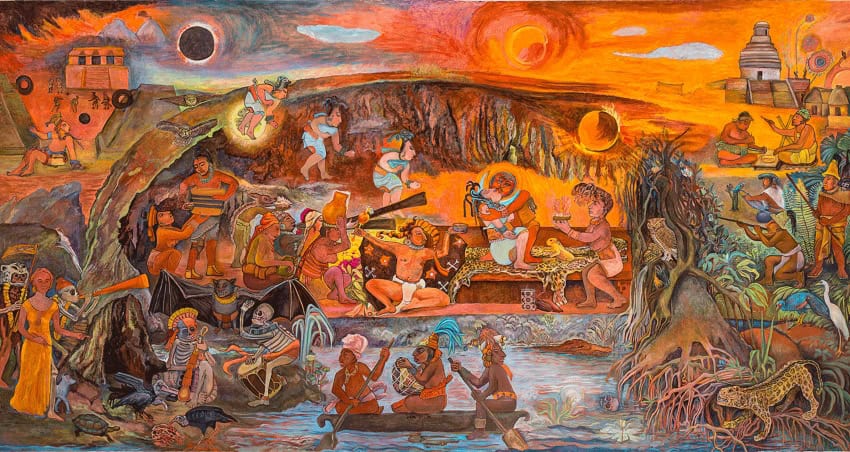
On Nov. 1, the Day of the Dead, Lazo celebrated her 96th birthday, finished her last mural, and then slipped into a deep sleep from which she never awoke. Those who knew her have said they like to think that her last mural, “Xibalbá, the Underworld of the Mayas,” was Lazo creating her own setting for her afterlife.
Xibalbá is the Maya place of the dead, a dark underworld full of all kinds of animals and trees. Thought by the Maya to be located in a cenote, Xibalbá is the home of deities associated with the dead.
For Lazo, it was not a place of suffering; it was a place of joy, where she believed all the elements of the Maya culture she had seen during her childhood would embrace her.
The portable mural would be displayed posthumously for a few months at a temporary exhibition. In 2024, it was incorporated into the permanent collection of the Palacio de Bellas Artes in Mexico City, making Lazo the first, and to-date only, female muralist to have a permanent space among the greats of Mexican Muralism like Siqueiros, Rivera, Orozco and Tamayo.
Lydia Leija is a linguist, journalist and visual storyteller. She has directed three feature films, and her audiovisual work has been featured in national and international media. She’s been part of National Geographic, Muy Interesante and Cosmopolitan.