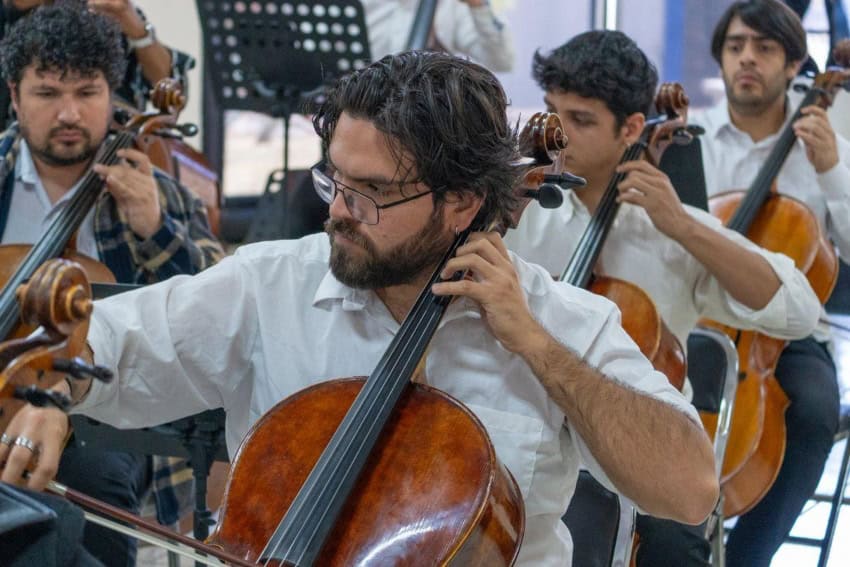
They say music has a way of rearranging a room. I used to think that was just a poetic way to talk about acoustics; how a violin’s tremolo slips into the corners, or how a timpani rolls and the walls seem to breathe with it.
I’ve come to learn, though, that rearrangement is something social as well as sonic. It’s how shared attention can change how strangers hold themselves in a place. The modern orchestra of Lake Chapala is close to 60 players strong, a mix of career professionals and talented retirees who keep their chops and their passions sharp. They manage a full season of six or more concerts, drawing 300 or more listeners without a single peso of government subsidy.
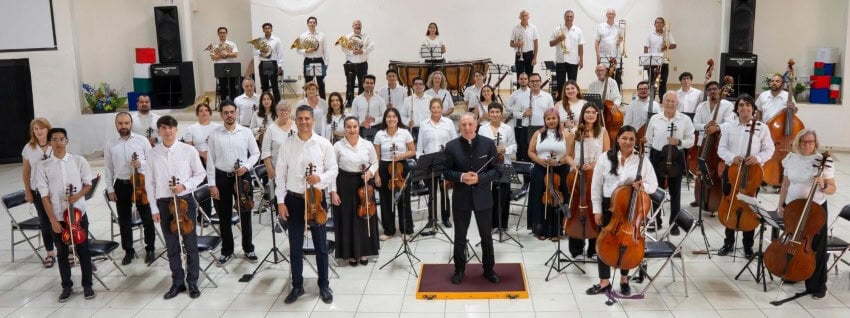
It’s astonishing that an ensemble of this size not only survives but runs in the black, supported largely by ticket sales and local donations. The sound they produce could stand toe‑to‑toe with offerings from orchestras in Guadalajara, Dallas or Washington, D.C., yet this one takes shape in a town of around 10,000 foreign residents living alongside 50,000 Mexicans.
Many of those foreigners prefer easy‑listening favorites to symphonic staples, and still, the orchestra thrives. How did this come to be?
How Lake Chapala sustains an orchestra
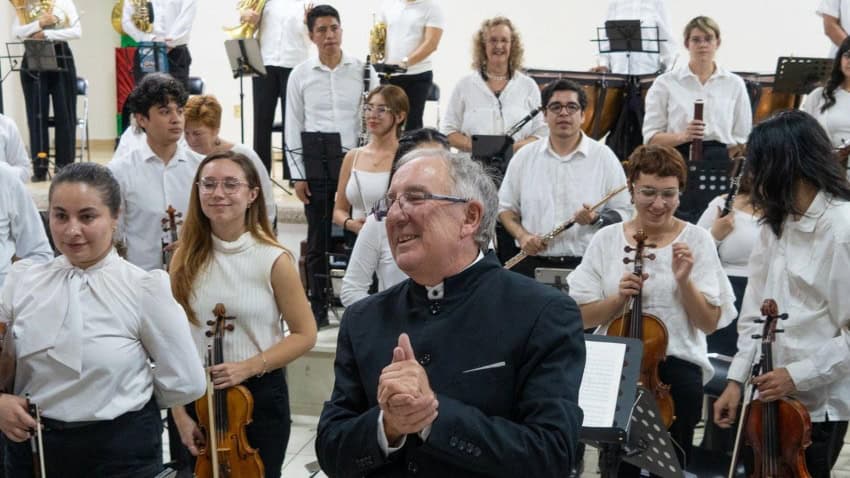
The answer winds through personalities, small gatherings and stubborn devotion. Much of it starts with Michael Reason, the artistic director and conductor who planted roots in Lake Chapala just as a few retired musicians were gathering in homes to play the music they loved.
Those weekly gatherings, baroque suites passed around living‑room chairs, an almost obsessive attention to phrasing and breath, were small and intimate. A private rescue of skills that retirement otherwise threatened to lose.
Michael arrived at the cusp of that movement and helped shape it into something larger: an organized, professional ensemble that nonetheless keeps the atmosphere of those house concerts. His approach felt less like institution‑building and more like tending in how he coaxed players toward a shared ideal of sound while preserving the generosity that had first drawn them together.

Rehearsals carried the warmth of friends sorting a passage over coffee, even as sectionals demanded the focus of a conservatory room.
People making music
The human stories are the heart of this orchestra. Take Joyce Noriega, a 92‑year‑old oboist who still plays with a steady, luminous tone. Joyce has subbed with the Jalisco Philharmonic and is cherished by musicians and audiences who know her. She and her friends used to meet at each other’s houses to play.
Those sessions were less about performance and more about preserving a life’s habit; the daily, necessary act of making music with friends. There’s a smallness and an intimacy in people who simply want to play, without the infrastructure of a concert hall or the pressure of a career.
Susanne Bullock is another linchpin. She’s the principal clarinet and a driving force on the executive board. Susanne gave up professional music when she moved to Mexico 10 years ago. Her return to active music‑making saw a renewed commitment to rehearsal schedules, auditions and administrative work, and it filled an essential gap.
Her leadership helped turn hobbyist sessions into a structured orchestra that could attract audiences and funding from private sources. The work she and others do, the scheduling, fundraising and recruiting, reads like a kind of civic music‑making in itself. Not glamorous, but essential.
The ensemble’s makeup reflects this duality, with roughly 80% foreign and 20% Mexican musicians. That split sparks a question: how did a mostly foreign group in a small lakeside town build an orchestra of this caliber? The answer is partly community network and partly sheer devotion.
How the orchestra came together
It’s about musicians who migrated and who brought training, experience and a desire to keep playing. They found one another, traded contacts and slowly moved from kitchen‑table quartets to a staged orchestra, rehearsing in community halls, churches and anywhere a piano and a few chairs could be set up.
As the venture matured, more professional standards were applied. Some community members who initially played were replaced by those with more recent orchestral experience to ensure a consistent, polished sound. That growth was sometimes painful, but it was instrumental in allowing the orchestra to present works that matched the technical and expressive demands of full symphonic repertoire.
The tension between inclusivity and artistic ambition is a familiar one in keeping doors open while also honoring the music’s demands. In Lake Chapala, that tension has shaped a pragmatic compromise of retaining community spirit, raising standards where necessary, and keeping the music honest.
Community support
Performances draw a fascinating cross‑section of people. There are foreigners hungry for cultured evenings, longtime Mexican residents curious about orchestral textures, and visitors who stumble upon a concert and stay for the whole thing.
The orchestra has learned to balance accessibility and artistic integrity, offering programs that can surprise and satisfy both casual and committed listeners. The result is an audience that supports the organisation financially and emotionally, buying tickets and spreading the word, sustaining a professional ensemble without municipal funds.
There are practical challenges, of course. Keeping an orchestra viable means booking venues, contracting professional players for demanding parts, managing payroll, transporting instruments and cultivating donors who see cultural value in a small‑town symphony. It means board meetings, logistics and the kind of detailed work that most audiences never hear beneath the music.
But these behind‑the‑scenes efforts are driven by people like Susanne, Joyce and Michael. People who not only love music but are willing to do the administrative and social labor that keeps it alive.
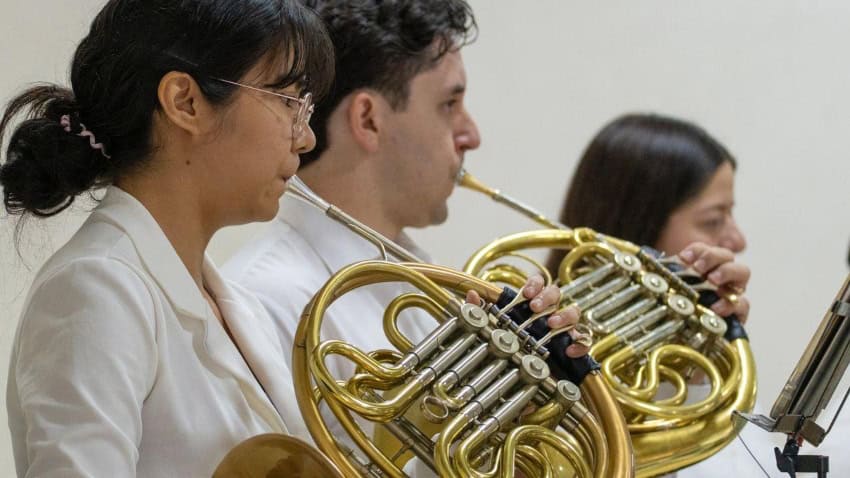
It’s also worth noting how regional dynamics thread into this picture.
A symphony of stories
The Jalisco Philharmonic, for instance, has its own complex story. Many of its players are refugees from Venezuela, a reminder of how politics and migration reshuffle cultural life. For Lake Chapala, the interplay is smaller‑scale but no less meaningful.
Musicians move, retire and reconfigure their careers, and in doing so create a microcosm of global musical shifts. They create an orchestra that, in miniature, mirrors larger changes in professional networks and cultural exchange.
I haven’t had the time to make the drive and experience a concert firsthand. But I will. I want to sit close enough to feel the timpani in my chest, to watch the conductor’s hand sketch questions into the air, and to hear Joyce’s oboe thread a solo line like a conversation across decades.
I want to be part of that communal attention, and to see how music can make strangers feel like neighbors and stretch the shape of a town until everyone fits. Until then, I treasure the stories I’ve learned about this merry band. The living‑room rehearsals that became concerts, the retired professionals who refused to let their art go silent, the board members who balanced budgets and ambitions, and the conductor who turned friendship into an institution.
Lake Chapala’s orchestra is proof that culture doesn’t need a metropolis to flourish. It only needs people who refuse to stop listening and playing. When I finally make it down to the shore, I’ll be ready to hear how the lake replies.
Charlotte Smith is a writer and journalist based in Mexico. Her work focuses on travel, politics, and community. You can follow along with her travel stories at www.salsaandserendipity.com.