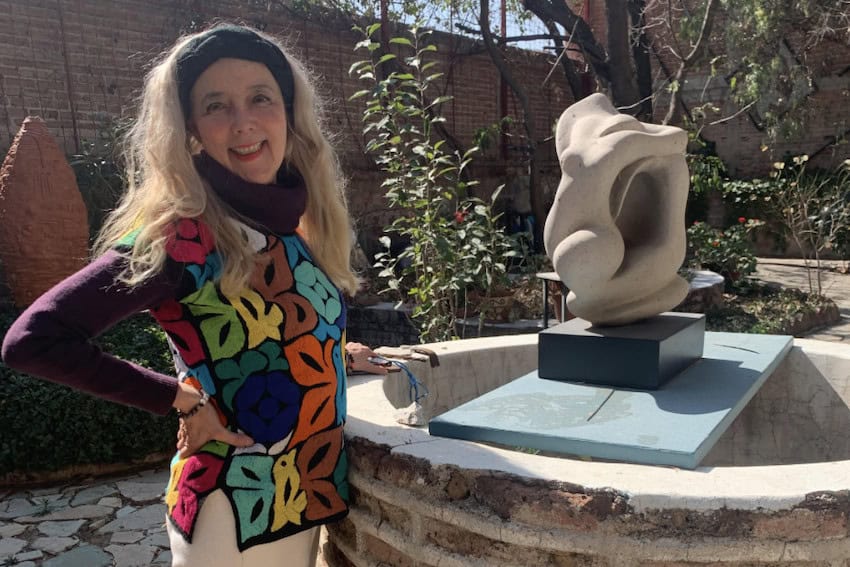
When Guanajuato painter and sculptor Rocío Sánchez was ten years old, her convent school held a contest for students to represent the 1967 International Year of Peace. Sánchez chose to draw a portrait of Gandhi. “Although I had sketched before, drawing Gandhi was a new experience for me,” she said. “I was overwhelmed by the discovery that through creating a simple drawing I could express feelings so deeply.”
Today, more than fifty years later, Sánchez still expresses emotions through her paintings and sculptures, which she has exhibited not only in many parts of Mexico but also in Paris, Florence, New York, Philadelphia and Washington, D.C., as well as other U.S. states and Canadian provinces.
How Rocío Sánchez became an artist
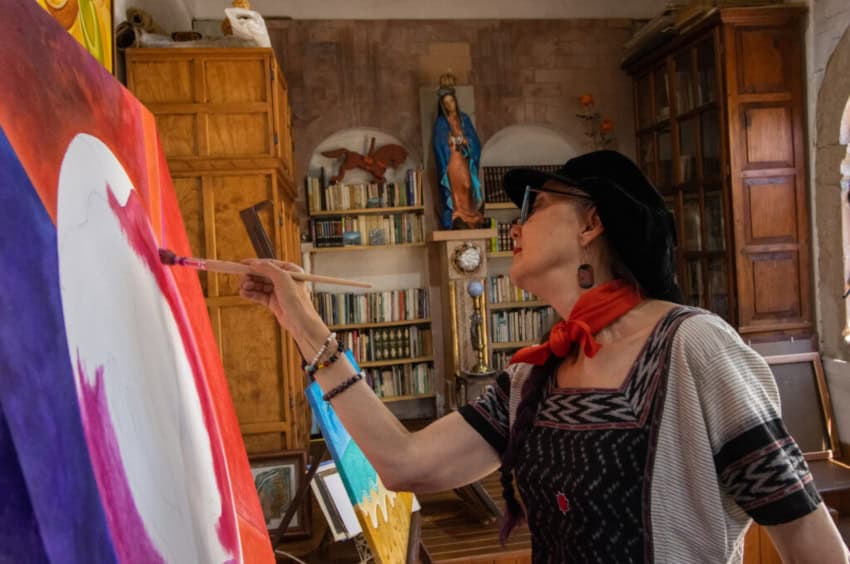
Growing up in Sahuayo, Michoacán, she was fortunate to have the renowned Mexican artist Luis Sahagún Cortés as her mentor. “He inspired me. He was very generous, never charged for his services and would take me outside to paint in plein air,” Sánchez says.
Later, she won scholarships at both the state and federal levels, building a reputation by showcasing her portfolio to various galleries. She also represented Mexico in different countries. In Paris, for example, her paintings were exhibited for the Casa de México and at the 2013 Biennial of Florence.
One of Sánchez’s goals is to integrate art with the surrounding landscape, as she did with her sculpture, “The Queen of the Seas,” located on the malecón in La Paz, on the Baja Peninsula.
She moved to Guanajuato in 2017 to develop her artistic project, “The Journey of Consciousness,” which she first visualized in a dream and whose goal is to promote self-knowledge through art, nature and technology. Throughout her home and garden are paintings and stone carvings that are all part of this vision.
A versatility in artworks and themes
Currently, she paints primarily with acrylics. However, in her 53 years of making art, she’s explored many media, including oil, pastel, tempera and encaustic. She has also created prints and sculptures, using diverse techniques such as stone carving, clay modeling and lost-wax bronze casting, ranging from miniatures to large-format works. More recently, she’s experimented with digital arts, incorporating virtual reality.

In 2025, Sánchez was asked by the prolific Spanish poet Julie Sopetrán to illustrate her book of erotic poetry, “Las Cuatro Estaciones” (“The Four Seasons”). After reading the book, intrigued by the idea of a “dialogue between literature and art,” Sánchez flew to the Spanish province of Castilla y León to meet Sopetrán. Of the book’s 365 poems, representing each day of the year, one was accidentally repeated. “So Sopetrán had to write a new erotic poem. At 82 years old!” Sánchez exclaimed in amazement. She smiled impishly. “The heart never wrinkles.”
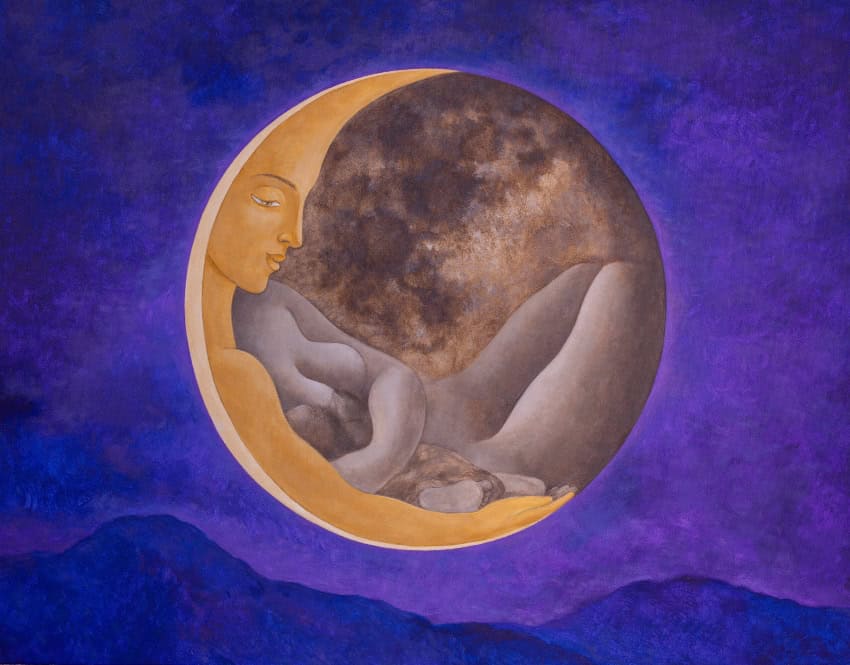
“Are the paintings erotic?” I asked Sánchez. Yes, but “eroticism is much more than human sexuality,” she said. “The illustrations are all acrylic paintings on canvas, in which I fuse nude human figures with mountains. It’s like a human landscape that evokes the sensuality of the close relationship between nature and humankind.”
Indeed, the cover shows a nude man and woman lying in each other’s arms, looking like a series of sensuously rounded hills. An exhibition of the illustrations was held in the Casa Gene Byron Museum outside Guanajuato in the fall of 2025.
The discipline and routine of an artist
Sánchez’s days vary. “My routine depends on the discipline I’m working on. For example, if I’m working on a direct plaster sculpture, I’m in my workshop. If I go to the foundry in Guadalajara to cast my pieces in bronze, it’s a different routine. If I’m painting, then I’m in my studio.”
She has experienced many changes throughout her artistic career, alternating between painting and sculpture and from the physical to the intangible. “For example, if I take a 3D photograph of a bronze or stone sculpture and then exhibit it in the Metaverse, what was once pure matter is transformed into a work that is visual but intangible.”
She’s also painted landscapes, portraits and nudes. During one period in the 1980s, she sketched classical musicians at concerts, then painted them at home, creating a project titled “Concerto in E Major with Countless Movements,” which was exhibited internationally.
Adapting to a changing landscape
Sánchez is not intimidated by the many changes in the art field. “It’s very exciting to see how organic art is,” she says, “and we’d better be flexible because it’s constantly changing, and faster all the time. She has experienced all the paradigm shifts that have occurred during the last two generations. “Private and public galleries, for example, which used to be entirely physical, have been transformed into virtual galleries, substantially changing the type of audience and collectors.” She shows her work at Saatchi Art, an online art gallery whose headquarters are in Los Angeles.
She applied to an innovative federal program called “Jovenes Construyendo el Futuro” (“Youth Building the Future”) to recruit two apprentices to work with her. Paid by the federal government, the young men currently work from 9:00 a.m. to 2 p.m., leaving them time to pursue their own creative interests.
A Renaissance woman, Sánchez gets her inspiration from her most intimate source: “Being a woman artist, I’m inspired by human nature and by the Earth as our mirror, which provides us with life itself.”
Louisa Rogers and her husband Barry Evans divide their lives between Guanajuato and Eureka, on California’s North Coast. Louisa writes articles and essays about expat life, Mexico, travel, physical and psychological health, retirement and spirituality. Her recent articles are available on her website, authory.com/LouisaRogers.