It seemed like a simple proposal: bring together two choruses from neighboring cities for a joint celebration of World Singing Day. But in this case, the choruses were separated by an international border, and making this happen was anything but simple.
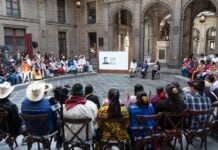
The event on October 18th at the Tijuana Cultural Center, northwest Mexico’s prime cultural venue, took months of planning and support from many quarters. It tested our endurance, our creativity, organizational skills and, at times, our patience. But the efforts paid off, and the result was glorious, as the voices of more than 60 women from the U.S. and Mexico rang out in a 90-minute concert titled “Voces Sin Fronteras,” or Voices Without Borders.

Borders divide, but they can also unite. Overlooked in the contentious debates over illegal immigration are the millions of people who routinely cross the border legally to work, attend school, shop, see friends and family, seek medical care and attend sports and cultural events. And in this case, to sing.
This event was many months in the making. It all started in December 2023 with Daria Abreu, the Cuban-born director and founder of Tijuana’s Coro Femenino Meraki, an all-female singing group founded in 2020 with support from the nonprofit Promotora Bellas Artes. She reached out to Kathleen Hansen, artistic director of the San Diego Women’s Chorus, a 125-member lesbian-identified musical community founded in 1987 that’s made up of LGBTQ+ and straight ally members.
Both choruses are members of the Choral Consortium of San Diego, a broad umbrella with more than 80 groups of all sizes and musical styles. While most members are from San Diego, a small number of Mexican groups have joined the consortium as well.
Abreu’s dream of a binational concert turned into a plan earlier this year. With help from the Mexican Consulate in San Diego, authorities at the federally run Tijuana Cultural Center offered the center’s Sala Federico Campbell as a performance space. And what better day to put on a concert than October 18th, World Singing Day — an annual global sing-along that “encourages people to put aside their differences and celebrate what we all share as human beings.”

As a participant and organizer (I’m a member of the Meraki chorus), I can say this: We are a small group founded in 2020 of no more than 20 members, and so grateful for the willingness of our guests to take a chance on us and accept this invitation to sing in another country with total strangers.
Those who joined us that day were adventurous women who woke at the crack of dawn to travel to the border from all corners of San Diego: North Park, Normal Heights, Poway, Ramona, Escondido and beyond. Onstage, they didn’t flinch when asked to perform a small cha-cha step to the rhythm of a song they were still learning.

The gratitude went both ways. Throughout the day, I heard “thank you” from so many of the San Diego singers. And on several occasions, I saw them moved to tears by the generous gestures of my fellow Meraki choristers, who greeted them with hot coffee, fruit, pan dulce, sandwiches and a song from central Mexico (“Madrigal” by Ventura Romero) as they arrived at 9 a.m. to begin the day.
Crossing the Western Hemisphere’s busiest border at San Ysidro can have its challenges, as members of the San Diego Women’s Chorus found out. Their delegation of close to 40 people showed up as instructed by 7:30 a.m. at Mexico’s El Chaparral entrance, only to find out it was closed and that the only option was to trudge a half-mile to the eastern entrance, and then again for several blocks in Tijuana to catch a bus. Returning to San Diego through the U.S. pedestrian line, they endured a 90-minute wait to reach the inspection booths.
These San Diego guests proved to be patient and appreciative musical ambassadors as they navigated the uncertainties of the day. Together, our choruses showed that we can strengthen cross-border ties and shine a different light on our shared border, no matter the political climate. For a few precious moments on that Saturday, we were two countries, but one chorus.
Sandra Dibble has been crossing the San Diego-Tijuana border since 1994. She is a member of Tijuana’s Coro Femenino Meraki and president of the San Diego Choral Consortium.