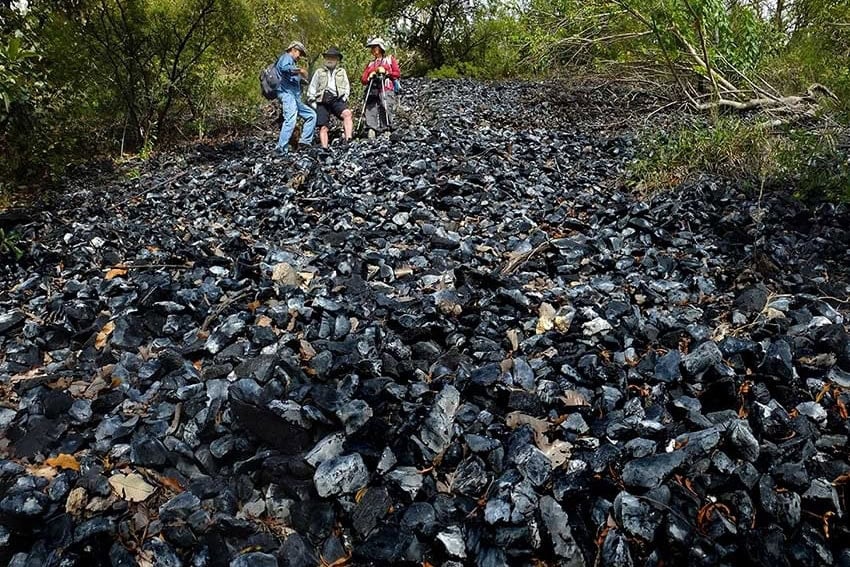
“Obsidian artisans have a long, long history in Jalisco,” says archaeologist Rodrigo Esparza with a big smile, adding that there is evidence that people were working volcanic natural glass in the area as far back as 10,000 years ago.
“This is not so surprising, considering that Jalisco is one of the richest sites in the world for obsidian deposits, ranking number four after Russia’s Kamchatka Peninsula,” added Esparza. “Nevertheless, we are losing it. Our obsidian is starting to vanish!”
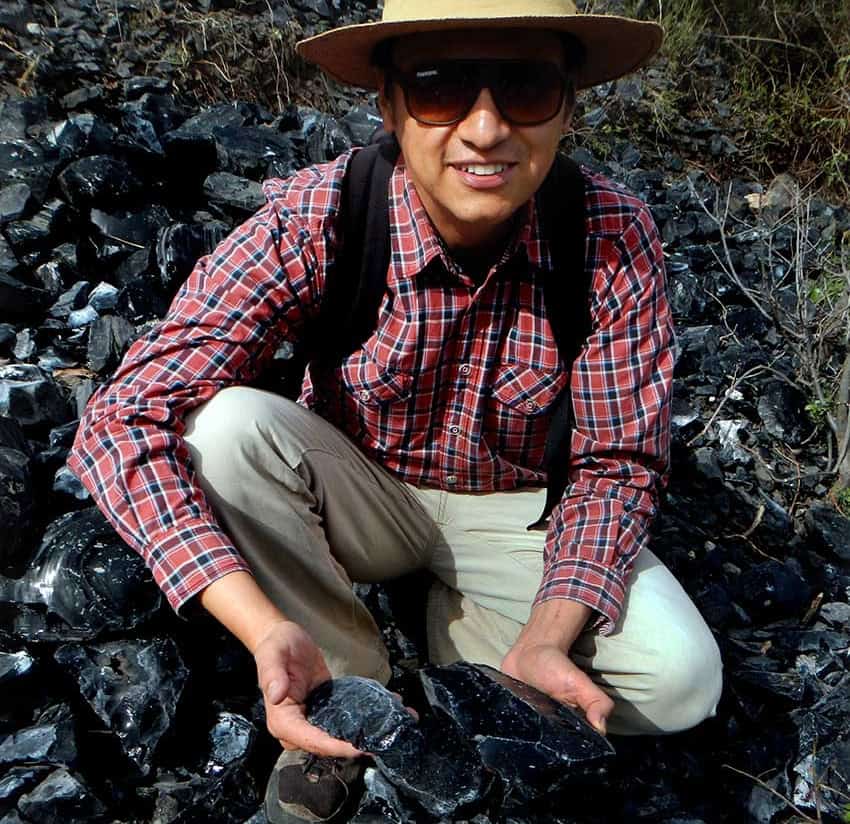
Esparza’s observations come after the recent publication of a book entitled “La Obsidiana en Jalisco” (375 pages, El Colegio de Michoacán, 2025), of which he is a co-editor.
“Twelve writers contributed to this book,” Esparza said, “giving us an up-to-date picture of what’s happening with obsidian in this state, and by extension in all of Mexico since Jalisco has more deposits of this traditional resource than any other part of the republic.”
The sharper edge
Obsidian is natural glass produced when lava flowing from a volcano cools quickly. For example, if it flows into water.
Curiously, obsidian is chemically the same as pumice, a rock which is ejected skyward from volcanoes and is so light that it floats.
Obsidian is an excellent material for blades and spearheads because it can produce a much sharper edge than any metal. The best scalpels in the world, in fact, are those made of obsidian. But, of course, they are very fragile.

The deadly Mexica sword
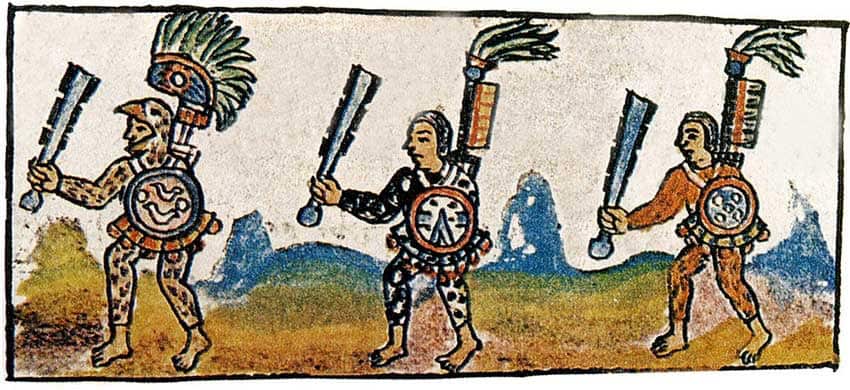
Because it can be used to make excellent knives and cutters, artisans have been working it since the dawn of time and have developed ingenious techniques for producing efficient blades. The Mexica even came up with a kind of machete called the macahuitl. This was a wide, flat sword made of wood with small obsidian blades glued into a slot all around the perimeter. Spaniards testified that with one blow, a macahuitl could easily decapitate a horse.
The remains of hundreds of ancient obsidian mines and workshops can be found in many parts of Jalisco, together with thousands of discarded artifacts bearing witness to a once-thriving industry that also had an impressive artistic component.
Ancient obsidian spangles
Take pre-Hispanic spangles, for instance. These are polished, coin-sized obsidian discs, only 1 or 2 millimeters thick, each perforated with a small hole. These were apparently meant to be sewn on clothing or strung together to form necklaces or bracelets. The finest of these are not discs at all, but small figures of animals or humans.
Even more astonishing are polished obsidian ear spools, just as thin as the spangles.
Today’s obsidian artisans can’t duplicate either of these, but they are using tools and techniques quite different from pre-Hispanic ones.
Still, with their grinding wheels and polishing discs, modern artisans turn out everything from spheres, hearts and butterflies to sophisticated works of art, taking full advantage of the many colors and sheens of Jalisco’s obsidian.
From Indian blood to rainbow
“We’ve found more than 20 colors here,” says Esparza. “There’s a mixture of red and black called meca, or Indian blood, which is much sought after, along with subtle meldings of gray and green. But, without doubt, the most popular kind of obsidian is arcoiris (rainbow), which gives you a mixture of almost every color.”
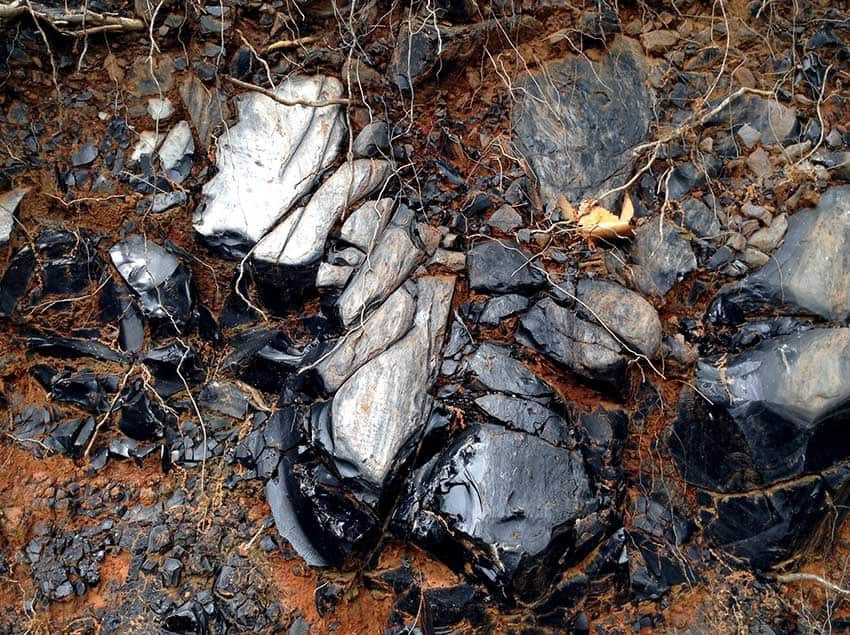
Some obsidians exhibit a deep sheen that almost seems to glow. Gold and silver sheens are the most sought-after.
Some of Mexico’s finest sculptors take advantage of obsidian’s special characteristics, bringing their works of molded clay to skilled artisans who reproduce them in natural volcanic glass.
In Chapter Six of “Obsidian in Jalisco,” Esparza lists modern workshops in the towns of Tequila, Teuchitlán, Magdalena, San Marcos and Navajas.
A visitor to any one of these workshops will have a golden opportunity to examine a variety of obsidian. Because all the workshops are continually exchanging pieces, you can quickly see everything available in the region. That would be the perfect moment to say: “Don Eleno, do you think you could turn this gorgeous piece of blue obsidian into a dolphin?”
Cheap rubble
But you’d better not wait too long to do this; the varieties and quantities of obsidian in Jalisco are on the decline.
“A key factor behind this problem,” says Esparza, “is that obsidian — which was once highly valued in Mexico — is now officially classified as cascajo (rubble), a category that also includes gravel and clinkers. Believe it or not, today you can buy obsidian for 1 peso per kilo.”
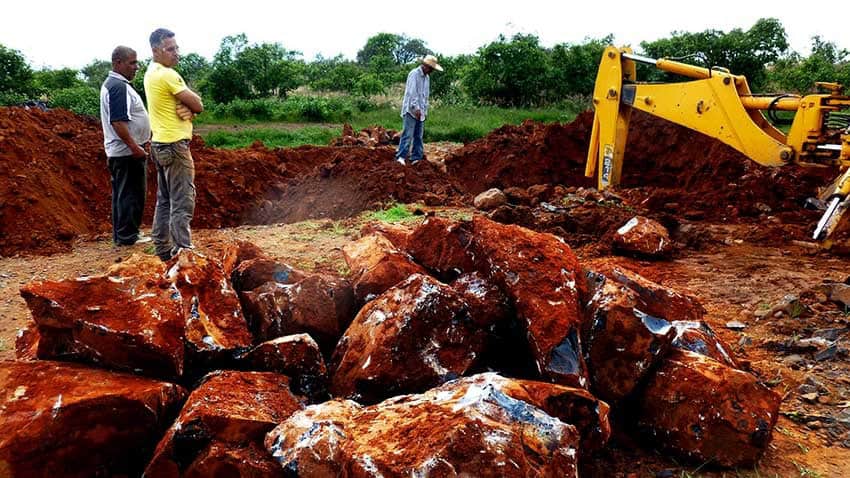
This means that forward-looking opportunists around the world can afford to purchase Jalisco obsidian in great quantities and ship it home.
Chinese connection
Naturally, the first to disappear are rarities like rainbow obsidian. For example, it was once abundant in the remote village of La Lobera, the last place in the world you’d expect to find a representative of China out looking for bargains.
But, “it’s all gone!” a local craftsman told me some years ago. “It’s all in China now.”
Another thing international bargain hunters are looking for is high-quality obsidian in large chunks. If you’d like to create the Pietà in obsidian, you have to start with a big piece. The place to go for blocks of obsidian, a cubic meter or larger in size, is a certain quarry near Magdalena, Jalisco.
But if you go there today, they’ll tell you, “Sorry, amigo, you are too late. The Chinese cleaned us out years ago.” Alas, you may have to forget about creating the Pietà in obsidian and sculpt a pizza instead.
Another place to which Jalisco’s obsidian is escaping is Teotihuacán.
The depletion of obsidian in Mexico
“Tourists love to buy obsidian souvenirs at this famous site,” Esparza said,” but local deposits [in México state] have been depleted thanks to entrepreneurs who have shipped the obsidian to places like Saudi Arabia, Japan and China. So artisans in the Mexico City area now come to Jalisco to buy their raw materials.”
This means if you have no obsidian knick-knacks on your shelves, you’d better visit a Jalisco workshop pronto … or buy yourself a ticket to China.
You’ll find the book “La Obsidiana en Jalisco” (entirely in Spanish) in the Colmich Bookstore. Co-editor Manuel Prados’ obsidian photo dossier can be accessed here.
John Pint has lived near Guadalajara, Jalisco, for more than 30 years and is the author of “A Guide to West Mexico’s Guachimontones and Surrounding Area” and co-author of “Outdoors in Western Mexico.” More of his writing can be found on his website.