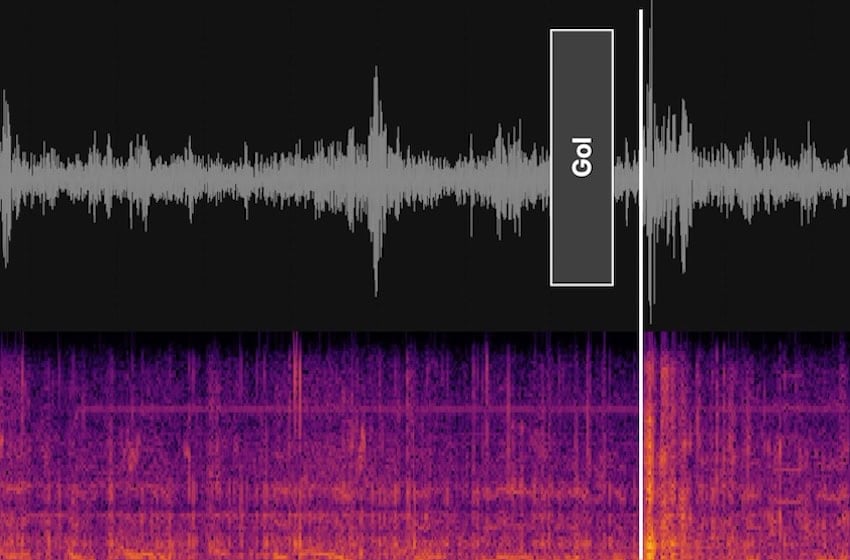
When Mexico’s Julián Quiñones scored in minute 22 of El Tri’s World Cup match against Ecuador at Mexico City Stadium on Tuesday, the exuberant celebrations that ensued caused vibrations that were detected by seismographs located in the capital.
The energy released by tens of thousands of fans jumping up and down simultaneously was captured by seismic monitoring instruments, which are sensitive enough to detect anthropogenic vibrations (movements generated by human activity).

According to a seismic alert, “an outstanding artificial signal” was registered at the Raspberry Shake station closest to the stadium in southern Mexico City.
Raspberry Shake stations are small, plug-and-play digital seismographs used by universities and researchers to monitor microseismicity, local tremors and even “artificial earthquakes” caused by massive crowd celebrations.
The Institute of Geological and Atmospheric Research (IIEGA) confirmed that an artificial earthquake was recorded in the perimeter of Estadio Azteca at 8:22 p.m. and captured by a seismic station located in Lomas de Sotelo near Naucalpan just north of the capital.
The IIGEA did not specify the intensity its instruments registered, but the newspaper Milenio speculated that it was likely above 1 degree on the Richter scale.
John E. Vidale, director of the Southern California Earthquake Center, has said that such fan-induced earthquakes would generate no more than a 2 on the Richter Scale, which would go unnoticed by the public if it were a typical quake.

A social media account named Sismo Alerta Mexicana (Mexican Seismic Alert) also commented on the incident, saying that two seismic stations detected “rapid vibration of people jumping at the same time.”
Describing the registered activity as a “sharp and collective thud against the ground that generates short surface waves,” the account specified that the instruments could distinguish that it was not a real earthquake.
“These are instruments that detect earthquakes on the other side of the world, so their sensitivity is extremely high,” a subsequent post explained.
The incident brings to mind a similar occurrence during a Mexico game at the World Cup held in Russia eight years ago.
Thirty-five minutes into El Tri’s June 17, 2018, match against defending champion Germany, Hirving Lozano scored, setting off raucous celebrations across Mexico.
Two monitoring stations in Mexico City picked up signals of a temblor at roughly the same time Lozano scored.
The following day, The Guardian newspaper reported that the IIGEA “said highly sensitive earthquake sensors registered tremors at two sites in Mexico City, seven seconds after the game’s 35th minute,” calling the tremors an artificial earthquake.
First Coast News reported that seismologists in Chile also said that their instruments detected an artificial temblor at the same time.
With reports from Milenio, Univision, The Guardian and First Coast News