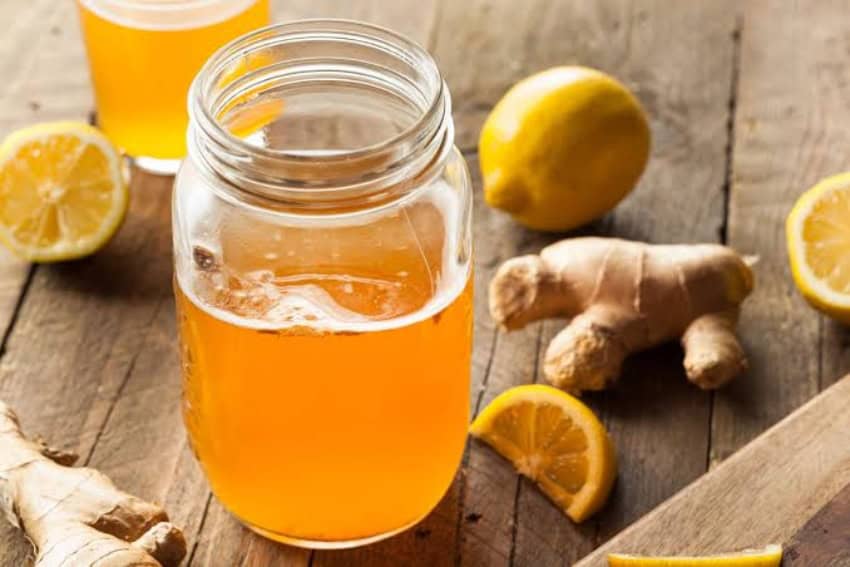
There are few drinks in history with an eccentrically bubbly origin story like kombucha.
The fermented probiotic can be traced back to China around 221 B.C. during the Qin Dynasty, when it was consumed as a “remedy for immortality” by those who considered the yeasty, naturally carbonated black tea a source of long-lasting health and vitality.
The long history of kombucha
In 414 B.C., the Smithsonian reports, the cloudy beverage was imported to Japan by a Korean doctor named Kombu, in order to treat Emperor Inkyo. To further complicate its history, Japan already had its own form of kombucha, made from kombu (brown seaweed) and cha (tea).
According to Forbes, kombucha began to spread during the global trade expansion of the 20th century, when the fermented Chinese tea variety migrated into Europe, with Russia and Germany having adopted it as “kambucha” and “kombuchaschwamm,” respectively.
In 1955, Italian piano prodigy Renato Carosone delivered a hit single, “Stu Fungo Cinese!” (translated as “The Chinese Fungus!”), which was rooted in a Chinese mushroom infusion similar to kombucha.
The drink gained mainstream popularity in China during the 1960s, ’70s and ’80s, with homebrews known as “Stomach Treasure” touted as digestive tonics.
Finally, in the 1990s, kombucha entered the North American market, largely thanks to major U.S. brands like GT’s Kombucha.

In the past decade, kombucha’s ubiquity — and value — has skyrocketed as one of the fastest-growing beverage markets on the continent. Now a mainstream supermarket item, North American kombucha sales generated revenue of US $2.1 billion in 2025, with revenues expected to top US $4 billion by 2033.
Tío Scoby kombucha: a healthy — and fizzy — alternative to soda
Of course, the United States accounts for much of the lion’s share. But a market study revealed that Mexico is predicted to have the continent’s largest compound annual growth rate for kombucha in the coming years.
So what has taken kombucha so long to work its magic in Mexico?
Mexico as a country of many beverages — except kombucha, until recently
In my personal recollection, the Eurasian style of kombucha was never plentiful in Mexico. As a child, I could get all sorts of aguas frescas, carbonated sodas and any flavored drinks imaginable. As I grew older, that evolved into other forms of consumption (micheladas, carajillos, etc.). But I have no memory of ever seeing kombucha on a restaurant menu, at a cafe or in mercados.
Here’s my theory: With all of the other beverages that are made in, and often native to, Mexico — including tepache, a naturally fermented pineapple drink — the craft of Asian and Western kombuchas couldn’t get a foothold. In a country where you can easily get tequila, mezcal, pulque, sugar cane aguardiente, rum, atole, arroz con leche and so much more on practically every corner in any pueblo (often made by someone in the neighborhood with generations of family knowledge, ancestral practices and native ingredients at their disposal), kombucha didn’t necessarily have much demand. I’ve watched señoras prepare natural tea remedies from flowers they’ve handpicked from their gardens. But getting offered kombucha inside someone’s home? Never.
It wasn’t until the mid-to-late 2010s that I started to notice kombucha — commercially and independently bottled — as a relatively more common option around Mexico.
Kombucha in Veracruz and other states in Mexico
Near my home in downtown Xalapa (a region known for its rich and deeply rooted coffee history), all of the new-school cafes now offer kombucha, with a noticeable amount of homebrewed and locally made brands available. While recently enjoying my neighborhood on foot, I popped into a few nearby cafes — touted for their espressos, flat whites and other caffeinated brews — and was excited to see artisanal kombucha on nearly every menu. I asked the owner of Marcelo whether she has noticed a rise in kombucha’s popularity and consumption; she confirmed that within the past five years (by her estimation) kombucha has exploded with trendiness across Mexico. She even started to experiment with brewing her own batches, but after failed attempts, opted to get her supply from LindaSol Fermentería, a micro-kombuchería located a few miles from her cafe in Xalapa.
View this post on Instagram
My personal go-to is Agua Brava, made by the chef at Bravo Pizza, a small pizzeria that opened in Xalapa two years ago. Their kombucha flavors rotate weekly and are made in-house and bottled on-site. Among other favorites that I’ve found in Veracruz are Komboocha Puerto (from the port city of Veracruz), Dominga Kombucha (from Cholula, Puebla) and Naran Fermentos (from Xalapa). Mexico City, Guadalajara, San José del Cabo and other cities are no different, offering their own unique brands like Cali Kombucha in Baja California Sur. Data and testimonials suggest that kombucha first infiltrated Mexico’s market roughly a decade ago, when Mexican-owned brands like the aforementioned Cali Kombucha and Brew Lab from Oaxaca launched their brands around 2015 and 2016, respectively.
To highlight the Mexicanization of kombucha since then, “kombucherías” are now a thing in Mexico — as evidenced in the social media reel above, made by a British tourist tasting Oaxacan kombucha in Mazunte. Spoiler: It’s “banging.”
Kombucha a la mexicana: Basil jamaica, pineapple coconut, and more
Though you won’t casually walk past a kombuchería on every corner, you’re likely to encounter a local kombucha brewer in your neighborhood, who might directly sell unmarked jugs or labeled microbatches of their SCOBY-made (Symbiotic Culture Of Bacteria and Yeast) concoctions. You’ll also find it in most grocery markets with a cosmopolitan clientele, or in small businesses that are dedicated to holistic living and organic products.
Rancho La Puerta — From US $17.50 a day to one of the world’s greatest destination spas
Often, the flavors have a tropical Mexican vibe: maracuyá, tamarindo, coconut, mango. Some brands add additional ingredients like ancho chile peppers, jalapeño, honey or kiwi for an extra kick of spice, sweetness or tang. Puebla’s Domingo Kombucha has a killer guayaba option — subtly effervescent, fruity and mellow. Mexico City’s Umani offers canned options including orange turmeric, Mexican pepperleaf and fig. Bruja Sana from Yucatán emphasizes herbally minty options with green, earthy additions like romero and hierba buena.
Many of Mexico’s leading kombucha brands are independent, and offer or encourage other lifestyle supplements like yoga and Pilates classes, SCOBY workshops and more. It’s far from commercial profit and mass-made consumer-targeted sales; instead, kombucha offers a doorway into a wider range of health-centered practices and mindful consumption with regional flavor.
Alan Chazaro is the author of “These Spaceships Weren’t Built For Us” (Tia Chucha Press, 2026), “Notes from the Eastern Span of the Bay Bridge” (Ghost City Press, 2021), “Piñata Theory” (Black Lawrence Press, 2020), and “This Is Not a Frank Ocean Cover Album” (Black Lawrence Press, 2019). He is a graduate of June Jordan’s Poetry for the People program at UC Berkeley and was selected as a Lawrence Ferlinghetti Poetry Fellow at the University of San Francisco. His work can be found in NPR, The Guardian, SLAM, GQ, L.A. Times, and more. He is currently based in Veracruz.