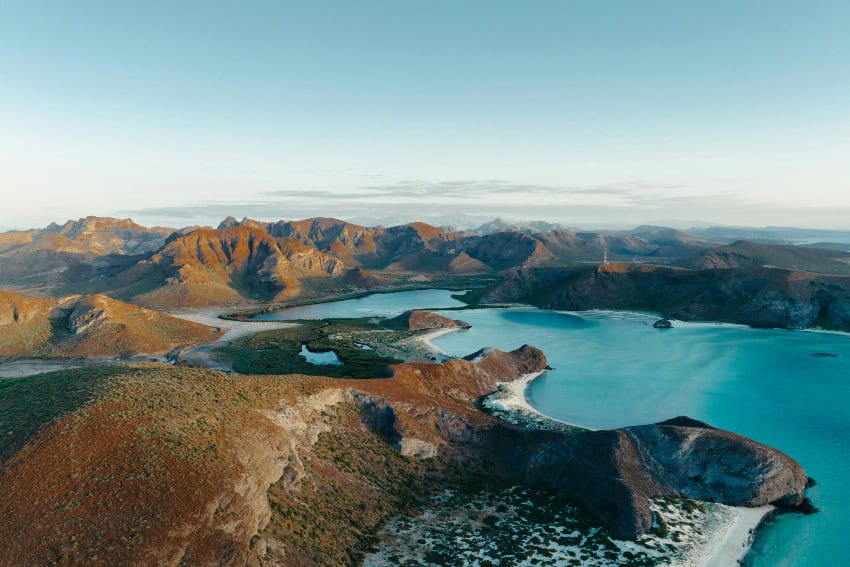
Baja California Sur has more coastline than any state in Mexico, and by a significant amount. Its 2,131 kilometers (1,386 miles) are 42% more than the next closest state, neighboring Baja California. Yet, it has fewer inhabitants than any state save Colima — 13 times smaller by land area — and even factoring in growth since the 2020 census, it still has less than a million residents.
This disparity and the attendant low population density (the lowest in Mexico, with only a dozen people per square kilometer, on average) help to explain the modern history of BCS. Historically remote and removed from the political power centers of mainland Mexico, the state was a backwater renowned for little besides fishing until advances in commercial aviation after the Second World War enabled the advent of modern tourism.
A state of unusual extremes
Blessed with year-round sunshine and an abundance of prime coastal real estate, the state — and Los Cabos and La Paz, in particular — emerged as up-and-coming resort destinations beginning in the 1950s, with the National Tourism Development Fund (Fonatur) aiding the rapid rise of Los Cabos that began in earnest in the 1970s and has continued ever since.
Today, tourism accounts for 60% of the state’s gross domestic product, compared with 8.5% for Mexico as a whole. But the revenues aren’t generated evenly or distributed equitably among the state’s five municipalities, nor are the population numbers balanced across the region.
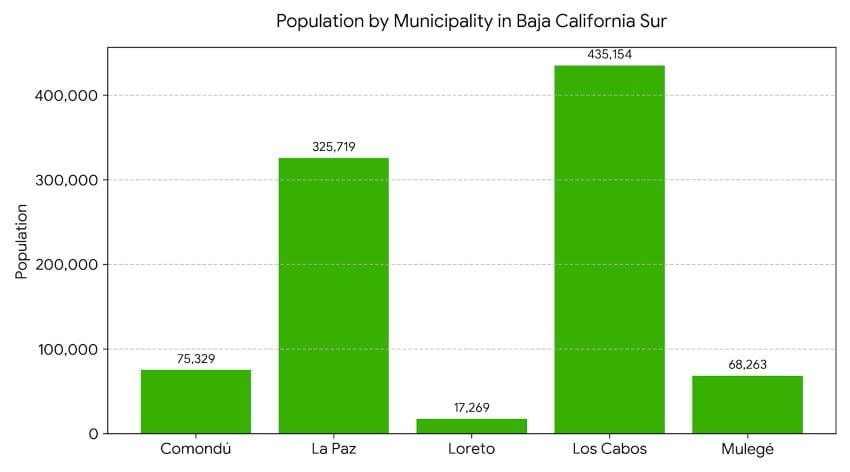
BCS is thus a state defined by unusual extremes, such as the fact that Mulegé is the second largest municipality by area in all of Mexico — at 33,000 square kilometers, only San Quintín in Baja California is bigger — yet with a tiny population that equates to only two people per square kilometer.
Population
Mulegé’s most populous town, for example, is Santa Rosalía, a Pueblo Mágico whose legacy is tied to its former House of Rothschild-owned copper mine. Its population barely exceeds 14,000, and tourism to the municipality is so scarce that it isn’t even actively tracked.
Cabo San Lucas, the most populous city in Los Cabos (202,694) and the second most populous in the state, behind only La Paz (250,141), rates as only a subdelegación … yet has far more residents than the municipalities of Comondú, Loreto and Mulegé combined.

Los Cabos and La Paz (city and municipality), as the foremost drivers of tourism to the state, also have developed the most robust and diverse populations. An estimated four out of every 10 state residents, for example, are now non-natives — transplants from states like Guerrero, Sinaloa, Mexico City, Oaxaca, Veracruz and Jalisco drawn by opportunities in the hospitality and tourism sector.
Because of tourism’s outsized importance to the state’s economy, the three largest cities — La Paz, Cabo San Lucas and San José del Cabo — now account for more than two-thirds of all residents in Baja California Sur.
Tourism
Last year, 4.523 million tourists visited Baja California Sur: with 3.77 million ticketed to Los Cabos, and just over half a million (575,509, to be exact) bound for La Paz. That means Los Cabos alone was responsible for 83% of the state’s tourism, and the municipalities of La Paz and Los Cabos combined for about 96%. The three other remaining municipalities — Comondú, Loreto and Mulegé — managed only 4%.
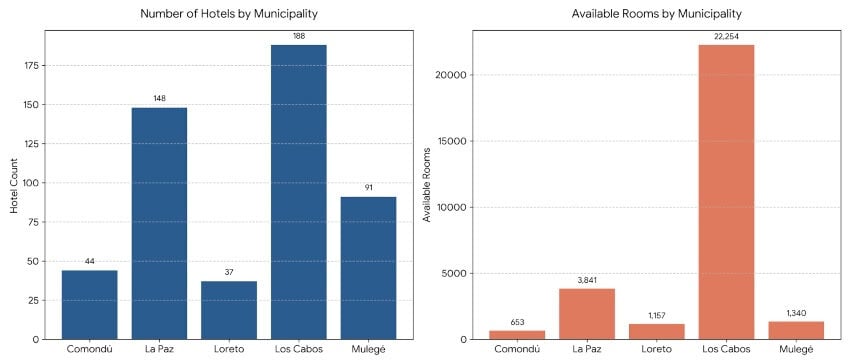
These destinations do have hospitality infrastructure. There were 508 hotels in Baja California Sur as of 2025, with 37% of them in Los Cabos, 29% in La Paz, a respectable 18% in Mulegé, 9% in Comondú, and 7% in Loreto. But of course, there’s a vast difference in size and quality of accommodations in Los Cabos compared to those of the state’s other municipalities.
In Mulegé, the average lodging has about 15 rooms. In Los Cabos, the number exceeds 100, with the RIU Palace boasting more than half as many rooms (690) as all the ones in Mulegé combined. Los Cabos, it must also be noted, has 22,254 of the 29,245 rooms in the entire state. So even though it has only 37% of the hotels, it has 76% of the available room inventory.
Los Cabos is also a class apart in terms of luxury, with the average room costing upwards of US $440 per night as of the end of 2025.
History, legacy and change
Tourism has certainly transformed the economy of Baja California Sur in recent decades, but history still plays a big part in how the state is laid out and governed. When BCS became the most recent Mexican state in 1974, there were only three municipalities: Comondú, La Paz and Mulegé. La Paz, which dates its founding to the arrival of Hernán Cortés in 1535, has been the capital of the state, and before that the territory, since 1830.
View this post on Instagram
Loreto, site of the foundational Jesuit mission in 1697 and the capital of California until 1767 (and Baja California until 1829), was also the site of one of the original municipalities established in 1822, the year after Mexico gained its independence from Spain. So, too, was San José del Cabo. But both historic peninsular communities saw their power diminished until relatively recently: 1981 for San José del Cabo, when it became the municipal seat of the newly formed Los Cabos municipality; and 1992 for Loreto, when it regained municipal status.
What’s next?
Cabo San Lucas, the fastest-growing city in the state, saw its population nearly triple between 2010 and 2020, and there’s little question that, in addition to being the state’s prime tourism revenue generator, it will soon surpass La Paz as the most populous city. But it has traditionally lacked governmental autonomy and adequate support from the Los Cabos municipality to tackle the infrastructure issues associated with its extraordinary growth.
Recent attempts to elevate Cabo San Lucas to become the state’s sixth municipality would change this narrative, but the outcome remains far from certain.
Chris Sands is a writer and editor for Mexico News Daily, and the former Cabo San Lucas local expert for the USA Today travel website 10 Best and writer of Fodor’s Los Cabos travel guidebook. He has also contributed to numerous other websites and publications, including The San Diego Union-Tribune, Marriott Bonvoy Traveler, Forbes Travel Guide, Porthole Cruise and Travel, and Cabo Living.