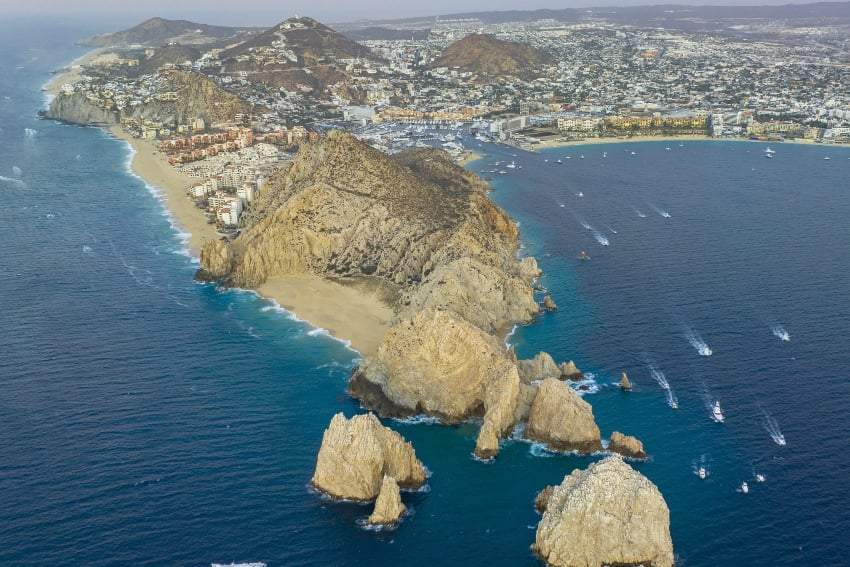
Tourism is the primary economic industry in Baja California Sur — it accounts for 60% of the state’s gross domestic product, as opposed to 8.5% in Mexico as a whole — and Los Cabos is its biggest driver. Of the 4.5 million tourists who vacationed in Baja California Sur last year, almost 3.8 million of them, or 84%, chose Los Cabos.
But it shouldn’t be supposed that the top two destinations in Los Cabos — Cabo San Lucas and San José del Cabo — are in any way comparable in terms of the revenue they produce. Cabo San Lucas has more hotel rooms than San José del Cabo, the Ruta Escénica and the East Cape combined. It also boasts the highest occupancy rates.
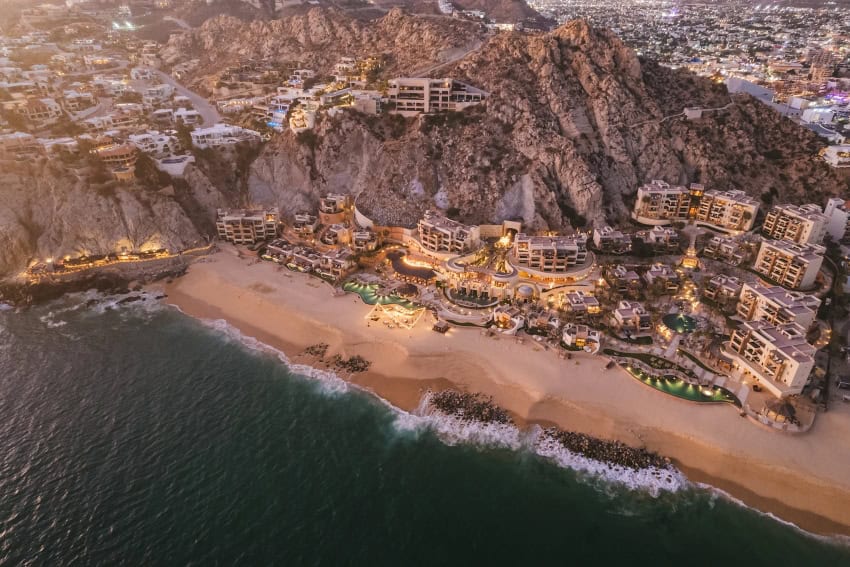
Cabo San Lucas alone accounts for the million-plus cruise ship passengers who visit the municipality annually. Its marina is the center of whale-watching season, its largest beach — Playa El Médano — is ground zero for the 50,000 students who descend each year during Spring Break, and it consistently hosts the biggest and most well-attended events (including the world’s richest fishing tournament).
The Land’s End city is thus, without question, the most important revenue generator and impetus to economic growth in the state. It’s also only a matter of time until it becomes the most populous city (it’s currently second to La Paz, the state capital, per the 2020 census, but with a much higher growth rate).
So why does it have so little political power?
Why Cabo San Lucas needs more autonomy
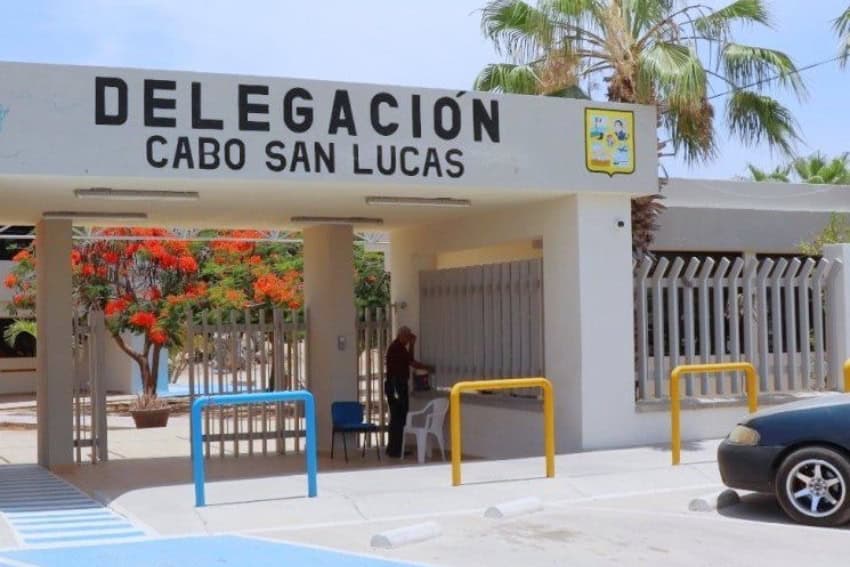
Cabo San Lucas is a delegation within the larger Los Cabos municipality, whose government is based in San José del Cabo, meaning essentially it is a territorial subdivision that remains hierarchically dependent on the municipal government for public works and services. This relationship has existed since Los Cabos became one of the now five municipalities in Baja California Sur in 1981, building on Cabo San Lucas’ creation as a sub-delegation of La Paz in 1976.
But because of the explosive growth that Cabo San Lucas has experienced over the last few decades — the city’s population nearly tripled, from 68,463 to 202,694, between 2010 and 2020 alone — it has increasingly dealt with chronic shortfalls of public services, security and infrastructure, an especially galling situation given its outsized contributions in terms of revenue and tax base.

During a recent meeting in La Paz held to consider the initiative to make Cabo San Lucas the state’s sixth municipality, elevating it in status in the interests of more autonomy to address its unique problems and challenges, Representative Sergio Huerta Leggs, president of the Special Plural Commission, noted: “We’re not saying this (that Cabo San Lucas deserves to be a municipality) to create confrontation, but to highlight the obvious; we experience it daily on the streets. More than 200,000 residents are receiving budgetary attention equivalent to a population of less than 50,000.”
Representative Alondra Torres, president of the State Congress’s Board of Directors, was even more succinct, per Diario El Independiente. “Making Cabo San Lucas a municipality is not just an administrative act, but the fulfillment of a dream of justice for its residents.”
The initiative to create a sixth municipality in Baja California Sur
The movement to elevate Cabo San Lucas to a municipality has been growing for two decades, but it wasn’t until 2019, when then-Representative Lorenia Lineth Montaño Ruiz proposed the idea, that it began to seem like it might eventually become a political reality … even as it failed to pass on that occasion.
The new version of the citizen-generated initiative, however, put forth by José Luis Alba Corona, president of the Citizen Council, along with Arturo López Delgado and Guadalupe Castro, shows much more positive signs of momentum. The initiative was formerly offered and began the process of review by the Political Affairs Committee of the State Congress in February 2025.
The legacy of regional history
To understand the current predicament of Cabo San Lucas as the most important economic force in the state — yet simultaneously an underserved delegación within a larger municipality centered in San José del Cabo, and beholden to state power in La Paz — it helps to have an understanding of regional history.
When Spanish exploration in the region began in the 16th century, the peninsula was known only as California. It wasn’t until 1804 that a territorial distinction was made between Alta California (now the U.S. state of California) and Baja California. The first political partitionings, meanwhile, were those made during the Jesuit era, when missionary jurisdictions were drawn up.
The Jesuit period began in 1697 and ended in 1767. Which is to say, a very long time ago. But it’s impossible to overstate the importance of this legacy, since even centuries later, as the Territorio Sur de la Baja California was established in 1931 and Baja California Sur became, along with Quintana Roo, one of the last two Mexican states in 1974, political power still largely resided in the same places it had been ensconced during the days of padres traveling on burros through inhospitable landscapes to convert Indigenous peoples.
Power still resides in the same places it always has
It hardly seems a coincidence, for example, that four of the five governmental seats of the current municipalities in the state — in Mulegé, Loreto, La Paz and San José del Cabo — were all formerly the sites of Jesuit missions. Of course, the Jesuits chose the locations of these religious outposts carefully, based on factors like fresh water, arable land for farming and defensive capacity, and the fact that La Paz and San José del Cabo, in particular, have remained among the most notable communities on the peninsula for the entirety of their existence, even long after the secularization of the missions, confirms the Jesuits’ keen judgement.
But quite obviously, Baja California Sur is a very different place today than it was even 50 years ago, let alone 300. Tourism, not farming or fishing, is now the primary income generator, and because of that transformation, Cabo San Lucas has ascended from modest beginnings to become the single most important destination in the state.
Remaking the map of El Sur
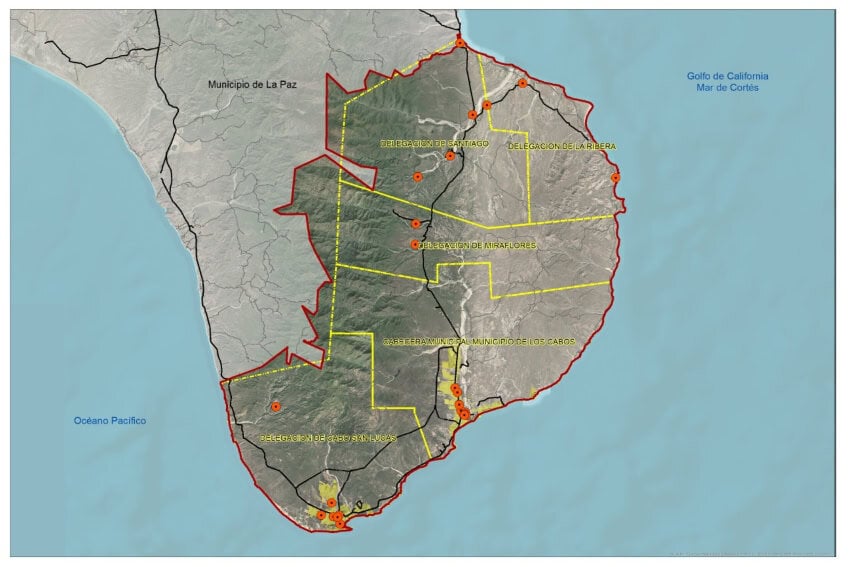
No official maps have been released showing what the creation of a sixth municipality in Cabo San Lucas would mean for the political boundaries of the southern rim of Baja California Sur. But clearly, it would be a seismic shift, not only in terms of the territory carved out of Los Cabos, but in lost revenue and power for the current municipal government in San José del Cabo. Not surprisingly, then — because no politician likes to give up power — current Los Cabos mayor Christian Agúndez Gómez has come out strongly against the initiative.
But, as Torres noted, this is about justice, and the right of the most powerful economic engine in the region to exercise a greater degree of autonomy over its governance and future. As of now, the State Congress is working through a schedule of forums, meetings and working groups on the issue in order to better inform the electorate ahead of the steps to come.
A question of votes
Ultimately, it comes down to votes. To be approved, the initiative must meet the benchmarks stipulated in Article 122 of the state constitution. The biggest hurdle is a plebiscite, or regional vote, which at present requires the participation of two-thirds of the residents of the new municipality, confirming that they are in favor of it. This participatory threshold is so high as to be realistically unattainable, which is why a reform has recently been introduced that would significantly reduce the number to 15% of registered voters.
If the plebiscite passes, then the Special Plural Commission, of which Huerta Leggs is president, will prepare a report and the state’s Congress will vote on it, with a two-thirds supermajority required for the initiative to be sent to the executive branch for final approval.
It’s still a steep uphill climb.
But as every sanluqueño knows, and even the initiative’s most ardent opponents must, on some level, admit, this is long overdue.
Chris Sands is a writer and editor for Mexico News Daily, and the former Cabo San Lucas local expert for the USA Today travel website 10 Best and writer of Fodor’s Los Cabos travel guidebook. He has also contributed to numerous other websites and publications, including The San Diego Union-Tribune, Marriott Bonvoy Traveler, Forbes Travel Guide, Porthole Cruise and Travel, and Cabo Living.