Rarely, if ever, does one utter the words: “Let’s play the Mexican panaderia game on Nintendo.” But thanks to PancitoMerge, an independent video game that was released on Nintendo Switch consoles last month, gamers — and pan dulce aficionados alike — can live out their Mexican bakery video game fantasies.
The game, an interactive ode to Mexico’s pan dulce (sweet bread), was developed by Antonio “Fáyer” Uribe — a Mexican indie game developer and cofounder of HyperBeard Games, who has long advocated for Mexican representation in the gaming industry with platforms like the “Mexican Entertainment System” — and illustrated by Jessica Álvarez, known as Vanila Ryder online, where she has a massive following on Instagram for her pan dulce-themed art.

A Mexican Candy Crush?
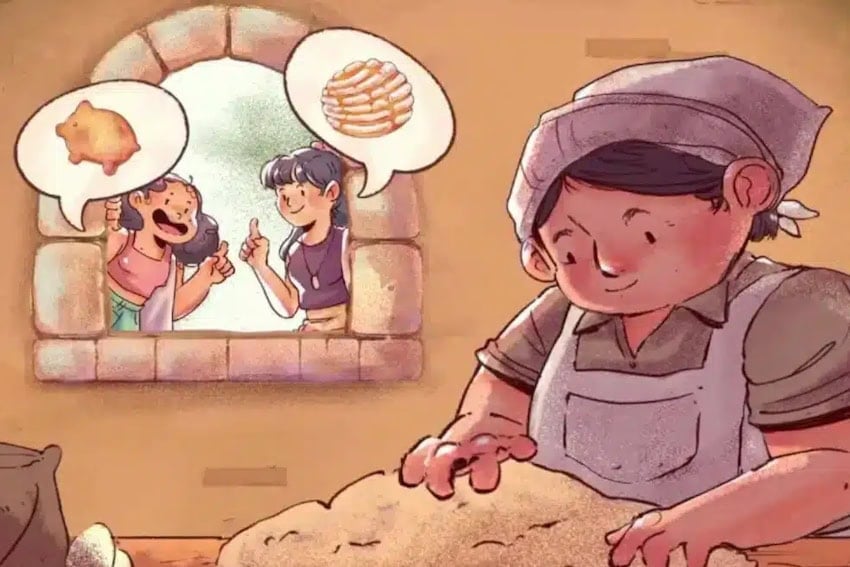
PancitoMerge offers a twist on the mega-iconic Tetris puzzle format. As the town’s panadero (baker), you are tasked with filling a bread basket full of falling pan dulce for a stream of enthusiastic customers. The catch? While you scramble to serve your customers, each type of pan dulce that drops from the top of the screen, à la the aforementioned Tetris — or, for younger generations, Candy Crush — is a different shape: conchas, bollilos, orejas, puercitos and more.
As a player, your job is to stack them in the correct order and sequence in order to gain points and avoid the bread basket from overflowing.
Nintendo’s official store, which describes the game as “whimsical” and “adorable,” invites gamers to “step into the warm, flour-dusted world where pan dulce takes center stage” and calls the game a “love letter to Mexican culture and the joy of pan dulce… inspired by real treats found in local bakeries, celebrating the warmth, tradition, and creativity of Mexican baking.”
It’s a perhaps appropriately timed ode to Mexican bread culture, on the heels of Richard Hart’s much-lambasted critique of Mexican bread — in which the British baker claimed that Mexico lacked sophisticated, high-quality breads. PancitoMerge proves otherwise — what other nation has made a Nintendo-backed video game based on its distinctive, at times iridescent, bread offerings?

The game has been celebrated by Mexican gamers and culture fanatics who have made viral videos and praised it for its highly decorative pan dulce illustrations and low-stakes, friendly gameplay. The game’s developers even wrote an original theme song for PancitoMerge, which lists off a variety of breads to the tune of a strumming mariachi guitar.
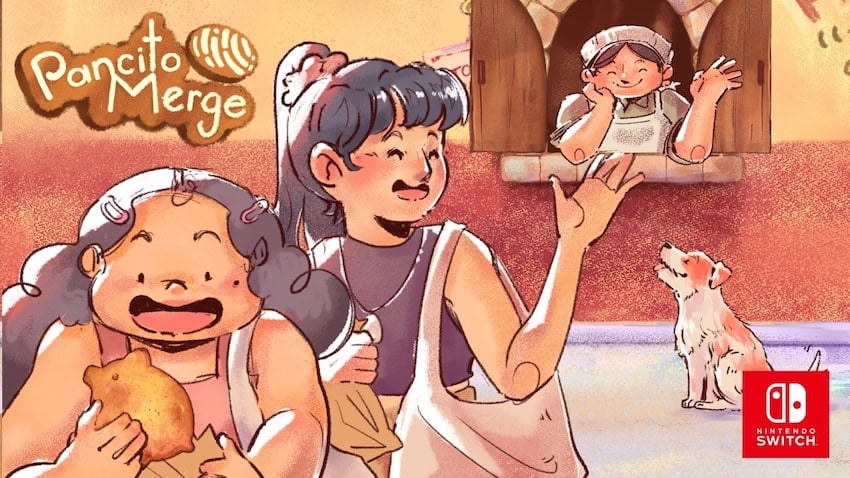
Though the game’s framework is relatively simple, a variety of thoughtful touches add to its appeal. For instance, you can switch the panaderia’s appearance and customers from a traditional look to one based on Dia de Muertos, or to a Japanese-inspired theme. As customers approach your panaderia’s window, you might encounter an anthropomorphic axolotl, a skeleton, or an old señora, each in search of the right pan dulce.
And that’s not all: You can rework your bread basket by giving it a shake, clearing off unwanted bread and creating new patterns and combos. And as you progress through the tasks, you unlock more bread types, and each bread comes with a paragraph-long explanation of the pan dulce’s characteristics and history.
What is pan de melón, one might wonder, for example?
“A popular Japanese pan dulce,” the description tells players, going on to outline the origin of the sweet bread’s name — which, it turns out, doesn’t come from the flavor resembling a melon but from its round shape and color. The game’s flavor texts are actually informative and not simply mindless filler.
As of now, the game is available in Spanish, English, and Japanese, currently is priced at US $7.99 — a bargain by today’s video game industry standards, in which the latest flagship Nintendo games cost US $79.99.
It’s certainly not the most advanced or complex game out there, but that’s part of its appeal, as is its very existence in what isn’t a very deep roster of Mexican-inspired games to begin with.
Mexican culture has been directly referenced in games like Super Mario, Pokémon and more, but rarely has Mexican culture been the centerpiece of an entire game’s design. A few exceptions include Lucha Libre AAA: Héroes del Ring (2010), Taco Master (2011), and Pato Box (2018), the latter being a beautifully rendered game in a black-and-white palette where you play a human with a duck’s head boxing his way through a corrupt organization to claim a world title. Beyond that, Mariachi Legends is slated to release later this year and has been garnering attention for its Mexicanized, action-adventure Metroidvania look and feel. More serious gamers may appreciate world builder Aztec: The Last Sun.
But none of those titles seem to fully satiate, or vividly represent, Mexico’s hunger for quirky gameplay and lighthearted storytelling as much as PancitoMerge. The fact that the game was developed by Mexican creators further gives it a taste of authenticity, care, and imaginative worldbuilding that gamers of any age or background are sure to delight in.
Alan Chazaro is the author of “This Is Not a Frank Ocean Cover Album,” “Piñata Theory” and “Notes From the Eastern Span of the Bay Bridge” (Ghost City Press, 2021). He is a graduate of June Jordan’s Poetry for the People program at UC Berkeley and a former Lawrence Ferlinghetti Fellow at the University of San Francisco. His writing can be found in GQ, NPR, The Guardian, L.A. Times and more. Originally from the San Francisco Bay Area, he is currently based in Veracruz.