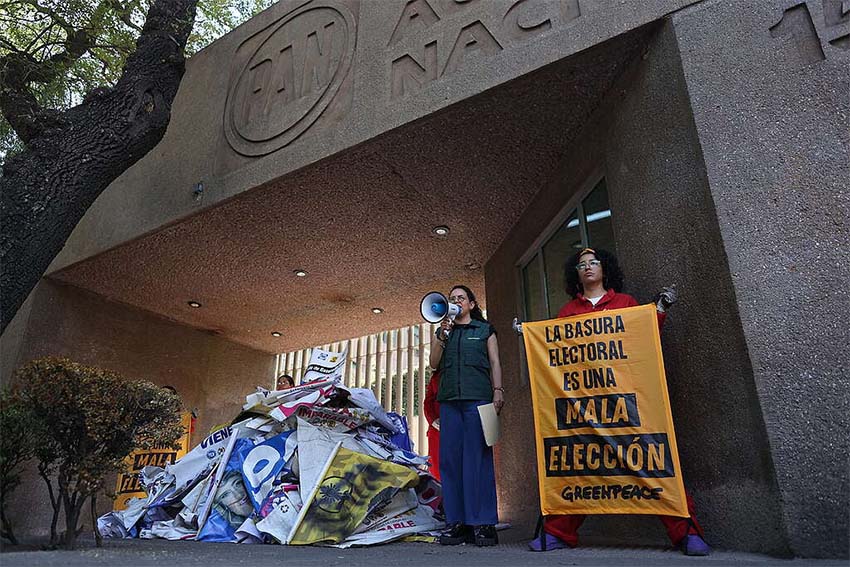
To protest the abundance of “election trash” — i.e., banners and posters produced for political campaigns in Mexico’s June 2 election — Greenpeace activists in Mexico City undertook a symbolic gesture last weekend: returning the electoral detritus to the doorsteps of the parties responsible.
Coming just two weeks before the June 2 elections, the action on May 18 and 19 against campaign materials as environmentally unfriendly election trash spanned several municipalities, including Iztapalapa, Tlalpan, Coyoacán, Benito Juárez and Miguel Hidalgo.
¿Cuánta basura electoral más tenemos que soportar? 🛑
Llevamos a los partidos políticos propaganda con la que han inundado nuestras ciudades, hecha de plástico e imposibles de reciclar.🚫♻️
Firma la carta ✍️ para lograr un futuro #SinBasuraElectoral 👉 https://t.co/4wFupyMWyp pic.twitter.com/6qHuXJh8VI
— Greenpeace México (@greenpeacemx) May 22, 2024

Greenpeace México activists also called upon citizens to sign an open letter supporting their demands. (Greenpeace/X)
According to a Greenpeace México post on the social media platform X, the nongovernmental organization Foundation for the Rescue and Recovery of the Urban Landscape (@TuMexicoLimpio) estimates that in Mexico City alone, election garbage during this election cycle could reach 25,000 tonnes.
To make their point, activists and volunteers took the banners and paraphernalia they had taken down from buildings, bridges and other locations around the capital to the headquarters of various political parties. Most of the “election trash” haul went to the offices of the National Regeneration Movement (Morena) or the National Action Party (PAN).
Morena leads the Let’s Keep Making History coalition, which also includes the Labor Party (PT) and Green Party (PVEM) and is backing Claudia Sheinbaum for president. The PAN-led Strength and Heart for Mexico alliance, which supports Xóchitl Gálvez, includes the Institutional Revolutionary Party (PRI) and Democratic Revolution Party (PRD).
The posters and banners, some of which are torn down and discarded by political rivals, end up accumulating without a recycling plan. Greenpeace México said that most political banners are made of plastics, which can take between decades and hundreds of years to degrade.
Ornela Garelli Rios, an activist with Plastic-Free Oceans at Greenpeace México, emphasized the urgency of the situation regarding election trash.
“In the midst of an unprecedented environmental crisis, it is unacceptable that political parties and coalitions flood our cities with electoral propaganda made with plastics. The statistics are staggering,” she said, citing the 25,000 tonnes figure.

Greenpeace México called for accountability on the issue from Mexico’s political parties.
Their demands included: publicly disclosing the quantity of election materials being used, its makeup and plans for recycling the resulting trash; ending further placements; and replaciing banner use with more innovative campaign strategies, such as online platforms.
As Mexico heads toward the June 2 elections, the INE has already enforced the prohibition of various forms of campaign materials in an attempt to foster an environment conducive to free and mindful voting.
The genesis of the ban lies partly in clashes between current contenders in the Mexico City mayoral race.
The Electoral Institute of Mexico City (IECM) intervened following a “propaganda war” between Clara Brugada of the Let’s Keep Making History coalition and Santiago Taboada of Strength and Heart for Mexico, opposing candidates for mayor of Mexico City.
The situation, which included sabotage of political banners, led to revised guidelines on the distribution of campaign materials.
Greenpeace seized upon that moment to urge the mayoral candidates to confront the plastic pollution engendered by their election campaigns.
Prior to June 2, there will be a three-day period in which the parties must halt political campaigning and refrain from placing new banners, posters and other campaign items in public. Said items must be removed during the seven days after Election Day.
With reports from Proceso, La Silla Rota and El Financiero