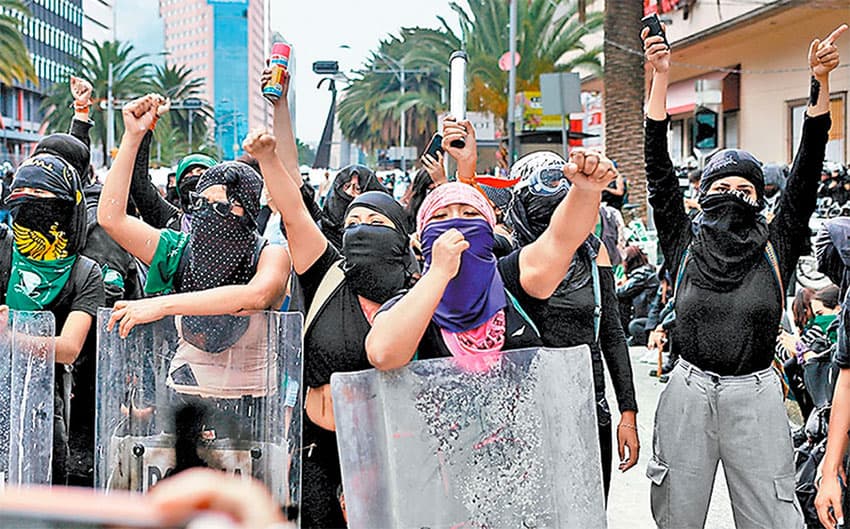
An estimated 1,000 women took to the streets of Mexico City Monday to mark International Safe Abortion Day and lobby for reproductive rights, some clashing with police as they attempted to march to the zócalo, the capital city’s central square.
Abortion rights activists began assembling around 2 p.m., chanting slogans such as “Abortion yes or abortion no, that’s for me to decide,” as they marched along Avenida de la República accompanied by Grupo Atenea, a women’s police brigade charged with keeping order during protests, marches and other public events.
But when the protesters reached Alameda Central park, police blocked their access to the zócalo.
The protesters responded by shoving at police shields, hitting them with hammers and metal pipes and throwing fireworks as they demanded to be allowed to proceed.
Police reportedly launched tear gas in order to retain order, triggering claims of police violence.
Mexico City Mayor Claudia Sheinbaum defended the police’s actions, observing that the protesters were invited to continue their march peacefully if they handed over objects that could be used as weapons, but they refused to do so.
One of the reasons they were not permitted to proceed to the zócalo and protest in front of the National Palace, she explained, was that another group of protesters — supporters of Frenaaa, an organization calling for President López Obrador’s resignation — has been camping out there since last week.

The mayor also denounced yesterday’s violence. “The feminist movement deserves all our respect and sympathy, what we do not agree with is violence. We cannot accept violence of any kind. It is the obligation of every government to protect people, regardless of their beliefs,” Sheinbaum said, noting that 44 people were injured during the protest.
Less volatile demonstrations also occurred yesterday in at least 23 states.
In Pachuca, Hidalgo, pro-choice activists held informational sessions, staged a performance and broadcast the events live from the Plaza Independencia before setting off on a march.
Women in Zihuatanejo, Guerrero, held a rally on the beach and placed a purple bandana on a statue of former president Lázaro Cárdenas.
In San José del Cabo, Baja California Sur, women decorated statues of the city’s founding fathers in the town square with green sashes and signs reading “Only I decide for my body” and “Take your rosaries out of our ovaries.”
More than 200,000 abortions have been performed in Mexico City since it became legal in 2007. Since September 2019, when abortion up to the 12th week of pregnancy was legalized in Oaxaca, the states of Puebla, Hidalgo, San Luis Potosí and Guanajuato have tried and failed to pass bills decriminalizing abortion.
Around 47,000 women die annually after undergoing unsafe abortions, Amnesty International says.