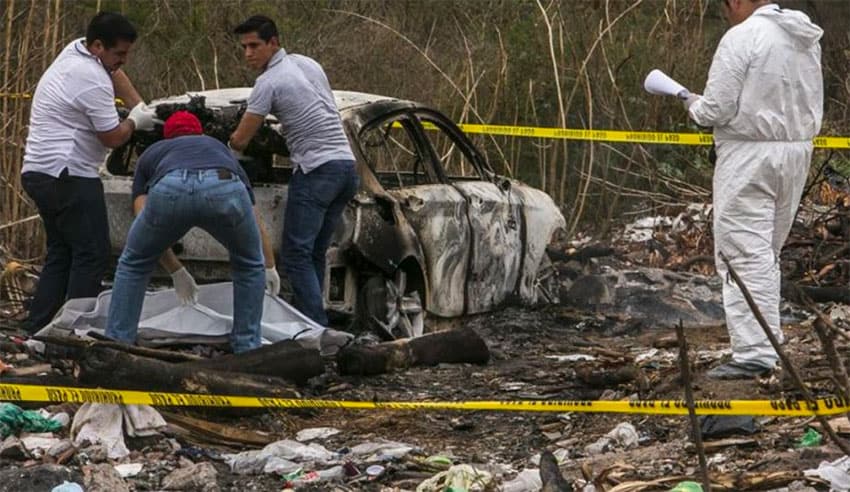
Tamaulipas state prosecutors told a judge Monday that they have ample evidence that 12 state police officers participated in the killings of 19 undocumented migrants whose charred bodies were found inside a truck on the side of the road in Camargo on January 22.
The judge agreed, and the officers, who participated in their arraignment via videoconferencing from jail in Ciudad Victoria, will stand trial on charges of premeditated homicide, abuse of authority, and falsifying evidence.
The victims’ bodies were found in a small Camargo community after an anonymous call. Although only 16 of the 19 have been identified, authorities believe all the victims were migrants hoping to reach the United States. Fourteen have so far been identified as Guatemalan and two as Mexican.
The case attracted much attention in Guatemala and ended up involving Guatemalan consular officials in Mexico.
State prosecutors said they can prove that the officers altered the crime scene, removing spent ammunition shells from the scene, and provided false information that suggested that the killings had taken place elsewhere. Initial reports had said that the truck showed no evidence of taking gunfire, although the bodies all had gunshot wounds.
However, prosecutors said, the truck had actually been shot at 113 times.
In addition, they said, there were other contradictions they did not specify between the official reports filed by the officers, the sttorney general’s own investigations and accounts given by other officers who had knowledge of the incident.

Prosecutors said their case is built on evidence from geolocation and call records, expert analysis and video surveillance footage. They also said they believe that other officers may have been complicit in the killing.
In a related note, the National Immigration Institute (INM) earlier this month fired eight employees in its Escobedo, Nuevo León, office after determining that one of the two vehicles found burned at the Camargo crime scene had been confiscated in a separate case in December, in which Escobedo police raided a home where 66 foreign migrants were being held captive.
Escobedo Police Chief Hermengildo Lara told the newsmagazine Proceso earlier this month that he had turned over the confiscated vehicle and the 66 migrants to INM officials, which prompted federal officials to make inquiries as to how the vehicle ended up in Camargo.
According to the INM, its internal affairs department conducted an investigation and found that after the vehicle was turned over to its office in December, the eight fired employees did not follow required administrative protocols regarding seized vehicles and incorrectly allowed it to be released from custody.