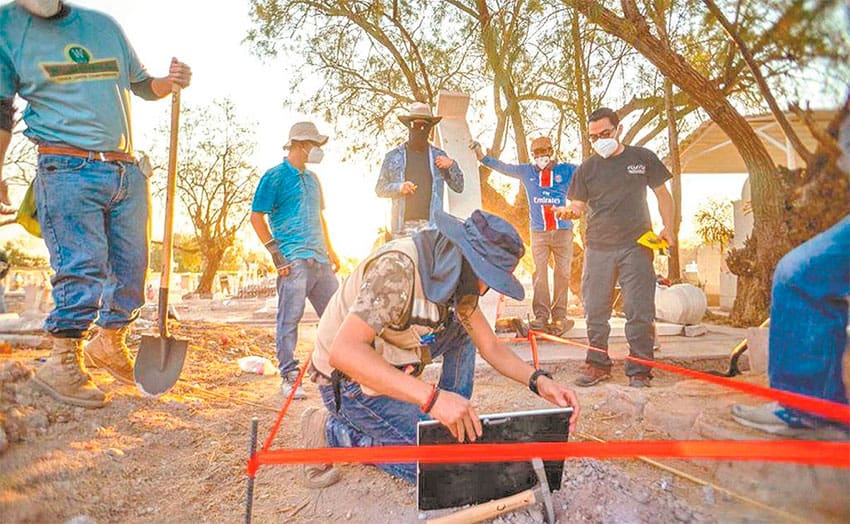
A mass exhumation began on Monday in Torreón, Coahuila, where at least 250 bodies of people presumed missing are to be raised from 161 common graves. Once the work has been completed, specialists will attempt to identify the bodies.
The Regional Center for Human Identification (CRIH) will work with the Forensic Anthropology Foundation of Guatemala for 33 days at Torreón Cemetery No. 1.
The first mass exhumation at the site was in March, when 148 bodies were raised over 17 days at Cemetery No. 2.
CRIH head Yezka Garza Ramírez said she was motivated to serve the victims. “Our obligation is to guarantee the right to be searched for to the highest level, and to return the bodies home with dignity,” she said.
Ramírez added that specialists are working alongside international organizations and the families of the disappeared. DNA samples will be collected from the bodies and compared to the CRIH gene database.
The post mortem analysis of the 148 bodies raised in the March exhumation has been completed, and bone samples will now be analyzed to form genetic profiles. Those will be entered into the gene database to search for a match.
The formation of genetic profiles from bone analysis is expected to take three to four months.

Sources: El Universal (sp), La Vanguardia (sp)